Twenty-nine active duty service members stood neck-deep in near-freezing water, then tried to think of words that had almost nothing in common. The result was more complex than a simple drop in thinking. The biggest early jolt of cold did not neatly predict who struggled most, yet colder skin still tracked with weaker performance once the task began.
The experiment, published in Frontiers in Psychology, came from researchers at the Naval Health Research Center, Leidos and Sheridan College. They wanted to know whether the first rush of the cold shock response would interfere with the kind of flexible thinking people may need after an unexpected fall into freezing water, when a group has only minutes to plan, coordinate and stay alive.
What the researchers tested in the pond
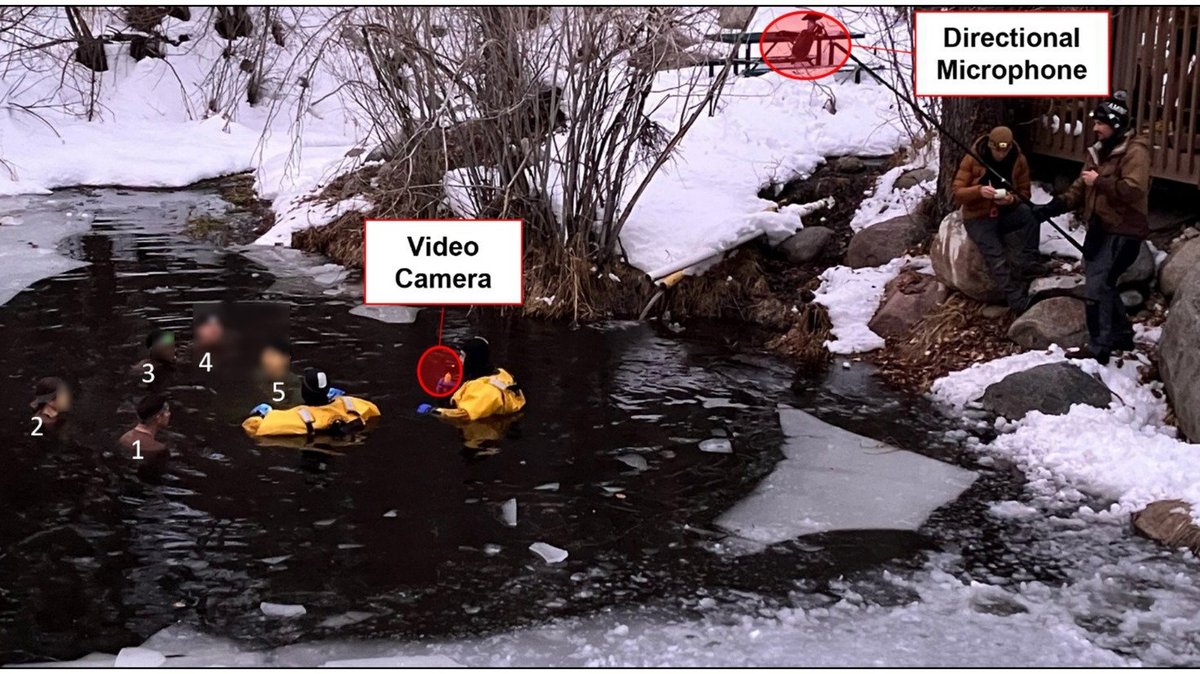
The team worked inside a real military cold-weather training setting rather than a quiet lab. Participants were divided into groups of four or five, completed a word task indoors at baseline, then repeated it during a 13-minute immersion in water measured at 1.3 degrees Celsius while the air sat at minus 2.7 degrees Celsius. The training staff kept water moving around the body so warmer pockets could not form near the skin.
The task was a group format Divergent Association Task, adapted from the original Divergent Association Task described in 2021. Each person had to produce 10 words that were as different from one another as possible. In plain language, the higher the score, the farther apart those ideas were. The measure does not capture full problem solving, yet it does test a useful part of creativity: the ability to move away from obvious associations and reach for remote ones.
Researchers also tracked physiology. Peak heart rate during the first six minutes of immersion stood in for the cardiovascular side of cold shock, while sensors on the chest, shoulder, thigh, hand and foot captured skin temperature. The word task began three minutes after the group entered the pond, a delay chosen because prior work shows the strongest cold shock wave usually fades within roughly 90 seconds to three minutes.
Why the first cold shock surge was not the main driver
The paper’s headline result was surprisingly narrow. People with a larger heart-rate spike during the early minutes did not reliably post worse word scores once the task started. In other words, the cardiovascular burst that marks cold shock did not explain most of the variation in divergent thinking during the brief test window the researchers examined.
The study’s three-minute delay matters for the design, even if the article’s broader message is about survival thinking. A recent systematic review of the cold shock response describes the reflex as a rapid and dangerous phase of gasping, hard breathing and cardiovascular strain. The new study did not ask people to think during the first instant of immersion. It asked what happened just after that first surge, when a person may finally have enough control to begin choosing what to do next.
The answer was partly reassuring and partly cautionary. The researchers did not find clear evidence that the cold shock spike itself erased divergent thinking in that short post-shock window. Even so, they also warned that the data were not strong enough to claim the ability was fully untouched. The sample was small, the field setting was messy and several trends still pointed toward subtle interference.
How colder skin changed the answers people gave
The clearer signal came from cooling at the body surface. Participants with lower mean skin temperatures tended to do worse on the individual-within-group version of the task. The paper argues that the feeling of cold at the skin likely pulled attention toward the immediate stressor, which left fewer mental resources for searching farther afield in memory.
The pattern showed up in the words themselves. During immersion, many people drifted toward named objects and repeated terms that were already in the air. The paper reports that 11 of the 29 participants gave named-object or repetition responses for more than half of their cold-water answers. Words tied to the setting, such as pond, ice, water and cold, are easy to reach when the body is under stress, but they are not the broad, distant associations the task rewards.
Researchers also noted that groups finished the task faster in the water than they had at baseline. Faster completion might sound like better fluency, yet the content suggests another possibility: people may have reached quickly for the most available words and moved on. Quick access to obvious words would let a group keep the task moving while still losing some of the wider search that supports divergent thinking.
What the study suggests for cold-water survival training
The practical lesson is careful, not dramatic. Once the first cold shock burst eases, some capacity for flexible thinking may still be available. A group in freezing water may have a short window to orient, communicate and start deciding on useful actions before colder hands, painful skin and mounting physical strain narrow attention further.
The paper also points toward preparation before anyone ever reaches the water. Earlier work linked in the study, including a study on repeated anxiety and cold shock habituation, suggests anxiety can interfere with the body’s ability to adapt to repeated immersions. The authors connect that line of evidence to training approaches such as stress inoculation training, where people practice under controlled pressure so the next real exposure produces less panic and better self-control.
The study added one more clue that could matter in the field. Researchers could not record the full breathing response from every participant, yet they found that people’s reports of how strong their first gasp felt tracked with peak heart rate. That does not make self-report a replacement for direct respiratory data and the paper is careful on that point. Still, it hints that instructors or rescue teams may be able to learn something from a survivor’s own account of the opening shock, especially when formal monitoring is unavailable and decisions have to be made quickly.
For instructors, rescue planners and military units, the study supports a layered view of performance. The first danger is still survival through the shock itself: breathing control, flotation and immediate safety. Soon after that, the next challenge becomes cognitive. A person may be conscious and responsive, yet still nudged toward narrow, local, easy thoughts because the cold at the skin keeps demanding attention.
Where the evidence stops
The authors were direct about the limits. They did not measure the respiratory side of cold shock, including the gasp reflex and rapid breathing, which is a major part of the response. They also did not test people during rewarming, when some earlier studies suggest slowed thinking can continue even after the cold exposure ends. The study further relied on retrospective reports after immersion rather than a fuller set of before-and-after subjective ratings, which leaves room for memory bias when participants described what the experience felt like.
The setting strengthened realism, because this happened during an actual training exercise, but realism came with tradeoffs. The immersion was planned, not accidental; group sizes were too small for strong between-group statistics; and the task itself was a proxy for one slice of creativity rather than a full survival scenario. Even with those limits, the study gives a useful picture of what may remain intact, what starts to narrow and why cold stress can interfere with thought even after the sharpest opening shock has passed.