A two-week trial aboard a U.S. Navy warship asked a simple psychological question in a hard place to test it: can a brief virtual walk through nature steady mood when real nature is out of reach? The answer was modest but clear. Sailors who used an olfactory-enhanced version of the virtual reality system showed an immediate drop in negative affect after sessions, while the standard audiovisual version did not produce the same result.
The finding comes from a Frontiers in Psychology study that followed 29 active-duty participants during an underway period at sea. Researchers compared a control group, a standard VR group and an olfactory-enhanced VR group over roughly two weeks, then separated the short-term mood response from the broader question of whether repeated sessions changed stress levels or cognitive performance over time.
That split is the key to reading the paper correctly. The study did find an acute emotional benefit after the scent-linked sessions and the reported effect size was large. The same paper did not find convincing evidence that the intervention produced sustained improvements in perceived stress, positive affect, overall presence, or the wide set of cognitive tests collected across the deployment window.
Shipboard psychology studies rarely get perfect conditions and this one did not either. Even so, the design gives a useful look at how small, portable interventions might help in confined operational settings where noise, fatigue, lack of privacy and sensory monotony can wear people down long before a crisis becomes visible.
What the shipboard trial actually tested
The researchers recruited 29 sailors aboard the warship and assigned them to one of three groups: no VR, standard VR, or olfactory-enhanced VR. Six participants did not complete the full protocol because of operational demands, leaving uneven groups by the end, but the study still captured a rare real-world test outside a calm laboratory.
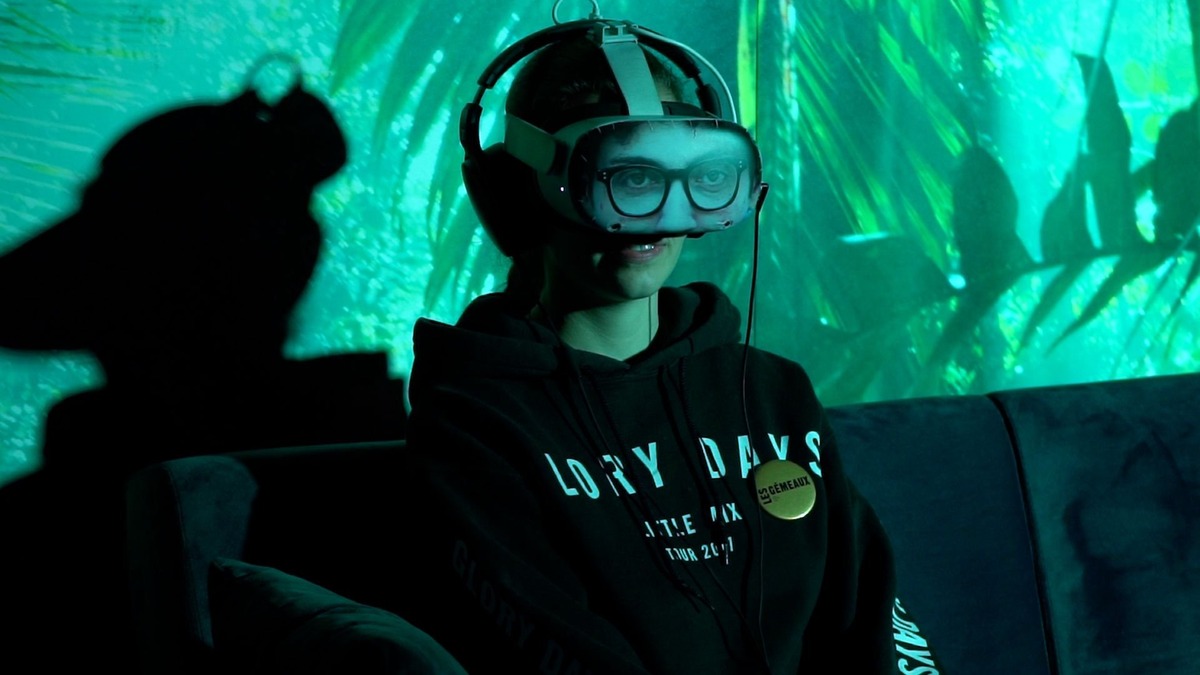
Each VR user was asked to complete four sessions during the study period. A typical session took about 30 minutes with setup and assessment included, while the actual virtual exposure lasted 15 minutes. Participants could move through a garden, a forest, or a beach scene and they were free to choose the environment they wanted during each session.
For the olfactory group, the system released synchronized scents when users entered specific parts of the virtual scene. The beach setting could deliver a beach scent, fresh grass, or wet-ground notes; the forest setting included cues such as lavender, pine and wet ground. The underlying idea matches a broader environmental psychology literature showing that water-rich settings often receive stronger restorative ratings than built scenes, a pattern discussed in research on blue space.
Attention restoration theory and stress recovery theory sit behind the whole experiment, but the paper kept its outcome measures practical. The team tracked mood, perceived stress, presence inside the VR environment, perceived restorativeness and a large battery of cognitive tasks. That setup made it possible to ask whether a more vivid sensory experience changed feelings first, performance later, or both at once.
Why the immediate mood effect stood out
The sharpest result came from the PANAS negative affect scale, which measures feelings such as distress, irritability and unease. In the olfactory-enhanced group, average negative affect fell from 16.4 to 13.9 after sessions, a statistically significant change with p = 0.02 and a reported effect size of d = -1.3. The standard VR group also moved slightly downward, but not enough to separate itself from ordinary variation.
Because the benefit appeared right after exposure, the finding belongs in the category of an acute emotional reset rather than a durable psychological overhaul. The paper says the effect was immediate post-intervention and the later longitudinal models did not show the same kind of repeated advantage building across the two-week schedule. Readers should keep those two timescales separate.
One reason scent may matter is that smell has unusually direct ties to emotion-related brain systems. A review of the olfactory system and emotion describes shared neural pathways involving regions such as the amygdala and hippocampus, which helps explain why odor can shift mood quickly even when the rest of an experience still feels technically imperfect.
The paper also fits a wider pattern in which virtual nature seems better at reducing unpleasant feelings than at creating a strong rise in positive mood. A recent systematic review of virtual nature outcomes found broadly similar limits: emotional relief is often easier to detect than broad cognitive or psychological transformation, especially when exposure is brief and the environment is constrained.
Why the cognitive story stayed narrow
The same study that found the immediate affect result did not find persuasive evidence that the scent-linked system sharpened thinking across the board. Across the two-week period, cognitive performance remained generally stable and the isolated changes that did appear were scattered across tasks rather than lining up as one coherent improvement pattern.
Some measures pointed the other way. The authors reported potential small decrements in sustained vigilance, emotion identification and risk-taking propensity over time, but they also stressed that these effects were inconsistent and should be treated cautiously. Wide confidence intervals and a large number of outcome measures make overreading those signals especially risky.
Emotion and cognition do influence one another, which is one reason the intervention was interesting in the first place. Still, the jump from a calmer mood after one session to a reliable improvement in attention or working memory is a large step and a broad review on the influence of emotion on learning and memory makes clear that the relationship is real but complicated rather than automatic.
Put plainly, the study supports a smaller claim than an excited headline might suggest. The scents may have helped sailors feel less negative in the moment. The same dataset did not show that four sessions of VR nature, even with smell added, reliably improved the demanding mental skills needed for longer operational performance.
Why presence and stress did not move the same way
If the scent-linked sessions improved mood, it would be easy to assume that the olfactory group also felt more immersed. The study did not show that. Average total presence scores stayed low for both VR conditions, even though the groups rated some subdomains, including general presence and spatial presence, more favorably.
The authors point to technical limits as one likely reason. A backup laptop had to replace the more powerful original system and the paper describes intermittent audio problems, visible lag, or both. Those issues can weaken realism inside VR before a user ever reaches the point where synchronized smell has a chance to add much extra lift.
Perceived stress also stayed stubbornly flat across groups over time. The intervention may have offered a short calm period without being strong enough, frequent enough, or technically smooth enough to change the larger background pressures of deployment life. A brief emotional break and a lasting reduction in stress burden are related outcomes, but the study only supports the first one.
Another complication is that the virtual worlds were self-selected. Sailors could choose the same scene repeatedly or switch among beach, forest and garden settings, which makes the study feel more realistic operationally but less tightly controlled experimentally. A real-world tool often needs that flexibility, yet flexibility also makes it harder to isolate exactly which ingredient produced each response.
Why the result still matters for ships and spaceflight
Even with all of its limits, the study offers a believable use case for behavioral health support in places where people cannot easily step outside, take a walk, or find a quiet natural setting. A headset, a compact scent generator and fifteen minutes of guided escape are much easier to imagine on a ship, in a polar station, or during a spaceflight analog than a full mental health intervention.
The link to shipboard life is direct. A qualitative study of mental health among shipboard sailors describes privacy limits, long waits for care and daily environmental strain that can block recovery even when service members know they need it. In that context, a tool that reliably trims negative mood for a short period may still have operational value.
Space researchers will notice the same logic immediately. Isolated, confined and extreme environments place pressure on mood and attention in ways that overlap across submarines, ships, Antarctic stations and long missions away from Earth. The current paper does not prove that olfactory VR solves those problems, but it does suggest a low-burden method for giving crews a fast emotional reset when real nature is unavailable.
The most defensible takeaway is also the most useful one. Scent-enhanced virtual nature looked promising as an acute affective tool aboard a warship, while longer-run benefits for stress and cognition remained unproven under the tested conditions. That leaves the door open for larger studies with better hardware, tighter scheduling and more sessions to see whether a small mood effect can eventually grow into something broader.