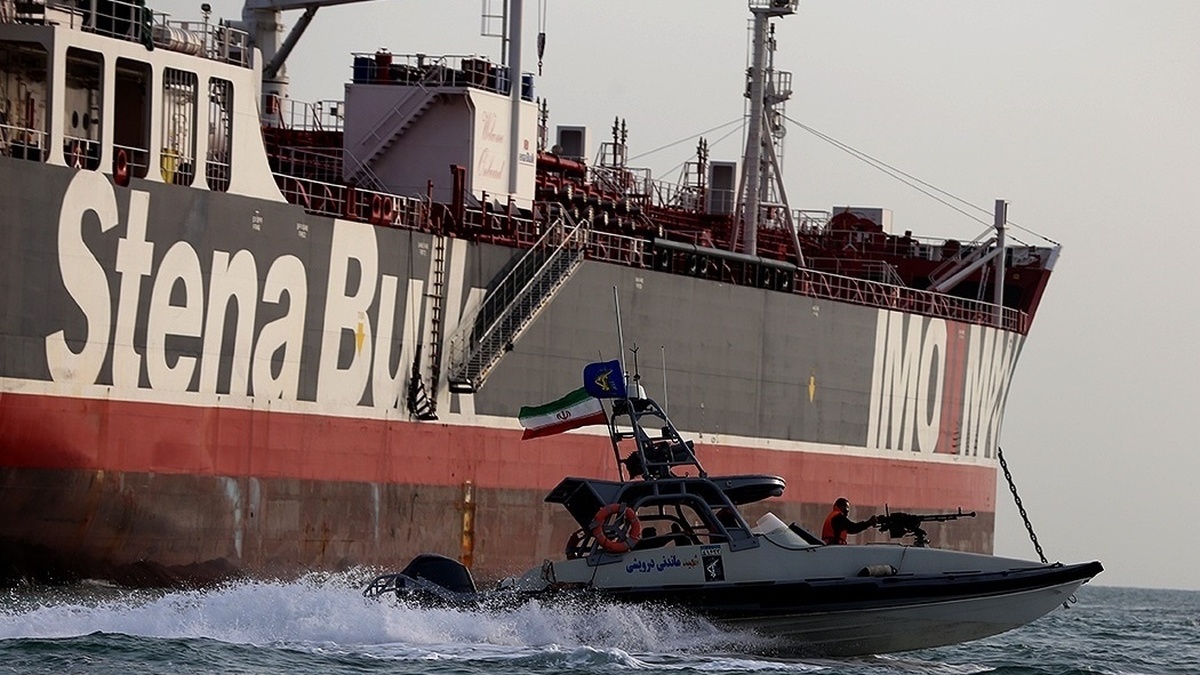
Twenty-three merchant sailors were at work aboard the Stena Impero on July 19, 2019, when the British-flagged tanker was intercepted in the Strait of Hormuz and taken toward Iran. The event became a sharp, human-scale episode in a regional crisis: a crew from India, the Philippines, Russia and Latvia suddenly found their voyage to Saudi Arabia replaced by confinement near Bandar Abbas. Their nationalities also meant that several governments had a direct interest in obtaining reliable news about people who had become caught in a dispute between states.
Britain’s account, delivered to Parliament on July 22, said Iranian forces used four fast boats and a helicopter. Footage released by Iran showed armed personnel descending from the aircraft onto the tanker. HMS Montrose, a Royal Navy frigate already in the Gulf, issued radio warnings but could not arrive before the vessel was taken under Iranian control.
The standoff lasted from July 19 until the ship and remaining crew were released on September 27. Stena Bulk, the Swedish owner, later described the detention as 10 weeks. The dates are 70 days apart, which explains the often-used 70-day figure, while inclusive calendar counting touches 71 dates. The people aboard remained at the center of the episode. Competing accounts of the interception also changed security planning for ships using the narrow waterway.
How the tanker was taken
At about 4 p.m. British Summer Time, the tanker approached the Strait of Hormuz during a passage from Fujairah in the United Arab Emirates to Jubail in Saudi Arabia. Stena Bulk said small naval craft and a helicopter approached while the ship was in international waters, after which contact with the crew was lost and the vessel turned north toward Iran. The operator described Stena Impero as a 49,683-deadweight-ton tanker built in 2018. Its size offered no protection from a boarding force. It was a sudden change in a voyage that normally depends on predictable routing and continuous communication, with a master able to direct the ship’s passage.
British officials said the tanker was in the westbound traffic separation scheme within Omani territorial waters. They also said its automatic identification system was operating. The company likewise said its transponders were functioning and that there was no evidence of a collision. Iran, in a letter cited by Stena Bulk, alleged violations of maritime rules and an unconfirmed collision. Those rival accounts were never merely a technical disagreement, because they shaped how each side described the crew’s confinement and whether the boarding had a legal basis.
Iran brought the ship to the area of Bandar Abbas, a major port on its southern coast. For the crew, the location mattered less than the immediate loss of control over their vessel. Merchant mariners depend on familiar watchkeeping routines under a clear chain of command. An armed boarding changes those working conditions at once, even when no injuries are reported.
Twenty-three sailors became the center of the story
Stena Bulk initially identified 23 seafarers from the four countries named above. Chief executive Erik Hånell said in mid-August that 18 Indian seafarers were among them. The company appealed directly to every government represented in the crew. It withheld individual names to protect the privacy of the sailors and their families.
Family contact was limited, which made official visits important. Company statements said representatives from three of the crew’s countries met sailors in late July and reported that they were in good health. A Finnish consular representative visited the Latvian crew member in early August. The consular visits did not end the detention, yet they offered families a rare independent update from a ship that remained beyond the operator’s control.
On September 5, seven crew members were allowed to leave Iran. The International Transport Workers’ Federation said 16 sailors stayed aboard, while Dave Heindel, chair of its seafarers section, urged a swift and transparent resolution. A tanker at anchor still needed a minimum safe manning complement. The sailors who remained had to maintain the vessel and respond if an emergency arose. They would also be needed to take the ship to sea after its release.
Ten weeks of waiting at Bandar Abbas
Updates from the owner chart the slow rhythm of the detention. On July 30, it said the crew had entered their 12th day of confinement. By August 6, the period had reached 19 days. The company warned about the strain of uncertainty and reported limited communication with those aboard. An August 20 meeting in Stockholm between Hånell and Iranian Foreign Minister Mohammad Javad Zarif placed the crew’s release at the center of the company’s diplomacy. The shipowner kept families informed while seeking access to the vessel. It also asked governments to press for a resolution.
Stena Bulk’s September 5 statement promised medical checks and debriefing for the seven people released first, while the other 16 remained. The division of the crew meant that relief arrived unevenly. Families had reason to welcome the first departures, yet the ship could not resume an ordinary voyage until the full detention ended.
Release came on September 27. In its final update, the company said the tanker had left Bandar Abbas for Dubai, where the crew would disembark for checks and debriefing before returning home. Hånell reported that “all crew members are safe and in high spirits following release.” The ship’s exit ended the confinement, although it could not erase the long period of uncertainty for the sailors or their families.
Why the seizure changed the shipping response
The Strait of Hormuz is a short sea passage between Iran and Oman, connecting the Persian Gulf with the Gulf of Oman. Its shipping lanes concentrate commercial traffic into a constrained space, so a single forced diversion carries consequences beyond one company’s voyage. Britain treated the incident as a challenge to freedom of navigation, while Iran maintained that the tanker had violated maritime rules. The confrontation showed why commercial vessels can become exposed even when their owners and crews are not parties to a diplomatic dispute.
HMS Montrose had stopped an attempted boarding of another British-linked tanker, British Heritage, nine days before the Stena Impero seizure. After July 19, the British government raised the security level for British-flagged vessels. It asked ships to give notice before transiting the strait and announced plans for a European-led maritime protection mission. The destroyer HMS Duncan was sent to relieve Montrose in the region. Advance notice could improve coordination, but it could not guarantee an escort would be close enough when a fast-moving interception began.
The government’s measures focused on reducing the risk to crews during passage, where distance and timing can decide whether a warship can help. Officers on board must share information with families far away and with officials who can request access. Crew welfare appeared repeatedly in the company and government statements issued after the boarding.
The British release statement on September 27 still called the seizure unlawful and linked it to efforts to disrupt navigation. Commercial traffic had long used the strait’s lanes, yet the seizure showed how rapidly a diplomatic dispute could reach a working deck. A captain’s watch allows no time to resolve an international argument. For the Stena Impero’s crew, the history has a simpler scale: 23 people were detained through most of a summer, then finally sailed out together after their release on September 27. Their safe passage to Dubai also allowed medical checks and family reunions to begin after weeks of uncertainty.