Researchers at Kyushu University have developed a solid molecular material that converts visible sunlight into ultraviolet light under natural outdoor conditions. Reported in Nature Communications, the material reached a visible-to-UV conversion efficiency of 1.9%, showing that ordinary sunshine can be transformed into higher-energy light with a carefully designed solid.
The result points to a practical route for sunlight-powered UV light, a form of light used in air purification, photocatalysis, resin curing and other technologies. UV light makes up only a small part of the solar energy that reaches Earth’s surface. A material that can harvest visible light and boost it into the UV range could expand what sunlight can do.
“What we do here is ‘add together’ the energy from two visible light photons to make one ultraviolet photon,” said Yoichi Sasaki, associate professor at Kyushu University’s Faculty of Engineering and corresponding author of the study.
A solid material that upgrades sunlight
The new material is built for a phenomenon called photo upconversion. In simple terms, it takes lower-energy light and produces higher-energy light. That sounds strange because everyday energy usually spreads out or dissipates. At the molecular scale, however, two packets of light energy can be combined through a chain of electronic steps.
Many previous systems that perform this kind of visible-to-UV conversion rely on liquids. Molecules in a liquid can move around freely, which helps the process along. Liquids bring their own problems for devices. Solvents can evaporate, leak, or require careful sealing.
Kyushu University’s advance centers on a solid-state molecular material. That matters because solid films are easier to imagine in coatings, panels, filters and devices. A solid can sit in place while sunlight shines on it. It also avoids the volatility that limits many liquid systems.
The team’s material works at light levels close to natural sunlight. That point is crucial for solar technologies. A material that needs a powerful laboratory laser has far fewer practical uses than one that responds to the sun itself.
How visible light becomes UV light
The conversion process used in the study is known as triplet-triplet annihilation. The phrase is technical, though the idea can be pictured as a molecular relay. One molecule first absorbs visible light. That energy enters a special excited state called a triplet state.
Next, the energy is passed to a second molecule that acts as an acceptor. When two acceptor molecules carry triplet energy at the same time, they can interact. Their combined energy can then emerge as one higher-energy photon in the ultraviolet range.
Sasaki described the process more directly: “It’s a fascinating process called photo upconversion.” The key feature is that two lower-energy photons help create one higher-energy photon. In this study, the target was the difficult jump from visible light to ultraviolet light.
This kind of visible-to-ultraviolet conversion has attracted interest because UV light can drive chemical reactions that visible light cannot easily trigger. For example, some photocatalysts work best with UV light. If visible sunlight can be converted into UV light, more of the solar spectrum becomes useful for those reactions.
The molecular spacing problem
Solid materials create a difficult balancing act. Molecules need to be close enough for energy to move between them. They also need enough separation to keep excited energy from vanishing before it produces light.
In many solids, molecules are packed tightly. Their electron-rich regions can overlap too strongly. That overlap can quench the excited states, which means the stored energy disappears as heat or through other nonradiative paths. Once that happens, the system loses the chance to emit UV light.
The challenge is especially sharp for triplet-triplet annihilation. The triplet states must survive long enough to find each other. They also need pathways through the material so energy can migrate efficiently. Too much molecular disorder slows the process. Too much electronic contact can destroy it.
Sasaki put the problem in molecular terms in the Kyushu University announcement. In solids, he said, molecules are packed tightly and their π electron clouds can overlap. “When that happens, triplets easily fizzle out before they ever meet,” he explained.
Why this design works in solids
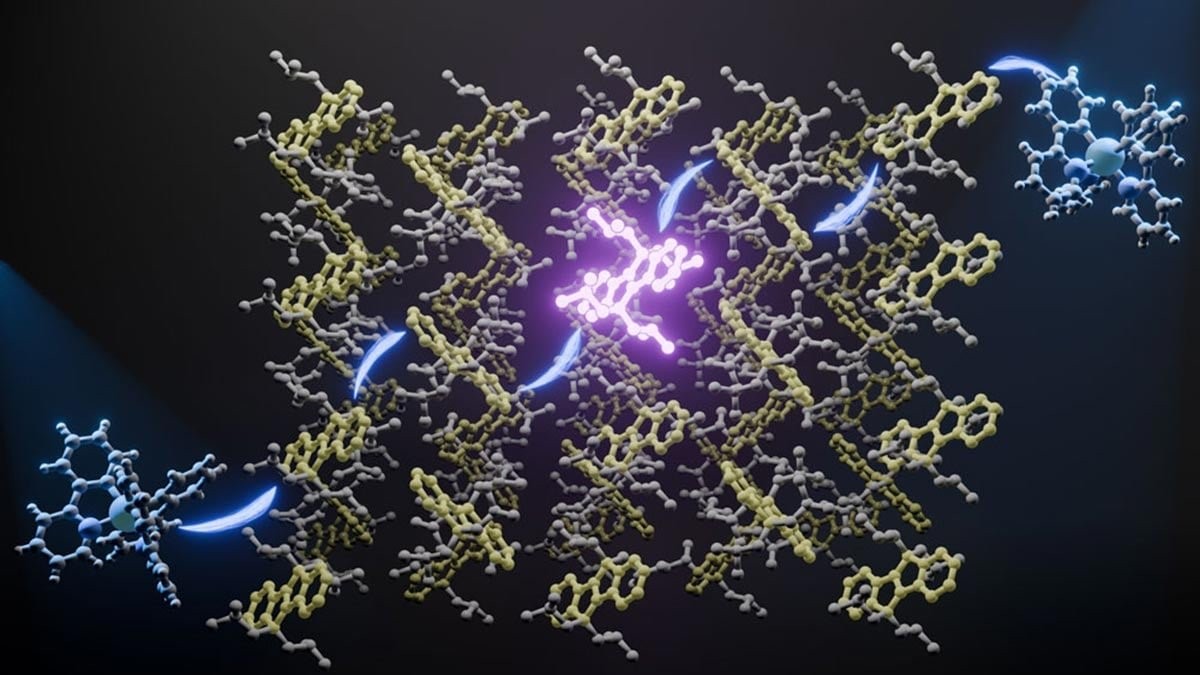
The researchers addressed the spacing problem with an organic semiconductor called dihydroindenoindenedene, or DHI. They modified DHI with alkyl chains attached to specific carbon atoms. These chains act like tiny molecular spacers that shape how neighboring molecules sit beside each other.
The design uses the three-dimensional geometry of sp3 carbon atoms. Because these atoms hold bonds in fixed directions, they can place protective groups above and below the flat electron-rich part of the molecule. That gives the material a way to control how closely the active molecular cores approach one another.
This steric protection lets the molecules keep enough contact for energy transfer while reducing the quenching that often defeats solid upconversion materials. The result is a solid with bright emission, long-lived excited states and efficient energy movement.
The study identifies an optimized DHI-based emitter that performs well in solution and in crystalline solid form. In the solid material, the team combined the acceptor with a donor molecule that starts the energy relay after absorbing visible light.
This is a piece of molecular self-assembly with a practical purpose. The molecules arrange in a way that supports energy flow. That structure helps the material produce UV light while remaining solid and solvent-free.
Performance under natural sunlight
The headline number is 1.9%. That is the absolute photon upconversion quantum yield reported for the solid-state system. Sasaki translated that number into everyday terms: “This means roughly two UV photons are produced for every hundred visible-light photons absorbed.”
That percentage may sound modest at first glance. In the context of solid visible-to-UV upconversion at sunlight levels, it is a meaningful step. Many solid-state materials need much stronger light before they show effective upconversion.
The study also reported a low threshold excitation intensity of 1.2 milliwatts per square centimeter. That is below the solar irradiance near the excitation wavelength used in the work, according to the Nature Communications paper. In other words, the material can operate in a regime relevant to sunlight rather than only under intense artificial illumination.
The solid film also showed features that matter for future development. The material maintained a high fluorescence quantum yield, supported long triplet lifetimes and allowed fast triplet diffusion. Each of these traits supports the core job of collecting visible light and releasing higher-energy UV light.
The researchers also note that dense molecular assembly can improve oxygen tolerance. Oxygen often interferes with triplet states in upconversion systems. A solid structure that shields or limits that interference could help make devices more stable.
Possible uses for solar-powered UV
Ultraviolet light is valuable because it can drive high-energy chemical and physical processes. It is used in air purification, resin curing, photocatalysis, 3D printing and dental or nail gels. These applications usually require UV sources, which often depend on lamps or LEDs.
A solid film that makes UV light from visible sunlight could create new options for solar-driven systems. The Kyushu University team points to possible uses in photocatalysis, indoor air purification and low-intensity 3D printing. These applications remain future possibilities, since the material still needs optimization and engineering before it could appear in commercial devices.
Photocatalysis is one of the most intriguing directions. Some catalysts use UV light to trigger reactions that split water, break down pollutants, or support environmental cleanup. Since visible light is more abundant in sunlight than UV light, a converter could help feed those catalysts with a broader portion of the solar spectrum.
The material may also matter for compact UV-generating coatings. A coating that uses ambient sunlight could support passive or low-power devices. For now, the study demonstrates a molecular principle and a strong early performance benchmark.
The team has filed a patent application for the material. The announcement also notes that the material is relatively simple to produce and uses inexpensive starting materials. Those details strengthen its long-term practical appeal, though further testing will be needed for real-world durability and scale-up.
A 14-year effort reaches a milestone
The new result builds on more than a decade of work at Kyushu University. In 2012, Nobuo Kimizuka, now professor emeritus at the Research Center for Negative Emissions Technologies, began pioneering research on photon upconversion through triplet energy migration in self-assembled systems.
That long effort first produced progress in solutions and gels. The harder goal was a solid material that could keep the needed excited states alive and let them move efficiently. The Nature Communications study marks a major advance toward that goal.
The final push came as graduate students Naoyuki Harada, Hayato Shoyama and Nutnicha Boonmong worked with Kiichi Mizukami and Sasaki to bring the research together. According to the Kyushu University announcement, the draft reached Kimizuka just 11 days before he left the lab.
“This discovery is the culmination of over 14 years of our research and marks a major milestone in photon-upconversion and molecular self-assembly research,” Kimizuka said.
For solar energy science, the achievement shows how molecular design can reshape sunlight’s usefulness. By protecting electron-rich molecular regions while preserving energy transfer, the researchers created a solid that performs a delicate optical trick under natural sunlight. That combination gives solid-state photon upconversion a clearer path toward practical solar-powered UV technologies.