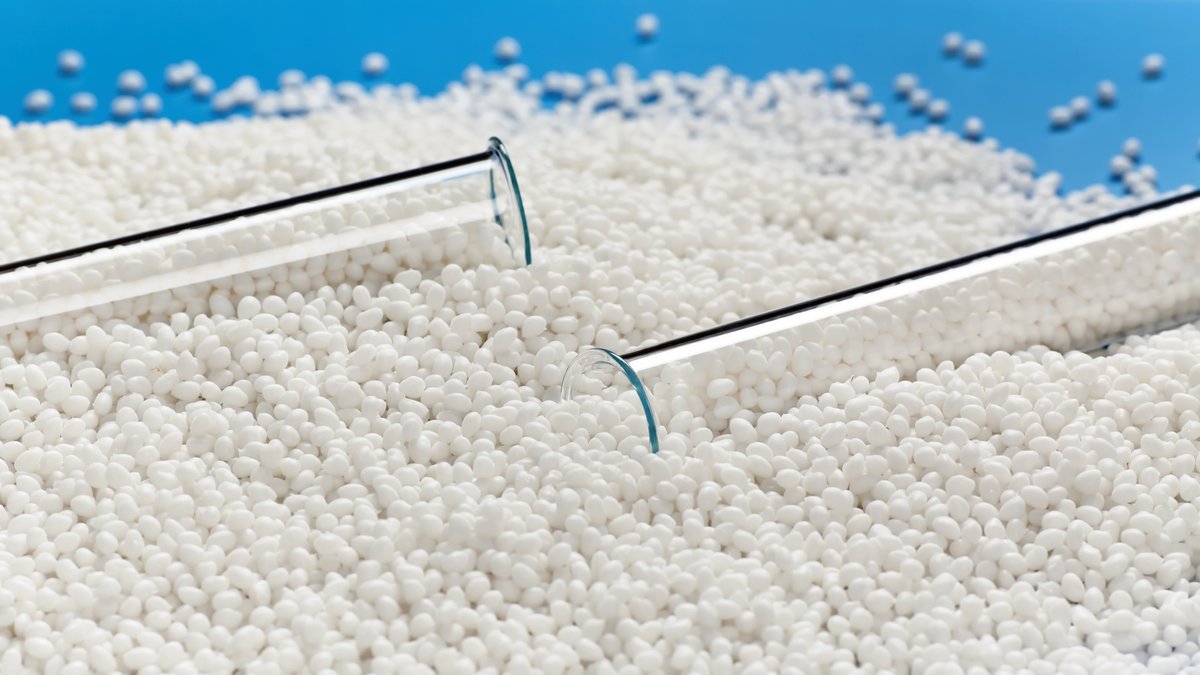
A study in the Journal of the American Chemical Society found that tunable tungsten carbide catalysts can hydrocrack polyolefin plastics efficiently, even when the feedstock contains 10 wt % PVC. The JACS study, published online on December 17, 2025, reports a catalyst design that tackles a stubborn problem in chemical recycling: mixed plastic streams that contain chlorine-releasing PVC.
The work centers on polyolefin hydrocracking, a chemical route that uses hydrogen and catalysts to turn long plastic chains into shorter hydrocarbons. Polyolefins include familiar plastics such as polyethylene and polypropylene. These materials make up a large share of plastic waste, yet they resist simple chemical breakdown because their carbon chains are long and chemically stable.
The researchers report that tungsten carbide catalysts can combine two key catalytic roles inside one earth-abundant material. Their experiments suggest that these catalysts can keep working in the presence of PVC, a material that often complicates plastic recycling chemistry because it can release chlorine under reaction conditions.
A New Catalyst for Tough Plastic Mixtures
Ten percent PVC in a plastic feedstock is a demanding test for a hydrocracking catalyst. In the reported experiments, the tungsten carbide materials maintained activity or even showed increased activity when PVC was included in the substrate. That result points to a possible route for processing more realistic plastic mixtures, where perfect sorting is difficult.
The study focuses on polyolefins, a family of plastics built from long chains of carbon and hydrogen. Hydrocracking aims to cut those chains into smaller hydrocarbon molecules. Those smaller products can be more useful as fuels, chemical feedstocks, or starting points for other refinery-style processes.
Traditional hydrocracking catalysts often use two separate kinds of active sites. One site type helps move hydrogen around. Another site type helps rearrange and break carbon-carbon bonds. The new work reports that tungsten carbides can provide both functions in close proximity, which matters when the reacting molecule is a bulky polymer chain.
The authors describe their materials as intrinsically bifunctional. In the language of catalysis, that means the same solid material carries the two catalytic functions needed for the reaction sequence. For a general reader, the idea is simpler: the catalyst can help prepare the plastic chain for cutting, then help cut it.
Why PVC Usually Causes Trouble
PVC creates a special challenge because it contains chlorine. Under hydrocracking conditions, chlorine can be released from PVC and interact with catalysts. That interaction can poison conventional catalyst surfaces, lowering their activity and shortening their useful life.
This matters because waste plastics rarely arrive as pure laboratory samples. A stream that contains mostly polyolefins may still carry some PVC from labels, films, packaging, tubing, or sorting mistakes. Even small amounts of chlorine-containing plastic can complicate high-temperature chemical processing.
Conventional noble metal and zeolite catalysts can be sensitive to chlorine. Noble metals are often used for hydrogenation and dehydrogenation steps. Zeolites can supply acidic sites for cracking. When chlorine reaches these materials, it can interfere with the surface chemistry that makes them useful.
The reported tungsten carbide system responded differently in the study. The abstract states that the catalysts “maintain or show increased activity with 10 wt % PVC in the substrate.” That short result is important because it connects catalyst performance with a practical feature of real plastic waste.
There is still a gap between a controlled experiment and a recycling plant. Mixed waste streams contain dyes, additives, fillers, multilayer materials, food residues and many polymer types. Even so, chlorine compatibility is a meaningful step for catalyst research aimed at more realistic feedstocks.
Two Catalytic Jobs in One Material
Hydrocracking needs a careful sequence of chemical steps. First, the plastic chain must interact with hydrogen-handling sites. Then it needs acidic sites that can rearrange and split carbon-carbon bonds. The balance between those jobs strongly affects how fast the reaction proceeds and what products form.
In this study, W and W2C phases provide metal-like sites on the tungsten carbide surface. These sites are linked to hydrogenation and dehydrogenation. Those words describe the movement of hydrogen atoms into and out of hydrocarbon molecules, a key part of hydrocracking chemistry.
The second job comes from Brønsted acid sites, often shortened to BAS. In the reported catalyst, these sites arise from hydroxyl groups on WOx species. These acid sites help drive isomerization and carbon-carbon bond cleavage. Isomerization changes molecular shape, while cleavage breaks the long chain into shorter pieces.
The close placement of these two site types is central to the study. Polymer fragments are large compared with small molecules such as propane or butane. When the two catalytic functions sit near each other, a bulky intermediate can pass through the reaction sequence with fewer transport barriers.
That close site proximity also separates this design from catalyst systems where the metal and acid functions are more physically separated. The study suggests that this integrated structure can help polymer chains reach the right chemical environments more efficiently.
Tuning Tungsten Carbide With Heat
The researchers found that the catalyst’s behavior can be adjusted through carburization temperature. Carburization is the heat-driven process that forms carbide phases by introducing carbon into a metal-containing material. In this case, temperature helps shape the ratio between metal-like sites and acid sites.
The study reports a volcano-shaped activity trend. That phrase describes a common pattern in catalysis, where too little of one function limits the reaction and too much can also reduce performance. The best activity appears near a balanced point.
For tungsten carbide, that balance involves the ratio of metal-like sites to BAS. If hydrogen handling lags behind acid-driven cracking, the reaction sequence can lose efficiency. If acid chemistry is poorly matched with hydrogen chemistry, the product distribution can shift in less useful ways.
Heat tuning gives researchers a way to adjust the catalyst without switching to an entirely different material. That makes the system scientifically interesting because tungsten carbide has a broad structural space. Different phases, surface oxides and surface hydroxyl groups can change how the catalyst behaves.
This is still catalyst design at the research stage. The study provides mechanistic and kinetic evidence, along with comparisons to conventional bifunctional catalysts. Future work would need to test durability, regeneration, scale-up behavior and tolerance to a broader set of contaminants.
Polymer Chains Break Step by Step
The kinetic data in the study indicate that each polyolefin chain undergoes sequential cleavage. That means the chain is shortened through a series of cuts. Long molecules become smaller molecules through repeated reaction steps rather than a single dramatic break.
This stepwise pathway is important because it affects the range of products that appear. Hydrocracking can produce molecules of different chain lengths. The catalyst’s metal-like sites and acid sites influence how far the chain is broken and how selective the process becomes.
The researchers found that trends in cracking ideality and selectivity follow patterns seen in short-alkane hydrocracking. Short alkanes are much smaller than polymer chains, so this comparison helps connect polymer hydrocracking with better-studied hydrocarbon chemistry.
At the same time, polymers bring physical challenges that small molecules do not. A long chain can be tangled, sterically hindered and slow to move through tiny pores. These transport problems can limit conventional catalysts even when their active sites are chemically capable.
The tungsten carbide materials appear to reduce some of those transport penalties. The study attributes their higher per-acid-site efficiency to enhanced polymer transport. In plain terms, the bulky plastic molecules and intermediates seem better able to reach and use the active sites.
More Efficient Than Conventional Catalysts
On a per-BAS basis, the tungsten carbide catalysts were reported to be more efficient than conventional bifunctional catalysts by more than an order of magnitude. That means the acid sites in the tungsten carbide system produced substantially more activity than comparable acid sites in typical catalyst designs.
The source of that efficiency appears to be physical as well as chemical. Many conventional catalysts rely on micropores. These tiny pores can be useful for small molecules because they provide controlled spaces where reactions happen. Large polymer intermediates can struggle to move through such confined structures.
The reported tungsten carbide system offers a different surface environment. The study highlights close site proximity and improved transport for high-molecular-weight polymer intermediates. Those features help explain why the catalyst performs strongly when activity is normalized to the number of acid sites.
Another important feature is material choice. Tungsten is a transition metal and tungsten carbide belongs to a broader class of transition-metal carbides. The authors frame these materials as earth-abundant bifunctional catalysts. That matters because many conventional high-performance catalysts rely on noble metals, which can be expensive and supply-limited.
Efficiency alone does not determine industrial value. A practical catalyst must also be stable, regenerable, affordable and compatible with real feedstocks. The supporting information for the study includes additional catalyst characterization, product analysis and regeneration tests, which helps build the technical foundation for future evaluation.
What This Could Mean for Chemical Recycling
Chemical recycling aims to recover value from plastics by changing their molecules. For polyolefins, hydrocracking is attractive because it can transform long, tough carbon chains into shorter hydrocarbons. Those products can potentially reenter existing chemical and fuel networks.
The new study adds a catalyst concept designed for a known weakness in plastic recycling chemistry. Mixed feedstocks are hard to sort perfectly and PVC can introduce chlorine. A catalyst that tolerates PVC could make hydrocracking research more relevant to waste streams that resemble real-world materials.
The work also points toward rational catalyst tuning. By changing carburization temperature, researchers can adjust the balance between metal-like and acid sites. That design lever could help tailor catalysts for different polyolefin feeds, target product ranges, or contaminant profiles.
There are clear limits to what the study establishes. The findings come from controlled catalysis experiments and published chemical analysis. They do not prove that mixed plastic waste can be processed economically at scale. They do show that PVC-compatible catalysts are possible within the tungsten carbide family.
The broader promise lies in combining earth-abundant materials, close catalytic site proximity and compatibility with heteroatoms such as chlorine. If future studies confirm long-term stability and broader contaminant tolerance, chemical recycling systems may gain a new tool for handling the messy reality of plastic waste.