A study in Scientific Reports used laser radar to detect elevated mercury vapor above the mausoleum mound of Qin Shi Huang, China’s first emperor. The findings give modern scientific weight to ancient accounts that described liquid mercury inside the still-sealed burial chamber near Xi’an.
The research team, with affiliations including South China Normal University and Emperor Qin Shihuang’s Mausoleum Site Museum, measured atomic mercury in the air around the tomb mound. Their mobile instrument found concentrations above the regional background level at several points around the pyramid-shaped earthwork.
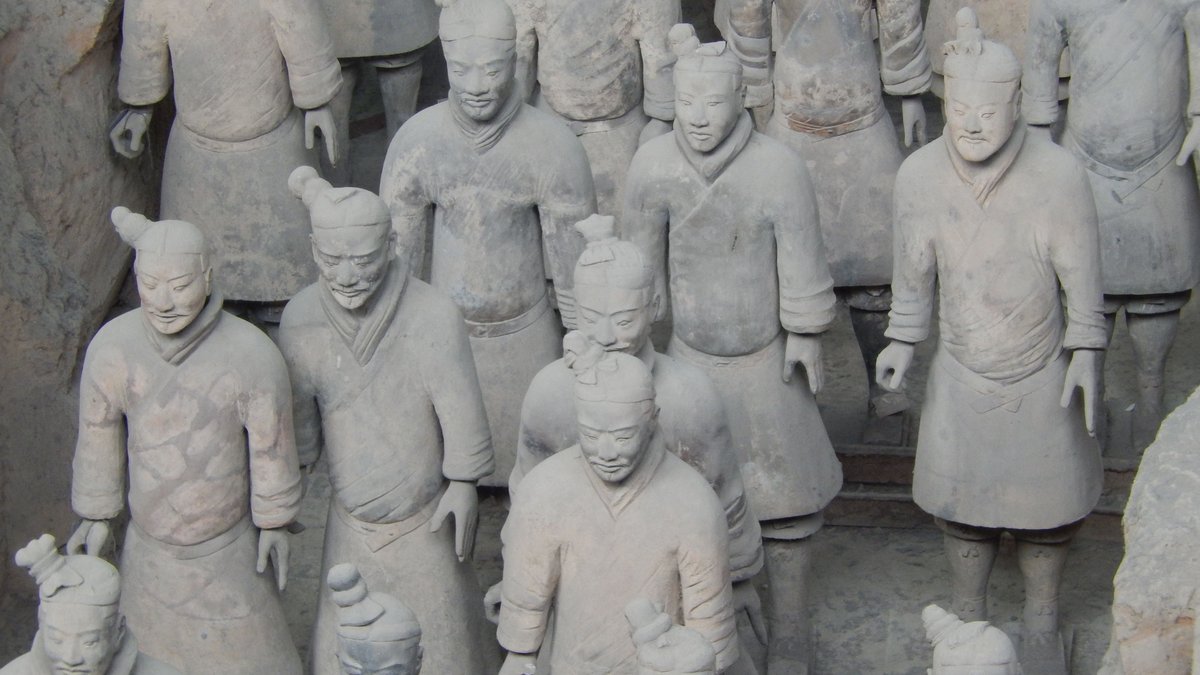
For archaeologists, the result touches one of the most famous unopened spaces in the world. Beneath the mound lies the central tomb chamber of an emperor who died in 210 BC. Around it stretches a vast funerary landscape guarded by thousands of life-sized terracotta soldiers.
A Laser Test Above an Unopened Tomb
The Scientific Reports study focused on mercury as a gas that can escape from buried structures over long periods. Mercury has a relatively high vapor pressure, so tiny amounts can move into the air even when the main source remains sealed underground.
To detect it, the researchers used mobile differential absorption lidar. The method sends laser pulses through the air and reads how specific wavelengths are absorbed. That lets scientists map trace gases from a distance without digging into fragile ground.
The team placed the instrument at three locations around the mausoleum mound. From those points, they scanned air masses moving above and around the burial complex. The measurements reached distances of up to about 700 meters.
This approach suited the Qin tomb because the central chamber remains closed. A remote sensing test can gather clues while leaving the archaeological site intact. For a monument more than two millennia old, that restraint matters as much as the detection itself.
The Army Found by a Farmer’s Shovel
The world’s attention turned to the site on March 29, 1974. A farmer named Yang Zhifa and others were digging a well east of Xi’an when they struck pieces of a human-sized clay figure. The first fragments soon led archaeologists to one of the greatest archaeological discoveries of the twentieth century.
Excavations revealed the Terracotta Army, a buried military formation made of life-sized figures. The pits contain roughly 8,000 soldiers, along with chariots, horses and cavalry figures. Each warrior carries distinct details in posture, clothing, hair and facial features.
The army stands east of the main tomb mound. Its formation faces outward, as if guarding the emperor in death. The figures represent only part of a much larger necropolis built for Qin Shi Huang.
That larger landscape includes ritual buildings, workshops, stables and other pits. Archaeologists have found figures of officials, entertainers and attendants. Bronze waterfowl and other objects point to a planned afterlife court, complete with administration, spectacle and symbolic nature.
A Pyramid Over an Underground Palace
At the center of the complex is a large earthen mound shaped like a stepped pyramid. Its present height is lower than many historical and popular estimates because erosion has changed the mound over centuries. Even today, it dominates the surrounding landscape.
Beneath that mound lies the Qin Shi Huang mausoleum, a monumental burial complex created for the ruler who unified China. Ancient sources describe a vast project that began when Qin Shi Huang was still a young ruler and continued for decades.
Archaeological surveys suggest that the underground palace occupies a carefully planned space beneath the mound. Researchers have used noninvasive methods, including geophysical survey, to infer the chamber’s position and layout. The central burial chamber is believed to remain sealed.
The broader mausoleum zone covers many square kilometers. The terracotta warriors sit far from the central chamber, which shows how large the funerary design really was. The emperor’s burial was conceived as a miniature imperial world beneath the ground.
Why Archaeologists Keep the Chamber Sealed
The strongest reason for leaving the chamber closed is preservation. The first major excavations of the terracotta figures showed how quickly buried materials can change after exposure. Painted surfaces that had survived underground for centuries began to deteriorate when air reached them.
Many figures originally carried vivid colors. Traces of red, blue, green, pink, black and other pigments have been documented on excavated warriors. The paint often rested on a lacquer layer that became unstable after exposure.
That lesson weighs heavily on any discussion of opening the emperor’s tomb. The central chamber may contain textiles, lacquered objects, painted surfaces, wooden architecture and organic materials. Some of those materials could be far more delicate than the clay soldiers.
Conservation technology has improved since the 1970s. Even so, opening a sealed burial chamber at this scale would create risks that cannot be reversed. Chinese heritage authorities and archaeologists have therefore favored patience while research tools advance.
Ancient Records Described Rivers of Mercury
The mercury question comes from one of China’s most important historical texts. The Han dynasty historian Sima Qian wrote about the tomb roughly a century after Qin Shi Huang’s death. His account described an underground palace with features meant to mirror the emperor’s realm.
In that description, rivers, seas and waterways were represented by liquid mercury. The same passage also describes a ceiling decorated with heavenly bodies. Together, the imagery suggests a burial chamber designed as a cosmic map of empire.
For centuries, readers treated parts of this account as a blend of history, court memory and dramatic storytelling. The idea of large quantities of mercury beneath the mound was especially striking. Mercury was also associated with immortality practices in ancient China, which gives the detail cultural context.
The Scientific Reports paper connected that historical claim with modern measurements. In the study’s own wording, “Our investigation supports ancient chronicle records on the tomb.” That short sentence captures why the lidar work drew attention far beyond atmospheric chemistry.
Modern Readings Found Mercury in the Air
The lidar results showed elevated atmospheric mercury around the mound. The study reported concentrations up to 27 nanograms per cubic meter at certain locations. The typical general pollutant level in the area was about 5 to 10 nanograms per cubic meter.
Those readings also matched earlier soil findings around the mausoleum. Previous measurements had found unusually high mercury concentrations in parts of the mound’s surface soil. The lidar study added a second line of evidence by detecting mercury vapor in the air.
The researchers estimated a mercury outflow of about 5×10⁻⁸ kilograms per second from the pyramid. That is a small amount in everyday terms. Over archaeological time, it is enough to suggest a persistent source sealed below the mound.
Mercury vapor could be escaping through tiny cracks or pathways that developed in the structure over centuries. The study framed mercury as a geophysical tracer gas, meaning it can reveal hidden underground sources through careful atmospheric measurement.
The finding does not show the chamber interior directly. It gives an indirect signal from outside the sealed mound. That is the value of remote sensing at a protected archaeological site, because it can test an old claim while leaving the tomb undisturbed.
The Tomb Waiting for Better Technology
The unopened chamber has become a rare case where scientific curiosity and restraint point in the same direction. Researchers want to know what lies inside. The safest path still favors studying the mausoleum from the outside.
Future tools may make that work more precise. Better gas mapping, improved ground imaging and stronger conservation methods could help archaeologists understand the site with less risk. Each advance can add a layer of information before any physical intervention is considered.
The Qin mausoleum also shows how science can revisit ancient testimony. A text written about 2,100 years ago described mercury in the emperor’s tomb. Modern laser measurements now indicate elevated mercury above the very mound that covers his burial chamber.
For now, the first emperor’s tomb remains sealed beneath its earthen pyramid. Around it stand the buried armies, officials, animals and ritual spaces built for an afterlife empire. Above it, the air carries a faint chemical clue from a chamber that has waited since 210 BC.