Researchers at University of Alicante have reclassified 43 iron helmets recovered from waters off eastern Spain, showing that the famous underwater cache belongs to the Late Middle Ages. The finding moves the objects from a Roman label into the turbulent world of 14th- and 15th-century Mediterranean trade, warfare and coastal defense.
The helmets were found in 1990 at the underwater archaeological site of Piedras de la Barbada, near Benicarló on Spain’s eastern coast. For more than three decades, they were treated as ancient pieces linked to the Roman world. The new work, published in the Cambridge University Press journal Antiquity, places them between the late 14th and early 15th centuries.
That shift changes the meaning of the whole discovery. A pile of corroded metal from the seabed now points to a lost shipment of military equipment, a period of rising maritime insecurity and a Mediterranean economy capable of moving weapons across long distances. The research was led by Manuel Frallicciardi, a doctoral student jointly supervised by the University of Alicante and the University of Salerno.
A helmet hoard changes eras
The reassessment began with a basic problem. The helmets looked familiar and strange at the same time. Their shapes recalled older traditions, yet the pieces resisted easy classification within known Roman types or standard medieval categories.
Frallicciardi said the first stage of the study was unusually difficult. “At the beginning, it was difficult to place them in a specific era,” he said. The helmets carried traits that recalled Late Roman models, along with features that fit medieval pieces shaped by classical visual traditions.
The new dating result gave the assemblage a firmer historical setting. The 43 helmets are now interpreted as a Late Medieval military cargo, likely connected to the movement of arms through western Mediterranean commercial routes. That setting makes the Benicarló finds rare evidence for military logistics at sea.
The reclassification also helps explain why the objects had been so hard to interpret. They appear to belong to a poorly documented transitional form of helmet. Their design reflects a moment in military technology that left few surviving examples and no obvious later lineage.
The largest medieval find of its kind
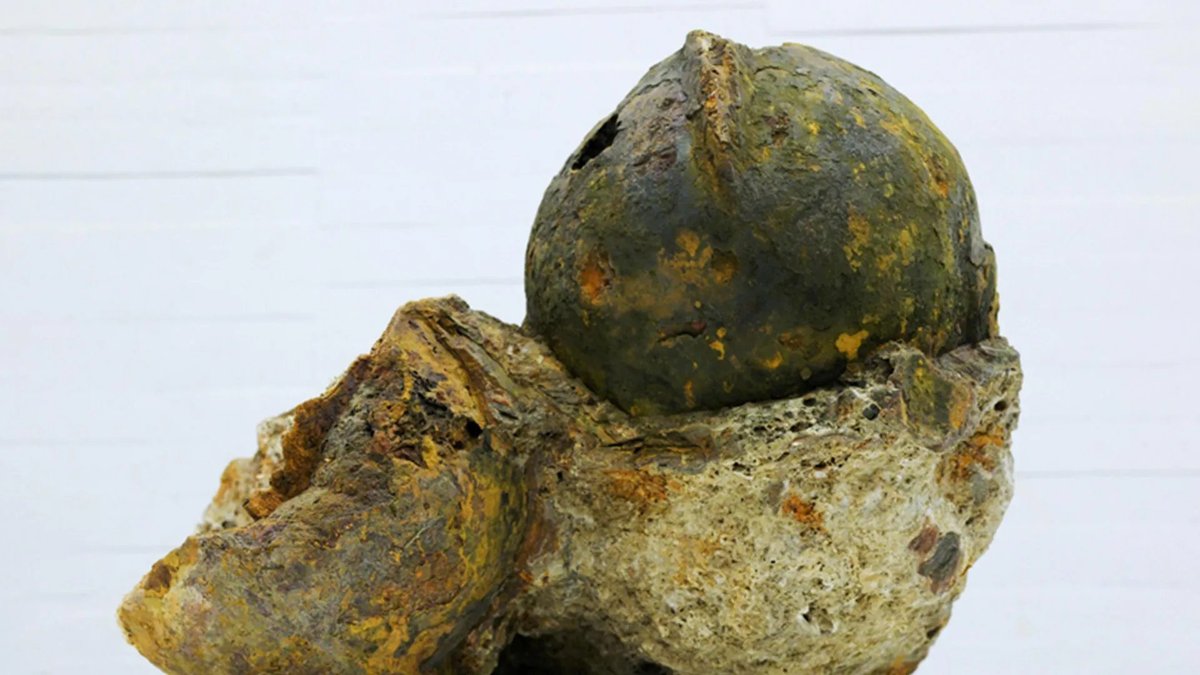
The hoard was discovered by accident when local fishermen snagged two large metal masses in their nets. Those blocks had formed after centuries underwater, as corrosion and marine deposits fused the helmets into compact concretions. Inside was an extraordinary concentration of iron headgear.
According to the University of Alicante, the surviving group of 43 helmets is the largest known medieval helmet hoard in the western Mediterranean. Archaeologists think the original shipment may have included additional pieces, which makes the surviving collection even more striking.
The quantity matters. A single helmet might tell researchers about one warrior, one workshop, or one owner. A tightly packed group of dozens of helmets points toward bulk movement, commercial handling and organized supply. These objects were probably cargo before they became archaeology.
Raimon Graells, a lecturer at the University of Alicante and co-author of the study, emphasized the broader significance of the find. “We are looking at direct evidence of large-scale arms trading,” he said. That evidence reaches beyond the helmets as individual artifacts.
The Benicarló cache suggests that protective equipment moved through the same maritime networks that carried other goods around the Mediterranean. The shipment may have been linked to major commercial centers in northern Italy, including Genoa, one of the powerful trading hubs of the period.
Textiles inside the helmets held the date
The decisive evidence came from fragile material preserved inside the corroded metal. In several helmets, underwater mineral deposits sealed the interior spaces and protected textile fragments that would usually disappear over time.
Those pieces of fabric became the key to dating the assemblage. Researchers used radiocarbon dating on preserved textile linings, then combined the results with detailed analysis of the helmet forms and materials. The dates placed the objects between the late 14th and early 15th centuries.
The team also applied an analytical approach developed at the University of Alicante. The method had proved useful in other archaeological investigations and this study extended it to medieval weapons of this kind. Together, the dating and material evidence gave the researchers a more secure chronology.
That detail is important because iron objects can be difficult to date on their own. Metal can be reused, repaired, traded and copied across generations. Organic remains sealed inside an object can provide a more direct line to the period when it was assembled or used.
Frallicciardi’s search for parallels showed how unusual the helmets were. “When I started the research, it was incredible to see that practically no known parallels existed,” he said. A few similar depictions appeared in 14th-century English artwork, but exact matches remained elusive.
A lost cargo in shallow water
The underwater setting offers clues to how the helmets ended up on the seabed. Piedras de la Barbada lies beside an area used as a jetty, in water only about six meters deep. That shallow location suggests the shipment may have fallen during loading or unloading.
Researchers interpret the helmets as part of a single cargo. An accident near the shore could have sent the grouped equipment into the water. Some of it may have sunk quickly into sand, where recovery would have been difficult even in shallow depths.
Over time, the seabed helped preserve the evidence. Sediment and mineral concretions surrounded the helmets and fixed them together. That same process damaged the metal, yet it also protected internal traces that became crucial to the modern investigation.
The setting gives the discovery a practical human dimension. These helmets were likely handled as goods before they vanished. Someone may have been moving them from ship to shore, from shore to ship, or through a coastal transfer point that linked local needs with broader Mediterranean trade.
The find also highlights the value of underwater archaeology. Harbors, jetties, anchorages and nearshore waters can preserve accidental losses that written records rarely describe. In this case, a mishap at the edge of the sea captured a moment in the movement of medieval weapons.
What the helmets reveal about medieval trade
The Late Middle Ages were a period of intense movement across the Mediterranean. Merchants carried textiles, grain, metal, ceramics and other goods through busy sea lanes. Military equipment traveled within those systems too, especially when coastal communities faced growing insecurity.
The University of Alicante team connects the Benicarló helmets to a region shaped by conflict, piracy and maritime defense. During the mid-14th century, Islamic piracy expanded along the Valencian coastline. That pressure likely increased demand for protective equipment among local forces and maritime communities.
The helmets may have been intended for local militias, forces linked to the Kingdom of Valencia, or armed groups responsible for defending the coast. Their presence in a large shipment points to organized supply, rather than isolated ownership. It also suggests that arms moved through established commercial channels.
Graells said the discovery reveals a bigger network behind the metal. “This discovery reveals a network of exchange and communication that was far more complex than previously thought,” he said. The helmets therefore speak to trade as much as to warfare.
The possible connection with northern Italy adds another layer. Genoa and other commercial centers played major roles in Mediterranean exchange during the Late Middle Ages. If the helmets moved through those circuits, the Benicarló cargo would show how far military goods could travel before reaching local users.
The new study gives the underwater hoard a sharper place in history. These 43 helmets preserve evidence of medieval arms trade, coastal defense and technical change in armor design. They also show how a small fragment of fabric, sealed inside corroded iron, can redraw the story of objects recovered from the sea.