About half of the oxygen produced on Earth each year comes from the ocean. Most is released by microscopic phytoplankton, algae and photosynthetic bacteria near the sunlit surface. The estimate concerns gross production, not a claim that every second breath contains a newly made oxygen molecule from today’s plankton.
Marine organisms and chemical reactions consume much of that oxygen again. The atmosphere contains an enormous reservoir accumulated over geological time, so short-term changes in ocean production do not immediately cut atmospheric oxygen in half.
The NOAA ocean oxygen overview summarizes the central estimate and notes that marine life consumes roughly comparable amounts. Production, respiration and long-term burial must be separated to understand the balance.
Phytoplankton release oxygen through photosynthesis
Photosynthesis uses light energy to turn carbon dioxide and water into organic matter. Oxygen is released as a byproduct when water molecules are split. In the ocean, this work is performed by diverse microscopic organisms rather than one type of plant.
Diatoms build silica shells, dinoflagellates possess flagella and cyanobacteria are photosynthetic bacteria. The cyanobacterium Prochlorococcus is tiny but abundant across warm, nutrient-poor regions, making it a major contributor to marine production.
Seaweeds and seagrasses also release oxygen locally. Their global contribution is smaller than the combined work of drifting microorganisms because phytoplankton occupy vast sunlit waters.
The sunlit layer supports most production
Light declines rapidly with depth. Most photosynthesis occurs in the euphotic zone, where enough sunlight remains for production to exceed or match respiratory costs. Its thickness varies with water clarity.
Nutrients can limit growth even under bright light. Nitrogen, phosphorus, iron or other elements become scarce in different regions. Upwelling supplies deep nutrients, while river inputs and dust affect coastal or open-ocean blooms.
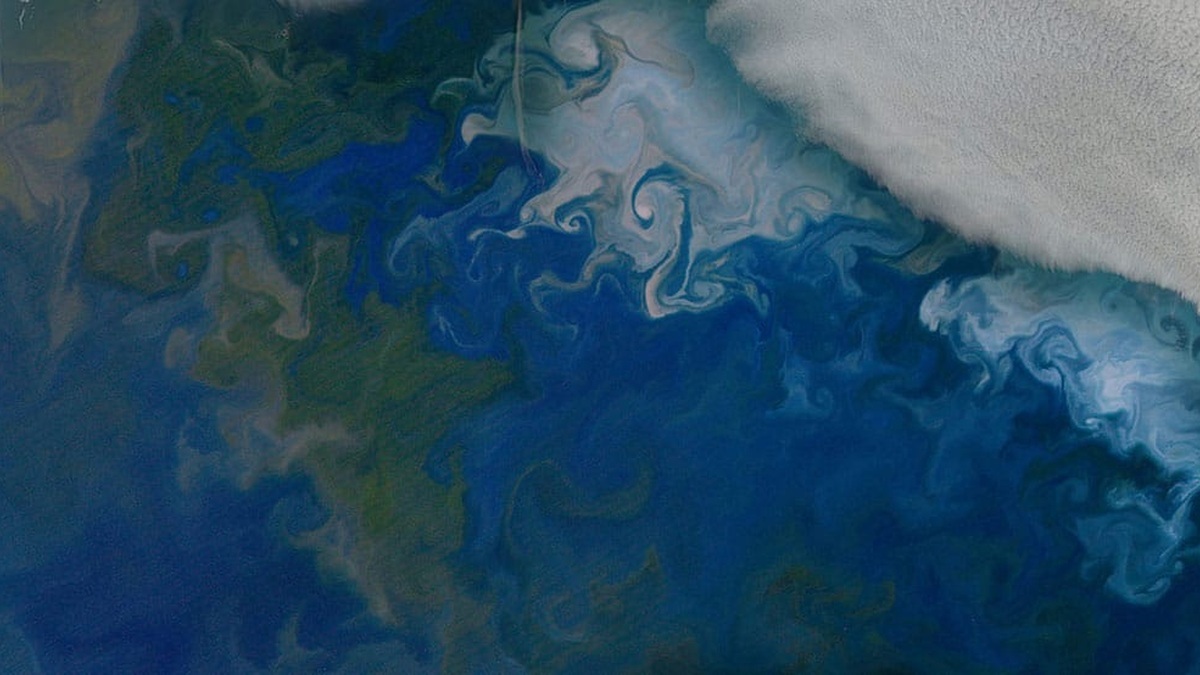
Temperature changes growth and metabolism, but warmer water also holds less dissolved oxygen. A satellite view of chlorophyll offers information about surface phytoplankton without measuring every photosynthetic rate below.
NASA Earth Observatory describes Southern Ocean phytoplankton as oxygen factories and shows how satellites reveal broad patterns that ships cannot sample everywhere.
Gross production is not the same as oxygen export
Gross primary production counts all carbon fixed and oxygen released before the producers use some energy themselves. Net primary production subtracts the producers’ respiration. Ecosystem net production also subtracts respiration by consumers and decomposers.
When plankton are eaten or decay, respiration consumes oxygen and returns carbon dioxide. Much of the oxygen produced near the surface is therefore balanced within the marine food web.
A small fraction of organic carbon sinks and becomes buried before it is respired. Over geological time, that separation allows oxygen to remain in the ocean-atmosphere system. Long-term atmospheric accumulation depends on burial and chemical cycles, not production alone.
The atmosphere mixes oxygen from many sources
An oxygen molecule does not retain a label identifying the forest or plankton cell that produced it. Winds mix the atmosphere and air-sea exchange moves gases across the surface according to concentration, temperature and turbulence.
The common phrase that every second breath comes from the ocean is a useful picture of annual global production. It should not be read as a literal division of inhaled molecules between land and sea at a particular location.
Atmospheric oxygen makes up about 21 percent of dry air. That reservoir is so large that annual biological production cycles only a fraction of it. The immediate concern from marine deoxygenation is aquatic habitat, not humans running out of breathable air.
The USGS discussion of dissolved oxygen explains how temperature, mixing and biology control oxygen available within water.
Ocean deoxygenation threatens marine ecosystems
Warming reduces oxygen solubility and can strengthen density layers that limit ventilation of deeper water. Respiration continues below the surface, so restricted mixing can lower dissolved oxygen even when phytoplankton produce oxygen above.
Coastal nutrient pollution may stimulate blooms whose decay consumes oxygen, creating hypoxic zones. Fish may leave if they can, while bottom animals can suffocate. Severity depends on duration, depth and species tolerance.
Deoxygenation also compresses habitat for organisms that need well-oxygenated water. Predators and prey may be crowded into shallower layers, changing feeding and vulnerability to fisheries.
Scientists estimate production with several methods
Researchers measure oxygen changes in incubated water, track carbon isotopes and record fluorescence associated with photosynthesis. Each method samples a limited place or process and requires assumptions when scaled up.
Satellites estimate chlorophyll, light and temperature across the surface. Models combine those observations with ship measurements to calculate global production. Clouds, depth structure and differences among plankton introduce uncertainty.
The NASA chlorophyll and productivity maps show how marine color observations are paired with terrestrial productivity. Comparing independent approaches improves the global range.
Scientists therefore say roughly half rather than one fixed percentage. Annual climate variation and methodological choices can shift an estimate while preserving the conclusion that marine photosynthesis rivals production on land.
Protecting ocean oxygen means protecting processes
Reducing greenhouse gas emissions limits warming-driven oxygen loss. Controlling nutrient runoff reduces coastal blooms that feed severe hypoxia. Monitoring reveals where ventilation or productivity is changing before mass mortality occurs.
The ocean’s oxygen role is both global and local. Plankton contribute about half of annual planetary production, while dissolved oxygen determines whether fish and bottom communities can live in a particular water mass. Keeping those ideas separate makes the famous estimate scientifically useful.
Oxygen varies across a day and season
In productive surface water, photosynthesis raises oxygen during daylight and respiration lowers it at night. A sensor may record a daily cycle even when the seasonal average remains stable.
Spring blooms can produce oxygen rapidly, followed by consumption as algae sink and decompose. Temperature and mixing change at the same time, making one cause difficult to isolate.
Supersaturation occurs when water temporarily holds more oxygen than expected at equilibrium with the air. Bubbles and gas exchange then release some excess to the atmosphere.
Below the sunlit layer, respiration generally dominates because light cannot support equivalent production. Ventilation from currents and sinking cold water replenishes deep oxygen on longer timescales.
Prochlorococcus illustrates scale without certainty
Claims that one cyanobacterium produces a fixed share of planetary oxygen simplify a diverse ocean. Prochlorococcus is enormously abundant, but its contribution varies with region, season and how production is modeled.
Cells divide rapidly under favorable conditions and are eaten or infected by viruses. The oxygen they release may be consumed soon afterward within the same microbial food web.
Its importance comes from cumulative activity across vast warm waters. Cell abundance and photosynthetic rate must both be measured before scaling from a bottle to an ocean basin.
The organism demonstrates why tiny producers can rival visible forests without implying that marine oxygen comes from one species alone.
Oxygen production and carbon uptake are linked
Photosynthesis releases oxygen while fixing carbon into cells. Measuring one process can help estimate the other, but their ratio changes with nutrient conditions and the chemical forms of carbon or nitrogen used.
Most fixed carbon returns to dissolved carbon dioxide through respiration. The biological carbon pump describes the fraction moved below the surface as particles or dissolved material, where it may remain isolated for years or longer.
Sinking does not guarantee permanent storage. Microbes and animals consume particles on the way down, using oxygen in deeper water. Only burial in sediment or very long ocean circulation supports durable removal.
Carbon and oxygen measurements therefore tell complementary stories. A productive bloom can release oxygen at the surface while its later decomposition lowers oxygen below.
Climate models represent these pathways with observations from floats, ships and satellites. Better plankton ecology improves both global carbon projections and estimates of future marine deoxygenation.
Related reading: ocean dead zones and harmful algal bloom forecasts.