There is no single depth limit for a human in the ocean. A breath-hold diver exposes the body directly to increasing pressure, a scuba diver breathes gas at ambient pressure and a passenger inside a rigid submersible remains near one atmosphere. The answer therefore ranges from tens or hundreds of meters for exposed divers to nearly 11 kilometers for people protected by a deep-ocean vehicle.
For everyday diving, the clearest benchmark is the widely used recreational scuba limit of 40 meters, or 130 feet. Specialized divers extend that range by changing the breathing mixture and planning decompression under extensive surface support. Record attempts reach farther than routine operations. They do not establish a safe working limit and a vehicle record says nothing about what an unprotected body could tolerate.
Breath-hold divers carry no breathing gas
Freedivers descend on one breath. Increasing pressure compresses the lungs and every other gas-filled space, requiring repeated equalization of the ears and sinuses. The body also responds with a diving reflex that slows the heart and shifts blood toward essential organs. A failed equalization can cause pressure injury, while falling oxygen during ascent creates a separate danger.
Rules matter when comparing records. The International Association for the Development of Apnea recognizes several disciplines, including constant weight, free immersion and no-limits events. Fins, guide ropes, weighted sleds and lifting devices differ among them. A depth achieved with a weighted sled and rapid assisted ascent is not directly comparable with a diver swimming down and back.
Herbert Nitsch’s 214-meter no-limits performance from 2007 remains listed in AIDA’s record history, while Guinness reports a later 253-meter dive in 2012. The later attempt caused severe decompression illness and is not presented identically by every record organization. These figures illustrate a central caution: the deepest claimed or verified performance depends on the discipline and certifying body.
The critical phase often comes during ascent. Expanding lung gas and falling oxygen pressure can leave a freediver unconscious near the surface even after a controlled descent. Competitive safety teams therefore meet athletes underwater, monitor recovery and apply discipline-specific protocols.
Recreational scuba has a conservative boundary
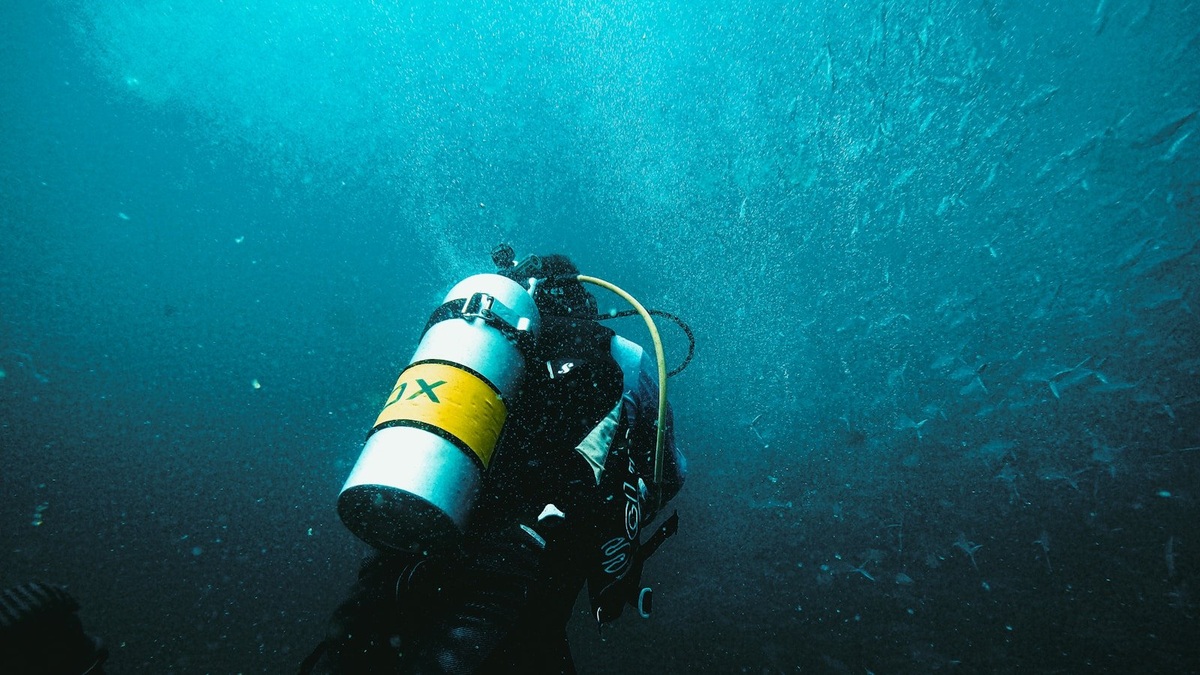
Scuba supplies gas at the surrounding pressure, allowing a diver to breathe underwater but increasing gas uptake in body tissues. Recreational training agencies generally set 40 meters as the maximum depth for properly trained recreational divers. Many certifications impose shallower limits, especially for beginners.
Deeper water makes each breath denser. Rising nitrogen pressure can impair judgment, while oxygen exposure eventually becomes hazardous. It also shortens the time available before decompression obligations build. A direct ascent can allow dissolved inert gas to form bubbles, causing decompression sickness. Divers control the risk through advance planning and a slow ascent that includes the required stops; a larger cylinder alone does not solve it.
Gas consumption rises with ambient pressure because each breath contains more molecules at depth. At 40 meters, absolute pressure is roughly five times surface pressure. A cylinder that lasts comfortably near the surface can empty far faster, leaving less time to solve an equipment problem.
Technical diving extends range with more systems
NOAA describes technical diving as work beyond conventional recreational limits that may use mixed gases, rebreathers, staged decompression and multiple cylinders. Such divers can exceed 90 meters, or 300 feet, but the complexity and consequences increase sharply. Helium-based mixtures can reduce nitrogen narcosis while introducing other planning and physiological concerns.
The Guinness record for the deepest scuba dive is Ahmed Gabr’s 332.35-meter dive in the Red Sea in 2014. The descent took minutes, while the ascent required many hours of decompression. It was a supported record attempt, not a depth that ordinary technical divers treat as a routine destination.
Depth alone also hides exposure time. A short excursion and a long work shift at the same pressure create different decompression demands. Cold, current, workload, visibility and emergency access can make a shallower dive more hazardous than a deeper one under controlled conditions.
Saturation divers live under pressure
Saturation diving addresses repeated decompression by keeping workers pressurized in a chamber between shifts. After enough time, their tissues become saturated with inert gas at the working pressure. They can travel to an underwater job in a pressurized bell, then complete one long decompression at the end of the assignment rather than after every excursion.
Divers Alert Network notes that commercial saturation work commonly occurs at far less than the most extreme experimental pressure. In 1992, the COMEX Hydra 10 experiment exposed divers in a chamber to pressure equivalent to 650 meters, with one brief excursion to 701 meters. That was a hyperbaric chamber experiment, not an open-ocean swim at that depth.
NOAA Fisheries describes how saturation teams support deep-sea coral work with pressurized living quarters and a diving bell. The method extends bottom time, but it requires medical supervision, gas management and a surface vessel able to maintain the pressurized habitat.
Cold-water protection, breathing-gas control, fire safety and continuous surface support make saturation work a system rather than an individual feat. The worker is still at ambient pressure. Equipment reduces specific risks but does not place the body in a normal sea-level environment.
Atmospheric suits isolate a diver from pressure
An atmospheric diving suit is a rigid, jointed one-person vehicle shaped roughly like armor. Its pressure-resistant shell keeps the occupant near surface pressure, avoiding the need to saturate body tissues at the outside pressure. External manipulators let the occupant handle a cable or operate a valve, with fine movement limited by the suit’s joints.
The suit changes the meaning of “diving.” Its occupant is underwater and can perform tasks, but pressure acts on the suit rather than directly on the lungs and tissues. A model receives its depth rating through testing and certification, while the support system defines how it can be deployed. Mobility and visibility are limited compared with ordinary scuba.
Crewed submersibles reach the full ocean depth
Human-occupied vehicles use pressure hulls to carry one or more people much deeper. Following U.S. Navy recertification in June 2026, the research submersible Alvin is certified to 6,500 meters. Its passengers observe through viewports and operate instruments while the cabin remains at a survivable pressure.
The most dramatic benchmark comes from Challenger Deep. In 1960, Jacques Piccard and Don Walsh rode the bathyscaphe Trieste to a corrected depth of about 10,911 meters, equivalent to 35,797 feet. Their descent, including the alarming sound of a cracked outer window component, is described in Argo’s account of how Trieste reached Challenger Deep.
The NOAA history of depth soundings places Trieste within the longer progression from lead lines to sonar and deep vehicles. Its pressure sphere protected the crew while gasoline provided buoyancy and iron shot served as releasable ballast.
Later vehicles have repeated full-ocean-depth descents, proving that engineering can take people to the deepest known seafloor. The occupants are not physiologically “diving” to 11 kilometers. They are traveling inside a pressure vessel, much as astronauts rely on a spacecraft to separate them from an otherwise lethal environment.
The practical answer depends on the method
A swimmer on one breath, a scuba diver, a saturation worker and a submersible passenger face different limits. Breath-hold and scuba records measure direct human exposure under specific rules. Saturation experiments measure prolonged pressure tolerance with elaborate life support. Atmospheric suits and submersibles measure the capability of a pressure hull.
Every depth claim should state whether pressure reaches the body. It should then identify how the person breathes and what protective system separates them from the water. Without that context, a comparison can place a freediver beside a passenger in a steel sphere as if both bodies experienced the same environment.
Across the five ocean zones, sunlight fades as temperature generally falls and pressure rises. Reaching a mapped feature described in ocean floor topography may require a robot or vehicle even when its depth is far short of a trench. A useful answer must therefore name both the depth and the technology that made it possible.