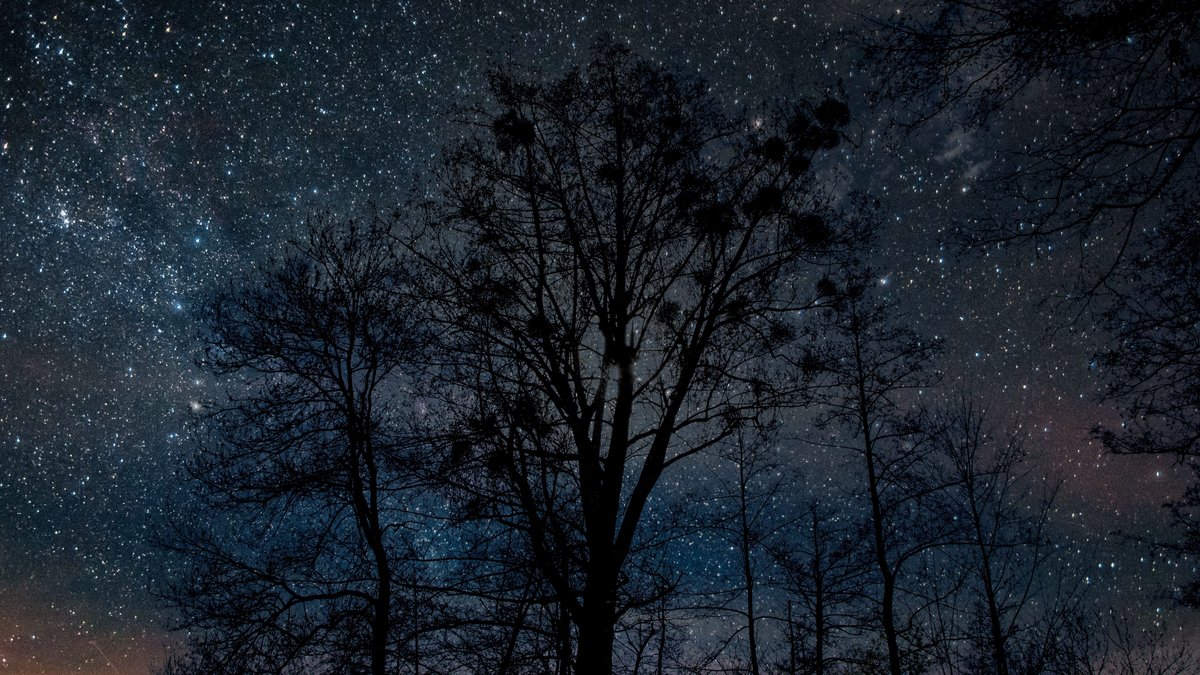
The kind of darkness many city residents rarely see may also be the kind that feels best under a planetarium dome. In a small experiment, the most soothing condition was not a bright field of easy-to-see stars. It was a sky background set to 0.001 lux, close to a new moon night in a place with very little light pollution.
A 2025 study in the International Journal of Environmental Research and Public Health followed five healthy young women as they lay under six versions of the same Orion star field, plus three movie clips used for comparison. The team from Chiba University and Konica Minolta Planetarium Co., Ltd. tracked brain and autonomic responses, then asked each participant to rate how healed or stressed she felt on an 11-point scale.
The result points to a narrow human response rather than a broad rule for everyone. The sample was small, the participants all came from one demographic group and the test took place in a controlled dome with added river sound. Even so, the pattern was clear enough to frame a practical design issue for planetariums and dark-sky advocates alike: a calming night-sky display may need to preserve genuine darkness instead of stopping at a brighter, easier-to-see compromise.
Why 0.001 lux stood out
The paper compared six starry backgrounds that kept the stars themselves constant while changing only the darkness behind them. The darkest condition, called S1, was a perfect dark starry sky at 0 lux. S2, the condition that performed best overall, represented a new moon sky at 0.001 lux. From there the backgrounds brightened in tenfold steps through crescent moon, full moon, street-lamp brightness and a sky 30 minutes after sunset.
On the 11-point healing scale, the darker star scenes ranked highest. The authors reported that S1 and S2 produced the strongest psychological healing ratings, while S5, S6 and the club video were clearly weaker. In plain terms, the women tended to feel better under a sky that still looked like night, not under a washed-out dome that resembled evening glow or urban brightness.
Brain data pointed in the same general direction, though with more nuance. The team measured oxygenated hemoglobin in the frontal area and used an asymmetry index to compare left and right activity. In their interpretation, S2 was associated with a more relaxed and positive pattern than several other scenes. The authors highlighted S2 as the darkness level of a beautiful sky that can still be seen on Earth, in isolated islands, mountains, or other wild areas with little artificial light.
What the women saw and how the team measured them
The experiment was simple in outline and careful in execution. All six star scenes showed the same projected region around Orion, with stars visible up to magnitude 6.5 across the entire dome. What changed was the background sky. The dome had a radius of 3 meters and each visual stimulus lasted 180 seconds. Between scenes, the researchers used 120 seconds of 1-lux reset light so the next trial would start from a more consistent state.
For physiology, the researchers used near-infrared spectroscopy to watch changes in oxygenated hemoglobin in the left and right prefrontal cortices. They also recorded heart rate variability, including CVRR and LF/HF, to estimate autonomic balance. Those measures gave them a way to compare fast reactions, mid-length responses and longer responses over the full three-minute viewing period.
The comparison movies were included for a practical reason. Most people do not regularly move between six levels of night-sky darkness, so the team added waterfall, cat and club videos as more familiar reference points. The movie scenes were shown at 1 lux and the researchers kept the sound level at 30 dB. For the star scenes and reset periods, they played the sound of a rushing forest river to help mask noise from the air-supported dome.
Each participant completed the measurements three times, with at least a week between sessions and the order of the stimuli was randomized. The group was small, yet the design tried to reduce noise from mood, memory and physical condition. The five participants were young Japanese women with a mean age of 26.4 years and they were described as naive observers who did not have daily experience with astronomical observing or regular planetarium star viewing.
Why absolute darkness felt different at first
The most interesting twist in the paper came from the difference between S1 and S2. S1 was the blackest possible field in the experiment, with 0 lux behind the stars. That condition did not win cleanly from the start. The authors reported that participants showed signs of stress immediately after S1 appeared, then moved toward a more healing response as time passed. The shift fits the ordinary experience of walking from a lit place into deep darkness and needing time to settle.
The team linked that pattern to dark adaptation. Their 180-second viewing window was chosen in part because total darkness requires at least about 30 seconds for adaptation to begin. In the first short interval, the black dome could feel abrupt and uncertain. By the middle and long intervals, the same scene may have become easier to inhabit, which helps explain why S1 improved over time while S2 remained the steadier favorite.
One reason S2 may have been easier on the mind is that it balanced visibility with darkness. The background still looked truly nocturnal, yet it was not as severe as total black. The authors also reported significant links between subjective healing scores and physical measures across different time windows. Their PubMed record summarizes the same core result: darker night-sky imagery reduced right-prefrontal activity and raised perceived healing compared with brighter sky conditions.
What the study can and cannot say about healing
The paper reaches beyond planetarium design and touches a larger human question. Modern lighting often removes the experience of a dark sky from everyday life and organizations such as DarkSky International have argued that darkness carries value for well-being as well as for astronomy. The U.S. National Park Service also notes that light pollution can prevent full dark adaptation and reduce what people can see at night. The planetarium experiment does not test outdoor life directly, but it does suggest that the visual character of a night sky, especially its darkness, can be linked with how people rate comfort and restoration.
Researchers in the wider astronomy-and-well-being field have also explored similar territory. An IAU Office of Astronomy for Development report described separate work in which engagement with the night sky was tied to lower anxiety and better emotional state. The planetarium study adds a more specific point to that conversation: darkness itself, measured in lux and reproduced under controlled conditions, may influence response alongside the stars.
There is also a practical message for dome projection. The best-rated scene was not an abstract laboratory setting with no real-world analog. S2 was meant to resemble a dark sky under new moon conditions, with an SQM value of 21.94, like isolated islands, mountains and wildlands. By contrast, S6 represented a much brighter sky 30 minutes after sunset and S4 resembled a full-moon sky over a large city center. Those anchors make the result easier to use in exhibition design and public outreach.
Still, the limits are important. Five participants cannot establish a universal rule and a planetarium dome is not the same as an outdoor landscape with wind, temperature, horizon lines and personal memories attached to a real night. The authors also noted that differences in sound content between star scenes and movie scenes may have affected physiology. What the experiment supports is a careful, modest conclusion: under these test conditions, a new moon level of darkness felt better than brighter skies and total darkness became more comfortable after the first shock passed.