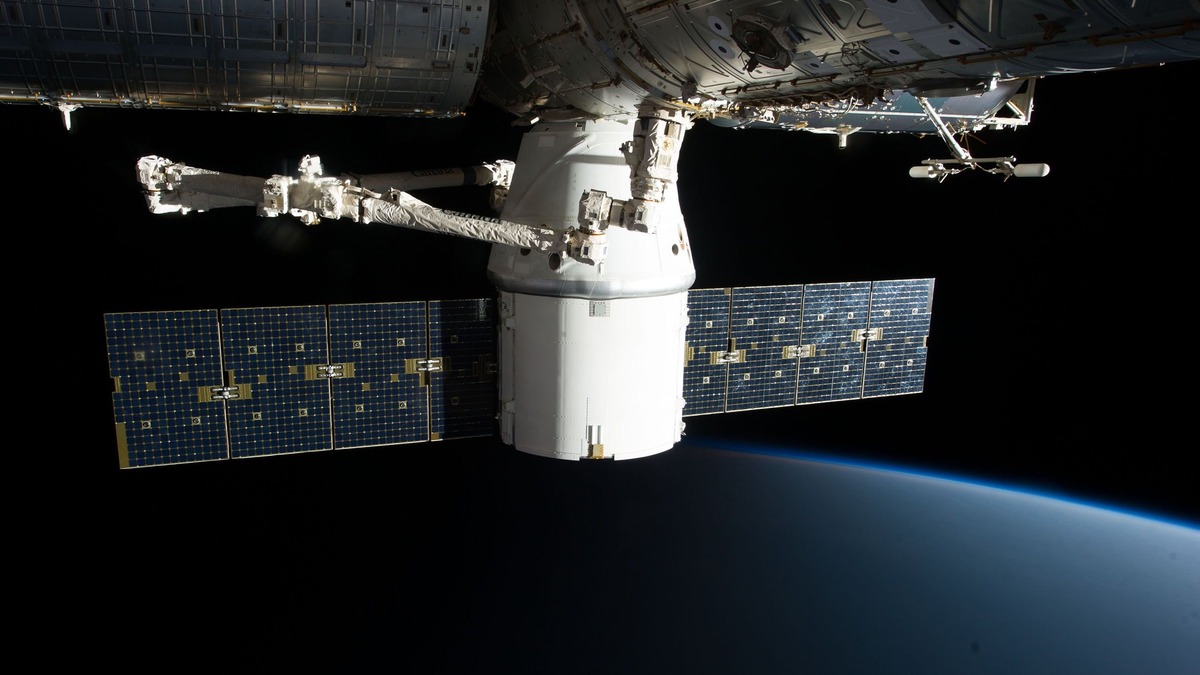
Long missions depend on fast visual judgments. Crews need to compare shapes, spot orientation changes and react before a small mistake grows into a larger one. A study of astronauts aboard the International Space Station found that this kind of performance can slip in orbit and stay below Earth-based levels longer than many people would expect.
A Scientific Reports study followed five male astronauts before, during and after roughly half-year missions on the ISS. The team tested them nine times in all, with three sessions before launch, two in flight and four after landing. Across two demanding visuospatial tasks, the astronauts were slower and less accurate in orbit than they were on Earth and the weaker performance appeared both early in flight and again about seven weeks into the mission.
The paper does not prove that every part of thinking declines in space. It focuses on a narrow but important slice of mental work: holding spatial information in mind, comparing it quickly and keeping attention steady while visual reference cues are limited. Even with that narrower scope, the result matters because astronauts already describe a hazy period of slowed thinking as space fog and this study suggests that at least one part of that problem may linger instead of fading away after the first adjustment period.
Why day 8 and day 50 stood out
The clearest finding in the study is the timing. The astronauts did not struggle only in the first few days after launch, when motion sickness, schedule changes and a new physical environment might be expected to interfere. The paper reports poorer performance at the first in-flight measurement, taken about 6 to 12 days after launch and again at a later in-flight measurement, taken about 49 to 59 days after launch.
Visuospatial performance in this paper means more than a vague feeling of mental fatigue. The astronauts had to remember the orientation of lines, compare them to a second line and judge whether a dot matched a clock position represented by a number. Those are simple ideas to describe, yet they place real demands on working memory and attention, especially when the body no longer has gravity as a stable directional cue.
Researchers saw no convincing sign that the in-flight slowdown simply disappeared with time. Reaction times increased, accuracy dropped and the pattern appeared at both measured stages in orbit. After the astronauts returned to Earth, behavior gradually moved back toward preflight values, which supports the idea that the weaker in-flight scores were tied to the space environment rather than to a permanent decline.
How the ISS team tested the astronauts
The experiment was unusually structured for a space study with such a small pool of participants. The five astronauts were measured across four ISS expeditions and each one completed about nine test sessions spread across preflight, in-flight and post-flight periods. Repeated testing matters here because many earlier studies relied on only a few snapshots, which made it harder to tell a brief adjustment effect from a longer-running pattern.
During each session, the astronauts worked through two main tasks after practice sessions on Earth. In the Lines task, they judged whether two briefly shown lines had the same orientation. In the Clock task, they had to decide whether a dot matched the clock time represented by a rotated number. The full session lasted about 70 minutes and the tasks were arranged in blocks to reduce simple fatigue effects from task order.
The physical setup also mattered. Participants looked at a laptop screen through a facemask attached to a cylindrical tunnel that blocked outside visual cues. On orbit, they worked in a quasi free-floating posture in the Columbus module, holding the tunnel-computer assembly while staying clear of rigid contact with the station. That design helped the team focus on how astronauts judged direction and position when many ordinary reference points had been stripped away.
What the brain signals added to the story
The astronauts did not just press buttons while researchers counted right and wrong answers. They also wore an EEG cap, which let the team track event-related brain signals tied to attention. The study reports lower amplitudes in both P3a and P3b during spaceflight, alongside the weaker task performance.
Those signals matter because they give the behavioral findings more weight. P3b is commonly linked to controlled attention during task performance, while P3a is often tied to the brain’s response to unexpected or novel events. When both measures dropped during flight, the result suggested that the astronauts were not simply moving more slowly with their hands. The paper’s interpretation is that attentional resources themselves were reduced during demanding visuospatial work in orbit.
The authors were careful with that interpretation and so should any summary of the study. EEG does not read thoughts directly and the sample was very small. Even so, the combination of slower responses, more errors and weaker attention-related signals makes the finding stronger than a simple report of subjective fogginess. It points to a measurable change in how the brain supported performance during those tasks.
Why adaptation may have limits in weightlessness
One of the study’s central questions was whether astronauts would rely more on visual cues when gravity stopped providing a dependable up-and-down frame. The team added a square frame around part of the clock task to test that idea. Results showed that the frame helped people respond faster overall, but it did not provide clear evidence that astronauts gained a large special benefit from that extra cue while they were in orbit.
The paper discusses several possible reasons for the broader slowdown. A missing gravitational reference frame is one candidate. So are other parts of the space environment, including workload, isolation, confinement, elevated carbon dioxide, radiation exposure and possible neuro-ophthalmic changes. A broader review of cognitive performance in spaceflight and analogue settings has already argued that results in this field are mixed and methodologically difficult, which makes repeated in-flight measurements especially valuable.
Sleep is an obvious suspect in any cognition story, yet this paper did not find a strong sleep-based explanation for the pattern it observed. The astronauts reported a small drop in average sleep hours during flight, but the omnibus test was not significant and subjective sleep quality and fatigue were unchanged. That does not erase the broader importance of sleep deficiency in astronauts; it simply means this particular study could not pin the visuospatial decline on that factor alone.
Why the finding matters beyond one ISS experiment
Long-duration crews will not spend all of their time comparing lines and imaginary clock faces. Still, those tasks stand in for a larger class of work that matters in spacecraft and habitats: keeping orientation, updating a visual picture in memory and noticing when something no longer fits the expected layout. Earlier astronaut research on distance and size perception has also shown that weightlessness can disturb how people judge space around them, which makes the present result part of a wider pattern rather than an isolated oddity.
Deep-space planning adds a second reason to pay attention. NASA-backed work on crew decision-making for the Moon and Mars warns that operational judgment will already be stretched by communication delays, unfamiliar terrain and heavier autonomy demands. In that context, any persistent weakening in attention-heavy visuospatial work deserves closer study before missions become longer and farther from Earth. One recent NASA manuscript on lunar and Mars decision-making treats cognition as an operational issue, not just a medical side note.
The limits of the present paper should stay in view. The sample included only five astronauts, all of them men, all of them experienced enough to have flown before and the tasks measured a specific corner of cognition rather than everyday mission performance. Yet the study is still one of the clearest repeated looks at how a half-year stay on the ISS can affect attention-heavy spatial thinking. For mission planners, the message is direct: some forms of space fog may last longer than the usual adaptation story suggests and future crews may need countermeasures that protect the mind as carefully as the body.