Eighteen people lived through three long HI-SEAS missions that tried to mimic some of the isolation, confinement and delayed communication expected on a trip to Mars. The crews were small, the living space was tight and the missions lasted either eight or 12 months, which gave researchers a chance to watch how stress changed as the months piled up.
A Frontiers in Physiology study brought together several kinds of evidence from those missions instead of relying on one mood survey or one hormone test. The team combined hair and urine biomarkers, wearable records for sleep and activity, resting heart rate for one mission and repeated self-reports on stress, mood, social participation and health.
The broad pattern was more complicated than a simple steady decline. Stress hormones ran high at the start, some mood-related chemicals fell during the early months and the most disruptive period appeared after the missions crossed the halfway mark. For the HI-SEAS crews, that turning point often showed up at about month six, when activity dropped, perceived stress climbed and team routines started to loosen.
What the researchers tracked
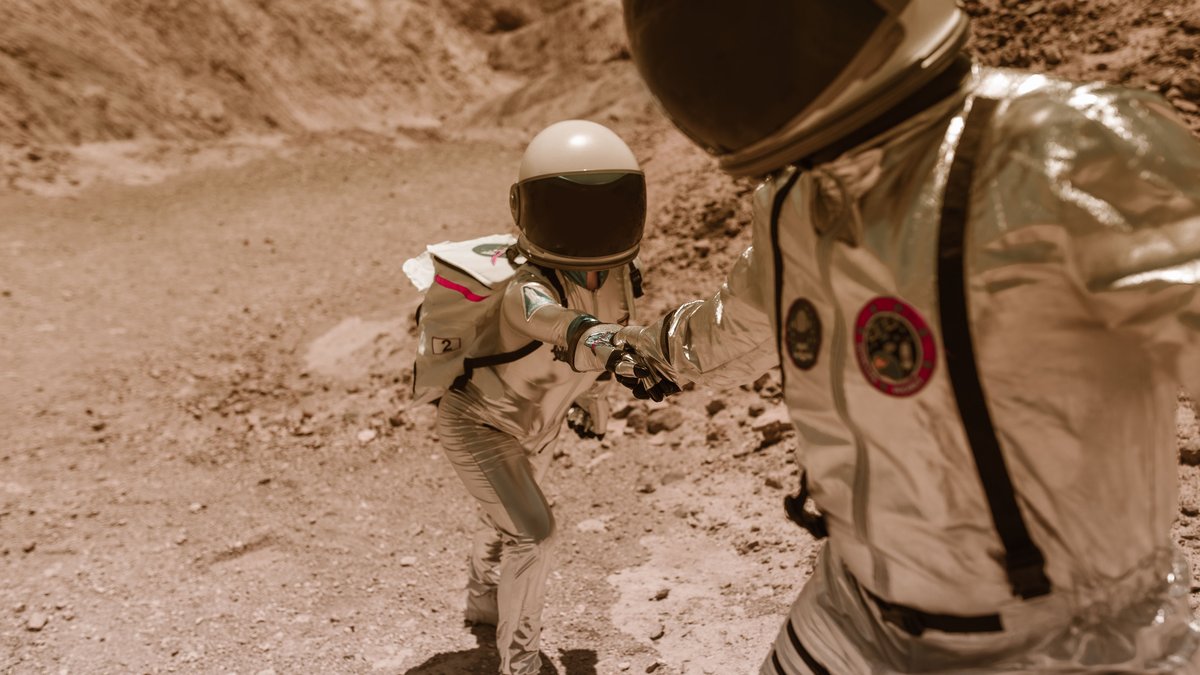
The study followed three six-person crews from HI-SEAS missions 3, 4 and 5, which together produced the full sample of 18 crewmembers. HI-SEAS placed astronaut-like volunteers in a dome on Mauna Loa with limited space, limited resources, mock spacesuits for outside work and delayed communication with mission support. The setting was built to stand in for the social and operational pressure of a long Mars analog mission.
Instead of asking whether one number rose or fell, the researchers built a multi-layer picture of stress. They measured cortisol-related hormones in hair, looked at urine markers tied to dopamine, serotonin, melatonin metabolism and oxidative damage and compared those signals with sleep and activity records from wrist-worn devices. Earlier work from the same HI-SEAS research program had already shown how consumer wearables could reveal changes in sleep and daily movement during an eight-month analog mission.
Each stream had limits. HM5 did not include urine or wearable data, some mission periods had missing records and device changes during the 12-month mission made the final months less directly comparable with the earlier ones. Even so, the authors argued that combining the available streams gave a better read on biobehavioral stress and psychosocial stress than any single measure could provide on its own.
Why the first months looked different
The opening phase did not look calm. The paper describes an early period of elevated alertness and elevated stress hormones, which the authors treated as a form of eustress rather than immediate breakdown. A mission start can bring separation from family, public attention, new routines and the pressure to perform well in a novel setting, so a sharp early stress response does not automatically mean a crew is already struggling.
At the same time, the biological picture suggested that prolonged isolation was already beginning to press on systems linked to mood and motivation. Dopamine and serotonin levels tended to decline across roughly the first three to four months, while testosterone also fell through much of the first half of the mission. The paper connects those shifts to long periods of restricted stimulation, narrow social circles and the daily sameness that can come with confinement.
Earlier isolation research from the 520-day Mars500 confinement study also found that long simulated missions can reshape behavior and psychological state over time. The HI-SEAS paper does not claim that every analog follows the same timeline, but it does place its findings inside a broader pattern in which crews adapt at first, then face a harder middle stretch when novelty fades and the mission still feels far from over.
What changed near month 6
The clearest warning zone arrived around the halfway point and then extended beyond it. In the integrated results, biobehavioral stress was high in the first month and again near the middle of the missions, while psychosocial stress built more gradually and then jumped after the midpoint. For the eight- to 12-month HI-SEAS runs, that meant the roughest patch often emerged after about month 6.
Several measures moved in the same direction. Low physical activity was most common around six to seven months into the missions and higher resting heart rate followed a similar pattern where that measure was available. Perceived stress also rose steadily through the five-to-seven-month window and then stayed elevated. The paper reports that dopamine and serotonin briefly recovered around the halfway point before dropping again near the end, which fits a story of short-lived relief followed by renewed strain.
Oxidative damage markers climbed until about months five to six, then eased, while sleep duration showed a cyclical pattern and later low points. The authors interpret that mix as evidence that chronic stress can spill across multiple systems at once. People may still keep working, exercising and participating socially for a while, yet the hidden biological cost can keep accumulating until the mission enters a more unstable phase.
How team routines started to drift
The paper argues that the second half of these missions was not only a personal stress problem. It was also a team-structure problem. Once crews moved beyond the midpoint, the researchers saw signs of team disruption, including changes in mood, social participation, activity and perceived stress. The authors describe this phase as one in which routines, informal norms and interpersonal balance begin to fray.
One comparison point comes from the classic third-quarter phenomenon, the idea that people in long expeditions often hit a difficult psychological period after the midpoint. The HI-SEAS team did not say that theory fully explained their data. Instead, they concluded that the missions looked closer to a blend of midpoint relief and later volatility, with adverse conditions becoming more likely after halfway rather than lifting cleanly in the final stretch.
By the last quarter, the authors say many crew members appeared to be coping more asynchronously. Some stayed up later, others woke earlier and people seemed to carve out more private time rather than moving through the mission on one shared rhythm. That pattern may reduce friction in the short term, yet it can also weaken the steady group habits that help a six-person crew stay cohesive under confinement.
What the study means for Mars planning
The practical lesson is not that every Mars crew will unravel at one exact date. The stronger lesson is that long-duration isolation can produce a layered stress response that changes form over time. Mission planners who watch only one signal could miss the shift from an early high-alert phase to a later period of social strain, inconsistent routines and worn-down recovery systems.
That is one reason the paper leans so heavily on data integration. The authors used a normalization approach and clustering method to turn uneven data streams into a time-based stress model and related methodological detail is also described in a Purdue dissertation behind the project. For operational spaceflight, the implication is straightforward: crews may need monitoring that combines biology, behavior, sleep and self-report rather than treating each stream as a separate problem.
The study is also careful about its own limits. The sample was small, some measures were missing for one mission and analog habitats cannot capture every demand of real deep-space flight. Even with those constraints, the HI-SEAS data suggest that a crew can look functional on the surface while stress chemistry, sleep timing, social participation and perceived pressure are moving in the wrong direction together. That is a useful warning for any future mission that expects six people to live far from Earth for many months at a time.