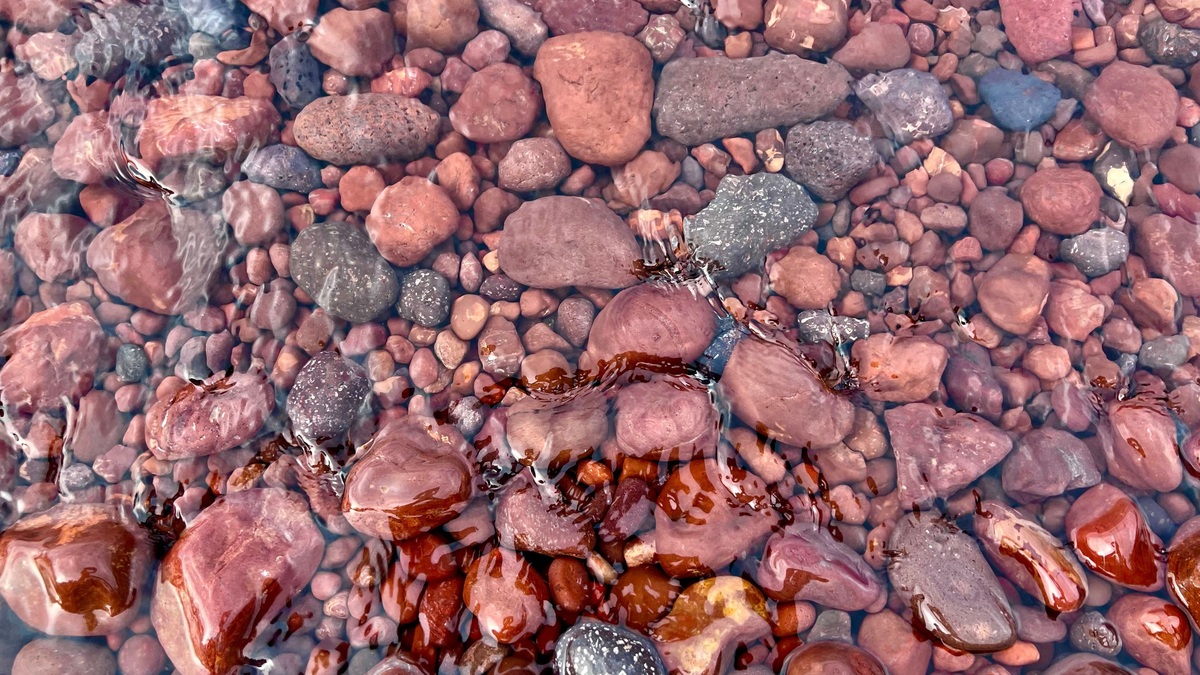
The most useful U.S. Lake Superior beaches for rock hunting include places where limited collecting is allowed and protected shores where visitors may only examine stones. Rules follow the land manager, not the lake as a whole. A beach that looks public can sit inside a state park, national lakeshore or scientific area with very different restrictions.
This guide was checked on August 24, 2026. Muskallonge Lake State Park is the clearest official collecting destination in this selection. McLain State Park requires a local rule check before taking anything. Pictured Rocks, Apostle Islands and Iona’s Beach are look-only sites. Posted notices and ranger instructions always take priority over this summary.
Muskallonge Lake State Park, Michigan: collecting allowed with limits
Manager: Michigan Department of Natural Resources. Status: collecting allowed/limited. The official Muskallonge Lake State Park page says rock collectors use its Lake Superior shoreline and specifically mentions agate picking. The park lies northwest of Newberry and has Lake Superior frontage north of Muskallonge Lake.
Michigan EGLE states that collecting on state-owned land and public-trust land is limited to 25 pounds per person per year. The limit is a yearly total, not a daily allowance at each beach. Local closures and protected resources can narrow the general permission, so check park notices before collecting.
Wave-washed gravel may contain basalt, quartz and jasper, along with occasional Lake Superior agate fragments. A colorful banded pebble still needs careful identification. Wetting a stone can reveal pattern temporarily, but a hand lens and good light provide a better look without breaking it.
McLain State Park, Michigan: verify locally
Manager: Michigan Department of Natural Resources. Status: verify locally. McLain State Park occupies Lake Superior shoreline west of Calumet. Michigan’s current state park directory lists the park and its contact information, confirming DNR management.
The statewide public-land limit may apply where collection is open, but the official material reviewed for this guide did not give McLain a beach-specific collecting statement. Shoreline erosion can also change access. Call the park before the visit and follow any posted closure or no-collection sign.
McLain is valuable even when a visitor chooses to leave every specimen. Keweenaw-area shores expose a varied mix derived from volcanic bedrock and glacial transport. Search loose gravel below the ordinary high-water area without prying rock from an outcrop or disturbing cultural material.
Pictured Rocks National Lakeshore, Michigan: look only
Manager: National Park Service. Status: look only. Pictured Rocks states plainly that collecting beach stones is not permitted. Its official beach guide names rocky and sandy locations such as Hurricane River and the beach below Sable Falls, while repeating the removal ban. Visitors can study colors, textures and sorting where waves rearrange loose material. Photograph the stone beside a scale, then return it to the same place. A specimen found at the waterline remains part of the national lakeshore.
Pictured Rocks also presents serious water and cliff hazards. There are no lifeguards and open-lake water stays cold. Check the marine forecast, remain away from unstable cliff faces and never enter surf to retrieve a rock.
Apostle Islands National Lakeshore, Wisconsin: look only
Manager: National Park Service. Status: look only. Apostle Islands’ laws and policies page prohibits collecting rocks and other natural objects. The rule applies across National Park Service lands within the lakeshore, including island and mainland park beaches.
The national lakeshore is known for sandstone cliffs, sea caves and beaches whose character changes by island. Those features make observation worthwhile without removal. Cultural artifacts and material associated with archaeological sites have additional legal protection and should be left undisturbed.
Access may involve boats, exposed crossings or long walks. Weather on western Lake Superior can change quickly. A rock-hunting plan should never encourage a crossing or landing beyond the visitor’s equipment and experience.
Iona’s Beach Scientific and Natural Area, Minnesota: look only
Manager: Minnesota Department of Natural Resources. Status: look only. Iona’s Beach is a state Scientific and Natural Area recognized for its pink rhyolite shingle beach. Minnesota DNR’s SNA rules prohibit collecting rocks or fossils.
The site demonstrates why a visually tempting beach may need strict protection. Wave action moves the rhyolite cobbles and produces the beach’s distinctive sound. Removing attractive pieces would gradually change the feature visitors came to experience. Photography and careful observation are appropriate. Stay on designated access, avoid rearranging stones and leave bedrock untouched. Minnesota also prohibits rock collecting in its state parks and state recreation areas, so nearby park shorelines should not be treated as collecting alternatives.
Why Lake Superior has such varied beach stones
Lake Superior occupies part of the Midcontinent Rift, where volcanic activity more than a billion years ago produced thick lava flows. Basalt and rhyolite remain prominent around portions of the shore. Later mineral-rich fluids filled cavities and fractures, creating material that includes quartz and agate.
Continental glaciers widened the basin and transported rock from distant sources. Ice deposited mixtures that waves continue to erode and sort. Dense or resistant pebbles may remain after finer sediment washes away, which is why neighboring coves can look very different.
Lake Superior agates formed when silica-rich fluids deposited bands in cavities within volcanic rock. Glaciers later moved them across the region. Minnesota identifies the Lake Superior agate as its state gemstone, but the name does not grant permission to collect one from protected land.
Rocks commonly examined on the shore
Basalt is commonly dark and fine-grained. Some pieces contain pale mineral-filled cavities called amygdules. Rhyolite is usually lighter and can appear pink or reddish, particularly along Minnesota’s North Shore. Granite and gneiss may arrive as glacial erratics from older northern terrain.
Jasper is opaque and often red because of iron minerals. Quartz can be milky or translucent. Unakite, a rock with green epidote and pink feldspar, sometimes appears in Great Lakes gravels, though appearance alone is not enough for a confident identification.
Fluorescent sodalite-bearing syenite is marketed under the name Yooperlite. Michigan EGLE explains that these glacial stones originated from Canada’s Coldwell Alkaline Complex. A long-wave ultraviolet light can reveal fluorescence after dark, provided the search does not disturb other visitors or violate park hours.
How to identify an agate without damaging it
Look for curved, parallel bands and a waxy surface. Some agates show fortification patterns that follow an angular cavity; others have fine concentric bands. Weathered rind can hide much of the interior, so certainty may be impossible from an uncut pebble.
Use a hand lens and compare the specimen with reliable geological references. Do not chip a stone at the beach. Breaking material can create sharp fragments, damage a natural object and violate collection rules even where loose-rock removal is otherwise limited. Argo’s overview of Great Lakes rocks and minerals provides a broader identification starting point. Lake Superior’s geological history differs from Lake Michigan’s, so the source region and local bedrock remain important.
Collection rules that apply beyond the beach
Ask who manages the exact parcel. Michigan’s general 25-pound annual limit applies to state-owned public land and public-trust lands where collection is allowed. It does not override a national park prohibition, a scientific-area rule, a local closure or private ownership.
Private land requires permission. Archaeological objects are not recreational rock specimens and fossils may be protected under separate rules. Avoid digging, powered tools and disturbance of cliffs or vegetation. Take only loose material within the explicit allowance.
For a new location, classify it as collecting allowed/limited, look only or verify locally before arriving. Save the official manager page offline when reception may be poor, then check signs on site. A lack of a sign is not proof that removal is legal.
Lake Superior safety comes before a find
Cold water, breaking waves and unstable cliffs present more immediate risk than specimen identification. Stay out of the surf during storms and keep distance from the water when waves wash high across cobbles. Wet stones can roll underfoot, making a walking stick and sturdy footwear useful.
Never search at the base of an eroding bluff after heavy rain. Watch children closely and keep pets under control where allowed. Tell someone the route, carry layers and leave before darkness unless the site permits night access and the group is equipped for it.
Readers planning a broader trip can consult Argo’s explanation of Lake Superior’s depth and its account of Great Lakes formation. The same ice and bedrock history that created the basin also supplied the stones moving along its shores today.