Lake Michigan beaches hold an unusually mixed collection of stones. Common finds include limestone and dolostone, chert, sandstone, granite, basalt, quartzite and vein quartz. Fossil corals such as Petoskey and Charlevoix stones are prized discoveries. Agate, jasper, conglomerate and other glacially transported rocks also appear, although their abundance changes greatly from one shore to another.
A beach stone is a piece of rock, while a mineral is a naturally occurring substance that may form part of that rock. Granite, for example, is a rock commonly made of quartz, feldspar and mica. Petoskey stone is fossil-bearing limestone rather than a mineral. Keeping those categories separate makes identification more accurate and explains why color alone rarely settles a mystery.
Why so many stones reach the beach
The last continental ice sheets scraped across bedrock, carried fragments south and left them in glacial deposits. Lake waves now erode bluffs and moraines, wash away fine sediment and concentrate heavier pebbles along the shore. Michigan EGLE describes these transported stones as glacial erratics. Some traveled hundreds of miles from the Canadian Shield, while others came from bedrock much closer to the lake.
At Sleeping Bear Dunes, the National Park Service geodiversity atlas explains how wave erosion reworked glacial moraines. Wind carried lighter sand up onto the high dunes, while heavier stones accumulated lower on the beach. The same broad sorting process operates wherever waves attack mixed glacial sediment.
Every beach has its own supply and wave exposure. A sandy reach may reveal few pebbles during calm water, then expose a cobble band after a storm. Northern and eastern shores lie near fossil-bearing bedrock and thick glacial deposits. Western and southern beaches can still yield fossils and erratics, but a named stone associated with northern Michigan is never guaranteed at a particular public access.
Limestone, dolostone and chert
Limestone commonly appears gray, buff or pale brown. It is made chiefly of calcite and may fizz when a fresh surface meets dilute acid, although field collectors should avoid chemical tests on protected land. Dolostone resembles limestone but contains the mineral dolomite and reacts less readily. Both can contain fossil fragments inherited from the shallow seas that covered the region hundreds of millions of years ago.
Chert is a dense, very fine-grained form of silica. It can be white, tan, gray, brown or nearly black and often breaks with smooth, curved surfaces. Some Lake Michigan pebbles have a pale weathered rind around a darker chert interior. Jasper is an iron-rich, opaque variety of microcrystalline silica that is typically red or reddish brown.
Mineral grains may be too small to see in these sedimentary rocks. A hand lens can reveal fossil pieces, crystals and texture, but one diagnostic property is rarely enough. Hardness, luster, fracture and reaction to acid work better together than a comparison based only on a photograph.
Petoskey and Charlevoix stones
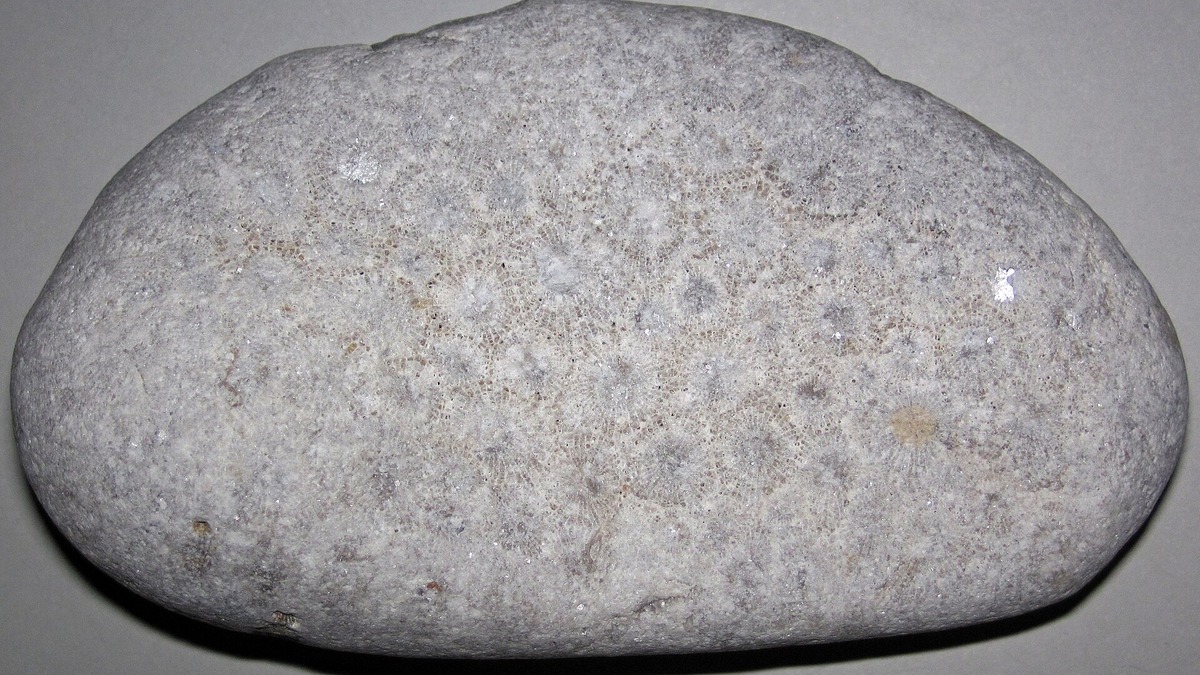
A Petoskey stone contains the fossil colonial coral Hexagonaria. When wet or polished, its tightly packed coral cells often show a radiating, roughly six-sided pattern. Michigan’s official fossil identification page classifies Hexagonaria among extinct rugose corals. The stone formed in Devonian marine limestone, long before Lake Michigan existed.
Charlevoix stone is the popular name for fossil Favosites, an extinct tabulate coral. Its tiny, closely spaced cells create a finer honeycomb than the larger corallites visible in many Petoskey stones. Weathering can blur either pattern, so wetting the surface with lake water often makes the structure easier to see without altering the specimen.
Other marine fossils include horn corals, chain coral, brachiopods, bryozoans and crinoid stem pieces. EGLE notes that most fossils found on Michigan beaches are marine invertebrates. They record ancient tropical seas within the Michigan Basin, not organisms that lived in modern Lake Michigan. For present-day aquatic life, see Argo’s guide to fish in Lake Michigan.
Granite, basalt and quartzite
Granite is usually coarse enough to show interlocking mineral grains. Clear or smoky grains are quartz, pink or white blocky grains are commonly feldspar and dark flakes may be biotite mica or amphibole. A rounded granite pebble can have many color combinations. Its visible crystalline texture separates it from uniform, fine-grained chert.
Basalt is a dark volcanic rock with crystals too small to see easily. Some pieces contain rounded cavities left by gas bubbles in lava. Later minerals may fill those cavities, producing amygdaloidal basalt. Although volcanic bedrock is much more prominent around Lake Superior, ice carried Canadian Shield and northern Michigan material into the Lake Michigan basin.
Quartzite begins as quartz-rich sandstone that heat and pressure weld into a harder metamorphic rock. It is often white, pink, red or purple and tends to break through grains rather than around them. Puddingstone is a conglomeratic quartzite containing conspicuous pebbles, often red jasper, in a pale quartzite matrix. Glaciers distributed examples across Michigan.
Quartz, feldspar and other minerals
Milky quartz forms white, glassy pebbles and veins within other rocks. It scratches glass and lacks the flat cleavage surfaces seen in feldspar. Feldspar itself is widespread in granite and may weather into blocky pink or white pieces. Mica creates thin, reflective flakes, though whole beach pebbles made chiefly of mica are uncommon.
Calcite is the main mineral in limestone and fossil coral. It is softer than quartz and has three directions of cleavage. Iron oxides coat or stain many stones orange, red or brown; the stain does not automatically make a pebble jasper. Magnetite may make a dark stone respond to a magnet, yet magnetism alone cannot identify the surrounding rock.
Agate is banded chalcedony, a microcrystalline variety of quartz that commonly fills cavities in volcanic rock. Lake Superior agates can be carried into the wider glacial landscape, but they are much less predictable around Lake Michigan than on Lake Superior shores. Michigan EGLE’s agate identification advice emphasizes translucent bands, waxy luster and pitted outer surfaces.
How to identify an unknown stone
Begin with texture. Visible interlocking crystals suggest an igneous or metamorphic rock such as granite; layers and fossils point toward sedimentary origins. Next examine hardness. Quartz scratches glass, while calcite can be scratched with a steel blade. Observe luster and fracture on an already broken surface and use a magnet only as one supporting clue.
A wet surface reveals patterns, but a dry specimen better shows luster and weathering. Record the beach and date because location can narrow the source. Avoid breaking, acid-testing or polishing a specimen until ownership and collecting rules are clear. A regional geologist, museum or university earth-science department can help with an unusual find when photographs include a scale and several surfaces.
Online labels can spread errors, especially trade names applied to many unrelated materials. “Leland Blue,” for example, is industrial slag rather than a natural blue mineral. Slag can contain bubbles, glassy flow textures or rusty metal and it records the region’s smelting history. Its presence alongside natural pebbles is another reason to examine structure rather than rely on color.
Collecting rules protect special places
Permission depends on who owns and manages the shore. Michigan states a limit of 25 pounds of rocks, minerals and fossils per person per year from state-owned land, while local rules may be stricter. EGLE’s beach fossil guidance tells collectors to check the rules for each site. Private property requires the owner’s permission.
National Park Service sites protect natural and cultural resources. The NPS states that recreational rock and fossil collecting is generally prohibited throughout the park system, with narrow exceptions outside the Lake Michigan region. Underwater artifacts and historic objects receive additional legal protection. Leave anything that may be archaeological or part of a shipwreck in place and report it to the land manager.
Responsible collecting also avoids dunes, bluffs and sensitive habitat. Digging accelerates erosion and can damage plants. Surface observation and photographs preserve the place while still allowing identification. The geological story begins with how the Great Lakes formed and continues through land use across the Lake Michigan watershed. Shore protection and habitat change are examined in Great Lakes habitat loss.
A beach is a moving geologic sample
The most useful identification guide treats each pebble as evidence. Fossil limestone records Paleozoic seas, crystalline erratics point toward northern source rocks and rounded surfaces reveal transport by ice and waves. Industrial slag adds a much younger human layer. A Lake Michigan beach can therefore place rocks of very different ages and origins within a few feet of one another.
Expect limestone, dolostone, chert, sandstone, granite, basalt, quartzite and quartz to account for many finds. Petoskey and Charlevoix stones are fossils within carbonate rock; agates and jasper are silica-rich materials with distinct textures. Confirming a name takes several properties and collecting remains secondary to ownership rules and protection of the shore.