How can a crew member who works a regular daytime shift still look almost as sleepy as a watchkeeper who stands night duty? A 2019 BMJ Open study followed 198 seafarers on 18 container-ship voyages and found that life at sea cut sleep for both groups, with watchkeepers averaging 5.5 hours per day and day workers only slightly higher at 5.8 hours.
The paper came from the Institute for Occupational and Maritime Medicine in Hamburg and used two kinds of evidence at once. Researchers tracked sleep with a SenseWear armband monitor for at least 72 hours during sea passage, then checked alertness before and after shifts with pupillometry, an eye-based test that measures small spontaneous changes in pupil diameter linked to drowsiness. A matching PubMed record confirms the publication details.
Results from the eye tests made the fatigue problem hard to wave away. Out of 396 pupillometric examinations, 88 landed in the study’s unfit for duty range and another 110 were labeled as needing particular attention. Half of all checks therefore fell outside the normal band, even before anyone tried to connect those readings to ship safety, port schedules, or night watches.
Why the study looked at the whole crew
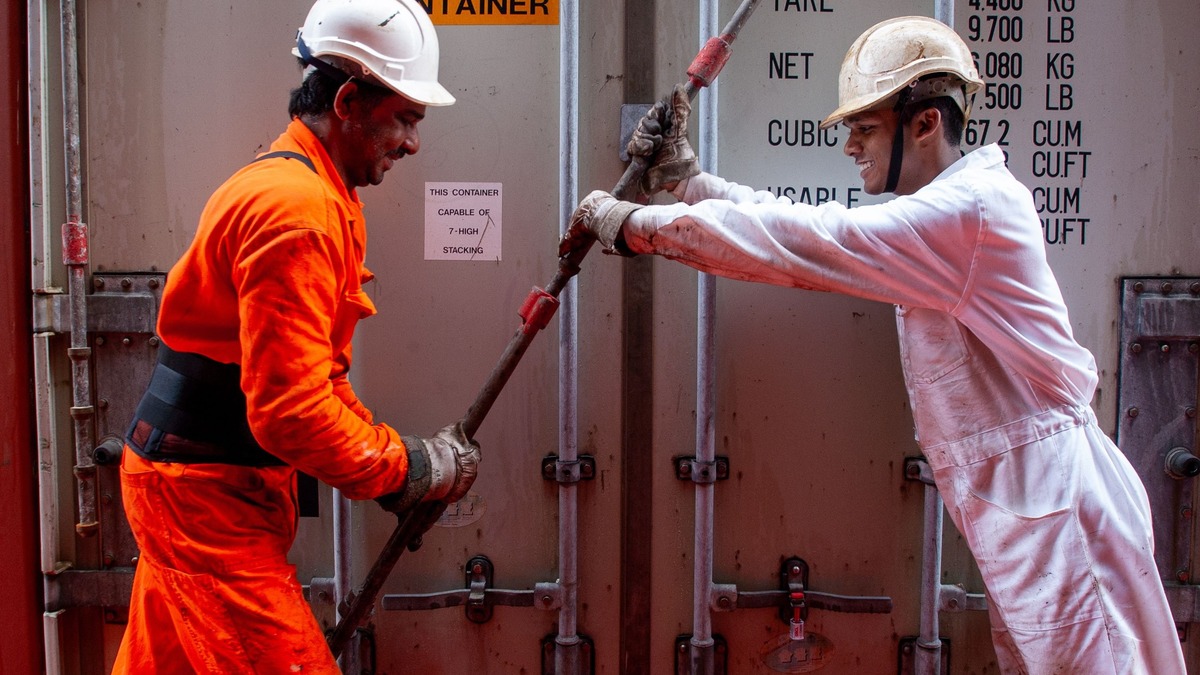
Most maritime fatigue studies have centered on officers who work through the night, so this project widened the frame. The sample included 75 day workers, mainly engine room staff, electricians and galley crew, plus 123 watchkeepers, made up of nautical officers and deck ratings. A medically trained scientist traveled with the vessels in the Baltic Sea and examined crews onboard instead of relying on distant surveys or memory alone.
Field work matters here because shipboard fatigue is built from ordinary conditions rather than a single crisis. The paper describes sea passage as the phase when day workers can often keep an eight-hour schedule, while watchkeepers rotate through a 24-hour system, usually four hours on and eight hours off. Even so, both groups live in the same noisy, vibrating environment and both remain inside the same restricted floating workplace for months at a time.
The participation rate was high enough to make the findings harder to dismiss as a narrow snapshot. Two hundred six of 225 seafarers joined the study, a 91.6 percent response rate and 198 were included in the cross-shift analysis because each of them completed pupillometry both before and after a shift. That design let the researchers compare workers across the crew and also compare each person against his own shift start and shift end.
Sleep was short even before the shift began
Numbers from the armband monitor show how compressed rest had already become by the time the tested shift started. Across the sample, cumulative sleep time during the previous 24 hours averaged 5.6 hours and watchkeepers slept significantly less than day workers. The difference between 5.5 and 5.8 hours may sound modest at first glance, yet both figures sit well below what many adults need for steady alertness.
Sleep quality slipped as well. During the examined shift period, average sleep efficiency was 69.3 percent for the whole crew and the abstract reports 69.6 percent overall. Watchkeepers had the weaker sleep efficiency of the two groups, a gap the authors still found after adjusting for age, rank, time of day and how long the seafarer had already been onboard.
Earlier research on maritime schedules has pointed in the same direction. A Chronobiology International study on 6/6 and 4/8 watch systems also found that alertness erodes under these work-rest patterns. The new BMJ Open paper adds something broader: day workers were not protected enough by their daytime schedule to escape the sleep squeeze that came with shipboard life.
Sleepiness climbed during the work period
Subjective ratings moved upward over the course of a shift. Before work began, the mean Stanford Sleepiness Scale score was 2.6. After the shift, it rose to 3.2, a statistically significant increase. Watchkeepers showed the clearest rise even though their selected watch period was shorter than the average day-worker shift, which suggests that the timing of work can bite harder than its raw duration.
One detail stands out because it captures the sharper edge of the problem. After their shift, 35 seafarers, or 17.7 percent of the sample, rated themselves at level 6 or 7 on the Stanford scale, which corresponds to fighting sleep or being very close to sleep onset. Among watchkeepers, the midnight-to-4 a.m. watch and the 4 a.m.-to-8 a.m. watch produced the heaviest burden, with severe post-shift sleepiness reported by 72.2 percent and 50.0 percent of those groups.
A 2017 review in International Archives of Occupational and Environmental Health concluded that night work was usually the most fatiguing part of seafaring. The present study fits that pattern, but it also broadens the concern. Day workers did not escape daytime sleepiness and younger seafarers in this sample reported recent daytime sleepiness more often than older colleagues.
The eye test showed a larger problem than self-report alone
Pupillometry adds weight because it does not depend on whether a tired worker chooses to downplay his own condition. The crew completed 396 eye-based tests, one before and one after the target shift. Researchers classified 88 examinations, or 22.2 percent, as unfit for duty and another 27.8 percent as requiring particular attention, which left only half of all examinations in the normal range.
Several details make those results harder to shrug off. Twelve seafarers actually fell asleep during the examination and were therefore counted as unfit for duty. The average pupillary unrest index did not swing sharply from pre-shift to post-shift for the sample as a whole, yet watchkeepers still trended somewhat higher after duty and the overnight watch periods again showed the heaviest burden inside that group.
The method also has outside support. A Journal of Sleep Research paper published the same year described pupillary instability as an accurate objective marker of alertness failure and performance impairment. That does not mean the maritime study can predict every mistake on a bridge or in an engine room, but it strengthens the claim that these eye-based signals track a real loss of alertness rather than a vague feeling.
Time onboard may wear crews down further
The most revealing pattern may be the one that built up slowly. The amount of time already spent on the vessel at the moment of testing was significantly associated with the pupillary unrest index. Seafarers who had been onboard for more than five months showed a much higher pre-shift index, 1.32, compared with 1.08 among those with a shorter stay. The Epworth Sleepiness Scale also rose with length of stay onboard.
That result points toward cumulative strain rather than one bad night. The paper did not find a meaningful link between the objective eye-test score and the previous day’s cumulative sleep time, sleep efficiency, or the ship’s motion parameters recorded in the journal. Months at sea appear to matter in their own right, probably through a mix of restricted recovery, repeated circadian disruption and the mental drag of living where one works.
Limits remain. The study was cross-sectional, so it cannot map long-term cause and effect with the certainty of a longer follow-up. Crew jobs were also heterogeneous, which complicates direct comparison. Even with those caveats, the findings are unusually concrete: short sleep, low sleep efficiency, rising shift sleepiness and abnormal eye-test results were spread across the ship, not confined to one glamorous job title. For shipping companies, the message is plain enough. Fatigue control has to cover the whole crew.