Sixty students took part in a pilot experiment built around a simple question: can a convincing view of Earth from space make ordinary people feel closer to the natural world after just one session? According to the final results, the answer was yes for the group that watched a virtual journey around the planet, while a same-length relaxation session left scores almost unchanged.
The paper, published on June 5, 2024 in Frontiers in Virtual Reality, tested a pilot study at the University of Stirling. Researchers compared a spaceflight-style program from EarthscapeVR with a guided meditation control. They measured change with the Nature Relatedness Scale, a questionnaire designed to capture how strongly people feel linked to the living world around them.
What the students actually saw
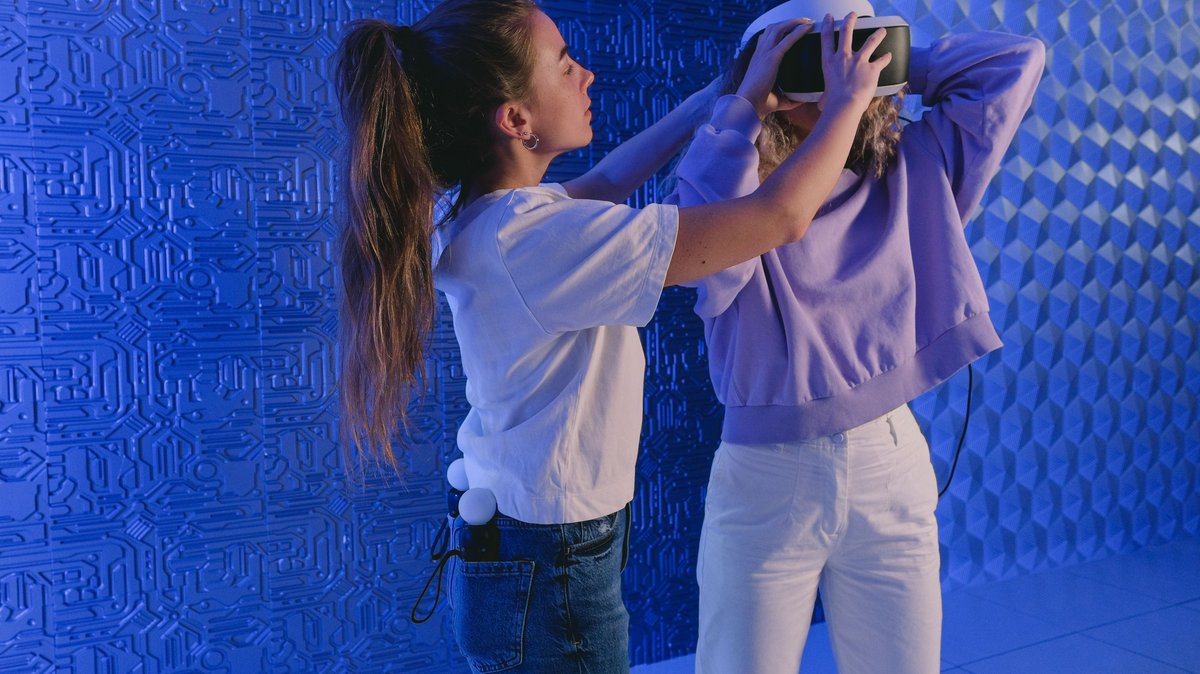
Participants were randomly assigned to one of two virtual reality sessions. One group watched a 25-minute, 180-degree simulation inspired by the overview effect, the psychological shift many astronauts describe after seeing Earth from outside the atmosphere. The other group spent the same amount of time inside a calm guided meditation program, which gave the researchers a way to compare the space view against a relaxing but less planet-focused experience.
In the experimental session, students were shown Earth as a whole world set against space, with day and night views meant to encourage awe and perspective. The paper says the presentation used sound and narration to deepen the emotional tone, but it remained a passive viewing experience rather than a game or task. That matters because the result came from a brief act of watching and reflecting, not from practicing outdoor skills or learning new environmental facts.
Before and after the session, both groups filled out the same scale. The authors also checked openness to experience, a personality trait that earlier research has linked with stronger nature connection. By measuring both pieces, the study could test whether the virtual Earth view appeared to move nature-relatedness on its own, or whether the result mainly reflected which students already tended to be curious, imaginative and emotionally receptive.
Why the virtual Earth view raised nature scores
The central result was direct. Students in the overview-effect condition showed a statistically significant rise in nature-relatedness, reported as p < 0.0021, while the meditation control showed no meaningful change. The authors frame that result carefully, because a pilot with 60 people cannot settle the whole question, but it does suggest that a short virtual encounter with Earth from orbit can push people toward a stronger sense of belonging within nature.
One reason the idea is plausible appears in the paper’s background research. A recent NASA overview-effect account collects astronaut descriptions of Earth as borderless, fragile and shared by everyone below its thin atmosphere. The Stirling team tried to reproduce a small part of that perspective in a headset. Their argument is that the orbital view can loosen the usual ground-level habit of seeing nature as scenery and instead place the viewer inside one connected planetary system.
The article also links the finding to a wider psychological literature on human-nature connectedness. In that literature, people who feel more tied to nature often report stronger wellbeing and more concern for environmental action. The paper cites a 2021 meta-analysis that reviewed more than 147 correlational studies and found that stronger nature connection consistently tracked with pro-environmental behavior. The virtual overview experience did not measure later action directly. It did move one of the attitudes that many researchers treat as an important precursor.
Why the meditation control stayed flat
Relaxation by itself was not enough to move the scores. The control session was immersive and equally long, yet its result was reported as p = 0.97, which is about as close to no measurable change as a study can get. That contrast gives the space-view intervention more weight, because it suggests the rise did not happen merely because students wore headsets, sat quietly, or expected to feel different after participating.
Another useful point is that the control content was designed to calm the viewer, whereas the overview-effect session tried to produce awe, self-transcendence and a broad planetary frame. Those are more specific emotional ingredients than ordinary relaxation. When the experimental session worked better than meditation, the likely active ingredient was the shift in perspective created by looking back at Earth as one whole place, not virtual reality as a gadget.
Researchers have been interested in that distinction for years because the overview effect carries a long cultural history. On June 14, 2024, NASA Science’s remembrance of Bill Anders described how the Apollo 8 Earthrise image helped millions of people share a version of the same orbital awe. The Stirling study takes a smaller, more controlled step. Instead of asking whether a famous image can inspire people in public memory, it asks whether a designed simulation can nudge the same emotional direction in a lab setting.
What the openness result did and did not show
The personality result was more modest. The authors expected that students who scored higher on openness might also score higher on average nature-relatedness, but the correlation they reported was weak, at r = 0.137. In plain terms, being more open to new experience did not clearly explain who ended up with the strongest nature-connection scores in this sample.
That weak relationship is useful because it narrows one easy explanation. If the whole result had been driven by a few highly open participants who were already primed to respond well to unusual imagery, the intervention itself would look less important. Instead, the paper suggests that the virtual Earth view may have had an effect that cannot be reduced to personality alone, even though earlier studies have often found some positive link between openness and nature connection.
Earlier astronaut-focused work also points in that direction. A Journal of Environmental Psychology study cited by the paper examined environmental attitudes and behaviors in astronauts after spaceflight. The Stirling experiment does not claim equivalence with real missions and it should not. Still, the lack of a strong openness signal leaves room for the idea that the act of seeing Earth from above, even in simulation, may itself be a meaningful psychological event.
Where the pilot study still needs stronger evidence
The paper is strongest when it stays cautious. This was a student sample, not astronauts and the intervention lasted one session rather than weeks or months. The study measured a change immediately after the video, so it cannot tell us whether the effect lasts, fades by the next day, or leads to any practical behavior such as donating, conserving, voting differently, or spending more time outdoors.
Method matters here as well. Nature-relatedness was measured through self-report, which is standard in this field but still limited by mood, expectation and the desire to answer in a socially appealing way. The trial also used a specific commercial simulation and a specific control, so future work will need to test whether the result holds with other kinds of virtual spaceflight, stronger comparison groups and participants beyond university recruitment pools.
Even with those limits, the finding is worth attention because it offers a low-cost way to study a psychological state that is otherwise available only to a tiny number of space travelers. If later studies can repeat the result with larger samples, longer follow-up and real measures of pro-environmental behavior, then a brief orbital view in VR could become a practical tool for education, conservation outreach and mental reframing around Earth’s shared vulnerability.