A study in Frontiers in Psychology found that schoolchildren could feel a version of the overview effect without leaving the ground and that the emotional lift tied to that experience helped explain who learned the most afterward. The hook was space, but the central result sat in psychology. Children who felt stronger awe and a stronger shift in perspective during a virtual trip around Earth showed better learning gains on a knowledge test about space science.
The research team from Tilburg University wanted to know whether a feeling long associated with astronauts could be recreated in ordinary classrooms through virtual reality. Their answer was careful but clear. The simulation raised awe scores above neutral, raised overview-effect scores above neutral and linked those responses to learning, especially for children who started with less prior knowledge. The paper even states that the experience “yields learning gains in the domain of astrophysics,” a short line from the abstract that captures the study’s core claim.
Space still matters in the story because Earth from orbit gives the emotion its trigger. Yet the stronger lesson from the paper is that education may benefit when a lesson makes children feel small in a good way, deeply curious and newly aware of how much more there is to understand. Those ideas fit a long-running awe framework that describes awe as a response to vastness that forces the mind to adjust.
What the children actually experienced
The project used SpaceBuzz, a Dutch educational program built around a trailer-sized rocket mock-up and a guided virtual flight. In the study, 233 children from eight classes in six schools in the Netherlands took part. After questionnaires were checked and incomplete records were removed, 188 children entered the main analysis and five more extreme outliers in the learning scores were later excluded, leaving 183 for the structural model. The average age was 10.68 years, which places the study squarely in late primary school.
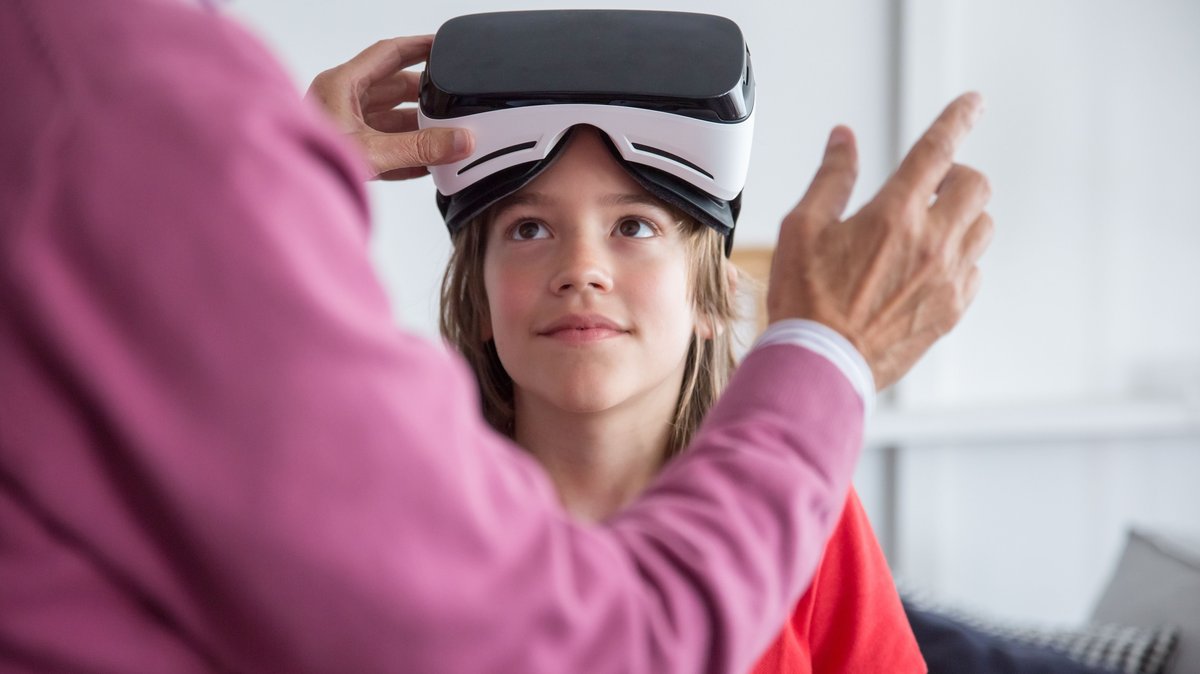
Before the virtual flight, the children completed either four or six lessons covering the universe, planets and satellites. They also answered questions designed to measure traits such as dispositional awe and compassion. During the trip itself, the children sat in groups of nine on moving seats and wore HTC VIVE Pro headsets while a 14-minute, 25-second simulation carried them into orbit. André Kuipers, the ESA astronaut used as the ship’s virtual guide, narrated the journey as Earth rolled into view below them.
Inside the simulation, the children first launched from Earth, then orbited the planet while the program discussed deforestation, excessive fishing and pollution. A short lunar detour followed before the virtual craft came home. Researchers also recorded gaze direction, using the angle between each child’s head direction and the area of interest when Earth first appeared. That gave the team a behavioral check alongside the questionnaires, which helped because awe is often hard to capture with numbers alone.
After landing, the children filled out more questionnaires, including a simplified measure of presence, the feeling of really being inside the virtual setting. They also completed a post-test with space-science questions that could be matched to earlier questions from the pre-test. Only eight content-matched items were used for the learning analysis, which helped the researchers avoid treating simple memory of the same wording as genuine learning.
How awe fed the overview effect
The paper starts from a simple idea: seeing Earth from far away can change how people feel about themselves, other people and the planet. Astronaut accounts gave that experience its name, but the authors treated it as a set of measurable psychological responses rather than a mystical event. In their framing, the virtual view of Earth could spark awe, compassion, self-transcendence and a new sense of connection. Earlier awe research also ties the emotion to a smaller sense of self and stronger collective engagement.
The children’s scores supported that model. Average awe reached 4.49 on a five-point scale and the overview-effect score reached 3.58, with both values significantly above neutral. In the structural equation model, dispositional awe strongly predicted the overview effect with a beta of 0.34 and a probability below 0.001. Dispositional compassion also predicted the effect, though less strongly, with a beta of 0.18 and a probability of 0.005. The emotional groundwork was already visible before the lesson score was even considered.
Presence played a smaller but still meaningful role. Children who felt more immersed in the virtual ride tended to report a stronger overview effect, with a beta of 0.16 and a probability of 0.018. The link from dispositional awe to presence was weaker, at beta 0.11, though it still cleared the statistical threshold used in the paper. Put plainly, some children arrived more ready to be moved and the headset experience gave that readiness a place to land.
Another clue came from where the children looked. A smaller gaze angle, meaning attention held closer to Earth when it first came into view, was associated with a stronger overview-effect score. The effect size was small, but it survived the model with a probability of 0.047. That detail helps the paper move beyond self-report. The strongest reactions were not only what children said after the ride, but also where their attention stayed during the most awe-heavy moment.
Why the learning gains were selective
The study did not show a giant jump for every child. Instead, it found a more interesting pattern. A simple regression showed only a trend between the overview effect and overall learning gains, with a probability value of 0.058, which falls just short of the usual cutoff. Once the researchers split the group by prior knowledge, the picture sharpened. Children who had scored lower on the pre-test showed significant gains linked to the overview effect, while children who already scored high did not show the same benefit.
The final model strengthened that reading. The path from the overview effect to proportional learning gains reached beta 0.22 with a probability of 0.031, which the authors interpreted as evidence that the feeling itself supported learning. The result fits the paper’s wider argument that awe can open the mind when a child meets something too vast or surprising to fit comfortably into old mental models. For a student who already knows many of the facts, that opening may be narrower.
Learning also sat inside a broader educational design, not a bare headset test. The children had pre-flight lessons, the virtual trip and post-flight classroom work that included science and the idea of a world without borders. That is one reason the paper should not be reduced to a claim that VR alone teaches astrophysics. The program used an educational package listed by Tilburg University and the virtual flight was one component within that package.
Even so, the psychological angle remains the most useful part of the result. The study suggests that children may learn more from a lesson when the content first shifts their point of view. Space offers that shift almost automatically because Earth from above feels vast, fragile and suddenly shared. The researchers did not claim that facts become secondary. Their evidence suggests that emotion can help prepare the mind to absorb those facts, especially in students who have more room to grow.
What the study leaves unresolved
Several limits keep the findings grounded. The work was done in one country, with one program, in a narrow age band. The reliability values for some questionnaires were acceptable rather than strong and the overview-effect measure was built around attitudes and self-report rather than a direct long-term behavior check. The headline result on learning was also conditional, since the strongest benefit appeared among children with lower starting knowledge rather than across the full sample in the same way.
Another open question is how much of the effect belongs to virtual reality itself and how much belongs to the surrounding lesson design. The study bundled pre-flight training, the ride, post-flight activities and social discussion. A cleaner experiment could separate those pieces and test whether the same emotional lift appears with a simpler video, a planetarium dome, or a different form of immersive teaching. It could also ask how long the changed perspective lasts after the novelty fades.
The paper still earns attention because it treats awe as more than a pleasant extra. In this study, awe was part of the mechanism that linked a dramatic view of Earth to measurable school learning. For educators, that means the most effective lesson may not be the one that only delivers information. A well-built lesson can also widen the child’s frame of reference, make old assumptions feel too small and create the mental opening that new knowledge needs.