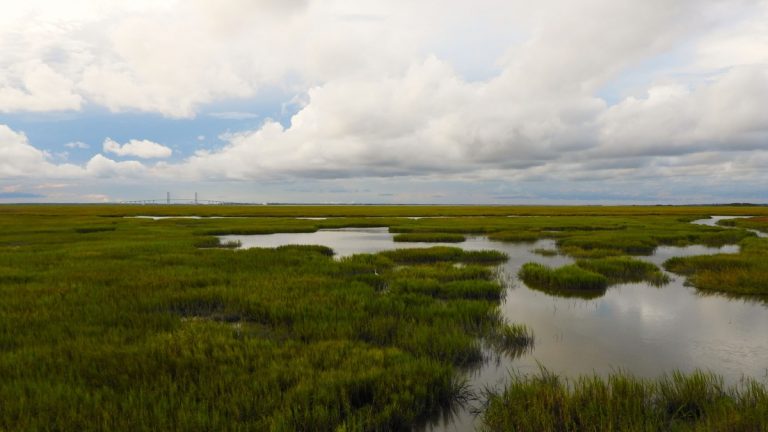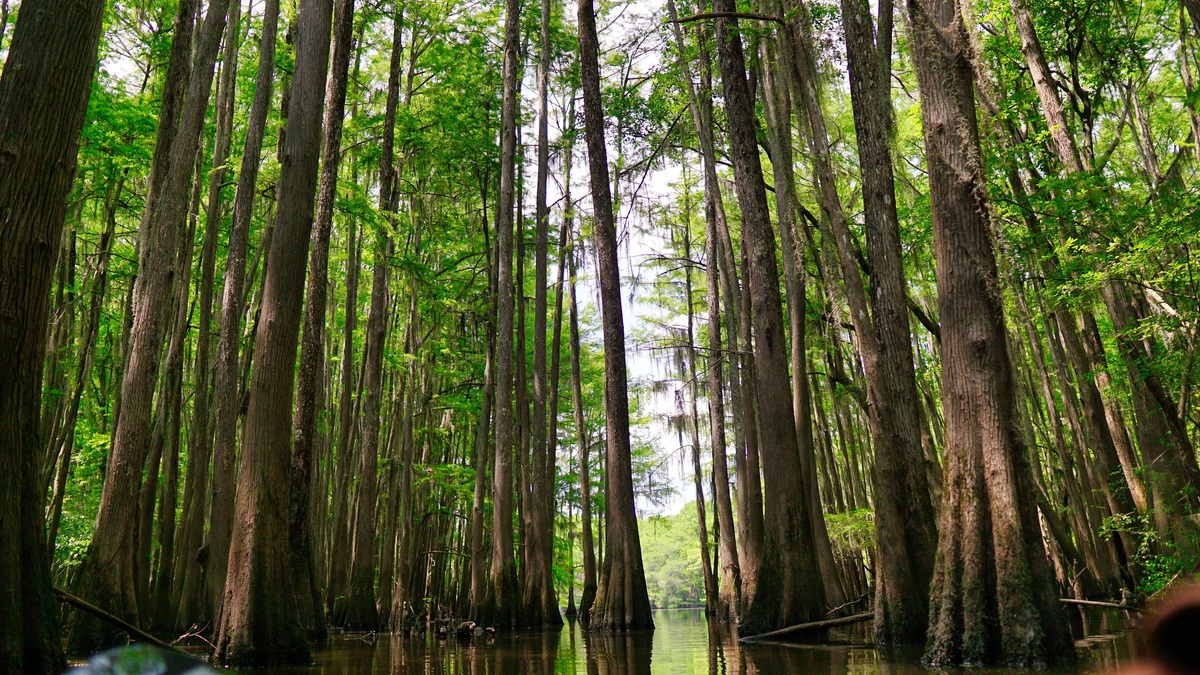
Trees that grow in wetlands include bald cypress, water tupelo, swamp tupelo, black willow, red maple, river birch and several flood-tolerant oaks. A wetland dominated by trees is normally called a swamp or forested wetland. Marshes are dominated by herbaceous plants, although trees may grow along marsh margins, on raised hummocks or within neighboring floodplains.
No tree tolerates every wetland condition. Species differ in their response to growing-season flooding, moving water, salinity and oxygen-poor soil. Many survive seasonal inundation but decline under permanent deep water, especially when young roots or seedlings cannot reach oxygen.
Tree-dominated wetlands are usually swamps
The EPA classification of wetlands separates herbaceous marshes from swamps dominated by shrubs or trees. “Forested wetland” is also used in mapping when woody vegetation above a defined height covers enough of the site.
A marsh edge can still contain scattered willow or maple. Local hummocks lift roots above prolonged flooding and natural levees offer slightly drier soil beside a channel. Once trees dominate the upper layer, the site is more clearly described as swamp or forested wetland.
The difference is ecological rather than cosmetic. A canopy reduces light and supplies leaf litter. Falling branches add woody debris that shelters animals and redirects flow. The trees also reveal a flooding regime compatible with establishment and survival.
Bald cypress handles seasonal flooding
Bald cypress grows in southeastern floodplains and river swamps, including isolated basin wetlands. It sheds its needles each year despite being a conifer. Broad trunk bases provide stability in saturated soil and woody knees often rise from roots in wet settings.
A USDA ecological-site description places bald cypress in seasonally flooded alluvial forests associated with free-flowing streams. Flood duration and water movement help determine whether it shares the canopy with tupelo or with bottomland hardwoods.
Mature trees can withstand long inundation. Germination requires exposed soil or very shallow water, however, because a submerged seedling cannot maintain gas exchange indefinitely. Permanent water can therefore stop forest replacement even while old trunks remain alive.
Bald cypress does not require standing water. It also grows on moist alluvial soil, so the species should be interpreted with soil and hydrologic evidence rather than treated as proof of permanent flooding.
Water tupelo and swamp tupelo occupy wetter basins
Water tupelo is characteristic of deep southern swamps and sloughs, including floodplain depressions. Its swollen base anchors the tree in soft soil. Fruits and flooded forest structure provide wildlife resources.
Swamp tupelo overlaps in the Southeast but also occupies acidic basin swamps and wet flats. The names are easy to confuse because both belong to the genus Nyssa. Site hydrology and region are more reliable guides than the word “tupelo” alone.
USDA descriptions of cypress-tupelo swamp forest show these species sharing canopy space where flooding is frequent. Prolonged deep water still filters which seedlings survive.
Tupelo seeds can move with floodwater, yet establishment depends on water receding at the right time. A forest may therefore reproduce successfully during one sequence of years and fail during another.
Black willow colonizes wet, disturbed ground
Black willow grows along streambanks, lake margins, sandbars and recently deposited floodplain surfaces across much of eastern North America. Flexible stems and rapidly rooting cuttings help it colonize places rearranged by water.
The species favors moist, open soil with abundant light. It often appears early after a bar forms or a bank is disturbed. Later forest development may shade it as slower-growing hardwoods establish on higher surfaces.
Willow roots can help bind sediment, but a tree does not make an eroding bank permanently stable. A migrating channel may undercut the roots. Ice or a large flood can then remove whole stands.
The USDA black willow profile shows a wide range across the United States. Local presence still depends on bare, wet ground and adequate light.
Red maple spans many wetland types
Red maple occupies an unusually broad range from upland forests to swamps. Within wetlands, it occurs in red maple swamps and on floodplain margins where water levels fluctuate. Its tolerance varies among populations and life stages.
The USDA red maple profile documents its wide distribution. Presence alone does not prove a site is continuously flooded, because the species also grows on mesic and sometimes relatively dry soil.
Red maple becomes common where drainage changes or fire is suppressed in some wetland landscapes. Interpreting it requires the surrounding plant community, soil indicators and water regime.
Floodplain hardwoods follow elevation
Floodplains contain subtle ridges and swales below higher terraces. River birch and silver maple often occupy active river margins or low alluvial surfaces. Green ash and American elm share parts of that forest, while cottonwoods specialize in open depositional ground.
Oaks sort along the elevation gradient. Overcup oak and water oak tolerate wet bottomlands, while species with lower flood tolerance occupy natural levees or higher terraces. A difference of less than a meter can change how long roots remain saturated.
Flood timing is as important as depth. Dormant-season inundation may cause less injury than warm-season flooding, when roots and leaves need more oxygen. The relationships connect directly with river habitat and floodplain exchange.
Seedlings usually define the future boundary more clearly than mature trunks. An old tree may survive a newly altered water regime for years even when no young individuals can replace it.
Northern and boreal wetlands support other trees
Black spruce and tamarack grow on peatlands across northern North America. Tamarack is a deciduous conifer that drops its needles. Black spruce may remain stunted because acidic peat supplies few nutrients, while cold waterlogging restricts its roots.
Northern white cedar occupies groundwater-influenced swamps where mineral supply is greater than in a rain-fed bog. Atlantic white cedar forms distinctive wetlands along parts of the Atlantic coastal plain. Each name covers a regional habitat rather than a promise that the tree grows in every swamp.
The National Park Service describes conifer swamps and bogs as separate wetland communities at Pictured Rocks. Tree cover can occur in peatlands, but hydrology decides whether the technical classification is swamp, fen or wooded bog.
Coastal forested wetlands face salt
Freshwater forested wetlands can occupy the landward side of tidal marshes. Storm surges or sea-level rise introduce salt that many hardwoods cannot tolerate. Repeated exposure may kill trees and create standing dead forests sometimes called ghost forests.
Mangroves are woody tidal wetlands in warmer climates. Their roots tolerate saline water while obtaining oxygen in saturated sediment. They are commonly classified as mangrove swamps rather than marshes. The EPA coastal wetland overview distinguishes mangrove swamps from salt marshes dominated by grasses.
Match species to the water regime
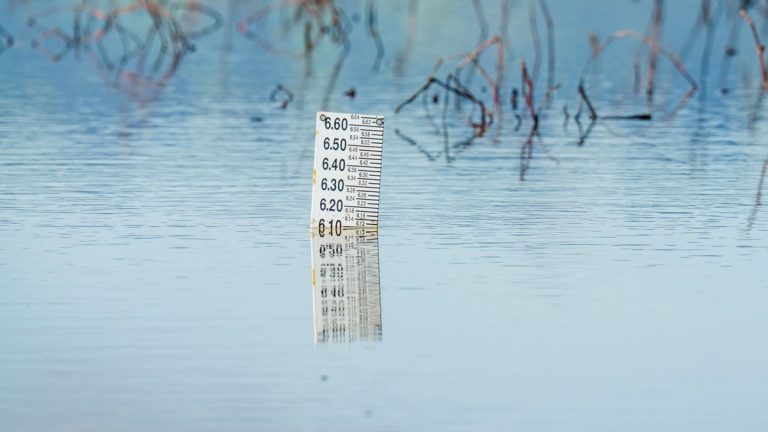
A planting list cannot substitute for site hydrology. Managers measure maximum water depth and the duration of flooding, then determine whether water is stagnant or moving. Soil texture and salinity further narrow suitable species, as do winter cold and herbivory.
Restoration also needs a future hydrologic range. A species chosen for today’s average level may fail if a dam changes flood timing or sea-level rise increases salt exposure during its lifetime.
The surrounding wetland landform provides the setting. A tree in a river floodplain experiences sediment and flowing water, while one in a closed peat basin depends more on precipitation or groundwater. The marsh and bog comparison explains why plant form alone cannot resolve every wetland name.
Wetland trees survive through combinations of shallow roots, flood-tolerant metabolism, rapid colonization or access to raised microsites. Their adaptations have limits, which is why a healthy forested wetland contains distinct zones rather than the same trees across permanent water and dry upland.