Marine biology focuses on living organisms in saltwater environments, from microbes and algae to fish and whales. Oceanography studies the ocean as a whole system, including its life, chemistry, circulation, climate interactions and geology. Marine biology is therefore organism-centered, while oceanography is a broader Earth science with a biological branch.
The boundary is permeable. A scientist studying coral reproduction may identify as a marine biologist; a researcher measuring how temperature and nutrients control plankton across an ocean basin may identify as a biological oceanographer. Job titles, university departments and research questions vary across countries and institutions, so the practical difference lies more in emphasis and scale than in a universal rule.
The scope of marine biology
Marine biologists investigate how marine organisms function, develop, behave, reproduce, evolve and interact. Their work spans molecular biology, physiology, taxonomy, genetics, ecology and conservation. A project might examine a sea turtle’s migration, disease in coral, fish population genetics, kelp forest recovery, or microbes living around a hydrothermal vent.
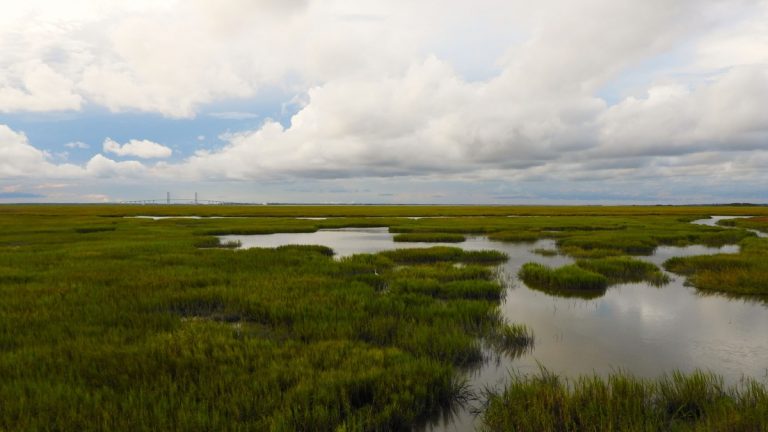
The term “marine” includes oceans as well as coastal salt marshes, estuaries, mangroves and other environments influenced by seawater. Some studies center on one species; others examine communities or food webs. Argo’s overview of ocean zones shows how light, pressure, temperature and food availability divide the water column into very different biological settings.
The scope of oceanography
Oceanography applies several natural sciences to the ocean. NOAA identifies four intertwined branches: biological, chemical, geological and physical oceanography. Researchers often collaborate across those labels because currents transport nutrients, seabed geology changes seawater chemistry and organisms affect carbon cycling.
Physical oceanography examines waves, tides, currents, mixing, air-sea exchange and the transmission of light and sound. Chemical oceanography investigates dissolved substances, reactions, pollutants, gases and elemental cycles. Geological oceanography studies the seafloor, sediment, tectonics and ocean-basin history. Argo’s geological oceanography explainer covers that branch in detail.
Where biological oceanography overlaps
Biological oceanography is the closest overlap. The MIT-WHOI Joint Program defines it through the distribution, abundance and production of marine species and the processes governing them. Questions often concern plankton productivity, microbial cycling, food-web structure, carbon export, or how organisms respond to changes across large areas.
Marine biology can address the same subjects. One useful tendency is that marine biologists often begin with an organism or biological process, while biological oceanographers often begin with a process operating within the ocean system. Yet a coral ecologist, fisheries scientist, or microbial ecologist could fit comfortably in either community.
Methods overlap too. Both may use field observations, experiments, genetic sequencing, underwater cameras, acoustic instruments, remote sensing and computer models. Institutional history and the researcher’s training frequently determine the label more than the equipment does.
Typical research questions
A marine biologist might ask how an octopus controls camouflage, which nursery habitat a fish uses, or how warming affects a species’ reproduction. Population biologists estimate abundance and survival. Physiologists study how bodies function. Ecologists measure relationships among organisms and their surroundings, while taxonomists describe and classify species.
An oceanographer might ask how heat moves between ocean basins, why an oxygen minimum zone expands, how nutrients reach surface waters, or how sediment records past climate. A biological oceanographer could ask how an upwelling event changes plankton production and transfers carbon into deeper water. The question links organisms to circulation and chemistry across space and time.
Both fields study environmental stress. Salinity, temperature, pressure, light, oxygen and substrate are abiotic factors in the ocean that constrain life. Marine biologists may measure an organism’s response, while oceanographers may map how the factor changes and model its system-wide causes.
Fieldwork and laboratory work
Popular images emphasize diving and research ships, but neither career guarantees daily work at sea. Marine biologists conduct shoreline surveys, maintain organisms in aquaria, process tissue samples, analyze photographs, or work with existing datasets. Some rarely dive because their subjects live too deep, their method is laboratory-based, or diving adds no value to the question.
Oceanographers deploy conductivity-temperature-depth packages, autonomous floats, gliders, moorings, drifters, sediment corers and sonar. Satellites supply broad measurements of sea-surface temperature, height, color, winds and ice. Ships remain essential for samples and instrument deployment, although months of calibration, coding, analysis and publication follow a cruise.
NOAA’s ocean exploration career guide also emphasizes engineers, data specialists, technicians, communicators, navigators and vessel crews. Modern ocean science depends on teams whose members do not all carry the title biologist or oceanographer.
Education for marine biology
An undergraduate marine biology curriculum normally builds on general biology, chemistry, physics, mathematics and statistics. Courses may include ecology, evolution, genetics, physiology, microbiology, invertebrate zoology and field methods. At Scripps Institution of Oceanography, the major combines natural-science foundations with marine biology and laboratory or field training.
Hands-on experience helps students test whether they prefer animal care, field surveys, wet-lab work, computational analysis, or policy applications. Internships and undergraduate research can teach data management and scientific communication. Entry-level technician and education roles may accept a bachelor’s degree, while independent research positions commonly require a master’s degree or doctorate.
Education for oceanography
Oceanographers often begin in a core discipline. A future physical oceanographer may major in physics, applied mathematics, engineering, meteorology, or ocean science. Chemical oceanographers need strong chemistry and quantitative skills. Geological oceanographers commonly study geology or geophysics. Biological oceanographers may come from biology, ecology, microbiology, or biochemistry.
Programming, statistics and data visualization are increasingly useful in every branch. Graduate programs then add ocean-specific theory and methods. The interdisciplinary character does not eliminate depth: researchers need a rigorous specialty before they can connect its results confidently to the rest of the ocean system.
Career paths and employers
Marine biology careers include fisheries biology, wildlife and habitat research, aquaculture, conservation, environmental consulting, aquarium science, education and resource management. NOAA Fisheries describes science roles involving ecology, genetics, environmental chemistry, statistics and marine-resource management. Job duties range from sample collection to population modeling and regulatory review.
Oceanographers work in universities, government laboratories, weather and climate centers, hydrographic offices, environmental firms, offshore industries and ocean-technology companies. They may forecast coastal water levels, map hazards, evaluate environmental impacts, maintain observing networks, or develop models. Many advertised jobs use narrower titles such as geophysicist, modeler, research technician, data scientist, or marine chemist.
Education requirements depend on responsibility. The U.S. Bureau of Labor Statistics says zoologists and wildlife biologists typically need a bachelor’s degree for entry-level work and may need graduate degrees for higher-level positions. Research-intensive oceanography follows a similar pattern, though technical roles can have different pathways.
How to choose between the fields
Start with the questions that hold your attention. Students drawn to anatomy, behavior, evolution, genetics, or species conservation may prefer marine biology. Those excited by currents, climate, seawater chemistry, plate tectonics, or large environmental datasets may prefer oceanography. Interest in plankton, food webs, or biogeochemistry can lead naturally to either marine biology or biological oceanography.
Course catalogs reveal more than degree names. Compare required mathematics, chemistry, physics, field courses and research options. Talk with faculty and working scientists about their weekly tasks. A program’s access to vessels, coastal sites, laboratories, computing and internships can matter more than whether the diploma says “marine science,” “marine biology,” or “oceanography.”
No choice seals off the other field. Marine biologists need to understand the water and habitat surrounding organisms, while oceanographers need biological knowledge whenever life affects measurements and cycles. Strong disciplinary training, quantitative practice and the ability to collaborate across boundaries provide reliable preparation for either career and for the many jobs that combine them.