Great Bear Lake offers exceptional lake trout fishing in Canada’s Northwest Territories, including fish of extraordinary size. Its remoteness, cold water and special regulations also make it a trip that requires more planning than an ordinary drive-to lake. Most visiting anglers fish through a lodge or licensed outfitter during the brief ice-free season.
Lake trout are the principal sport species. Arctic grayling can be found in moving water around tributaries, while northern pike inhabit suitable shallower areas. The broader watershed also supports whitefish and other northern fishes. Where an angler may fish and what can be retained depend on the current Northwest Territories rules.
The territorial catch-limit page currently gives the Great Bear Lake Special Management Area a daily lake trout limit of one and a possession limit of two. Only one lake trout may be removed during any fishing trip. Regulations can change, so these numbers must be checked again when a trip is booked.
Why Great Bear Lake grows large trout
Great Bear is an immense, deep and exceptionally cold lake. Its surface covers roughly 31,000 square kilometers, making it Canada’s largest lake located wholly within the country. Deep basins preserve cold, oxygen-rich habitat that suits lake trout throughout the year.
Northern fish generally grow slowly. The same cold water that supports long life also limits metabolism and productivity, so a large trout may be decades old. Removing one old fish has a greater effect than taking a fast-growing fish from a warmer, more productive lake.
That biology explains the conservative harvest rules and strong catch-and-release culture. Trophy fishing depends on keeping large breeding fish in the population. Readers looking for the lake’s physical scale can compare its basins in how deep Great Bear Lake is.
Fish species anglers encounter
Lake trout range through rocky shoals, points and deeper water. Early in the open-water season, cold surface temperatures may keep them relatively shallow. As the upper layer warms, some fish move deeper and anglers adjust presentations accordingly.
Arctic grayling favor rivers and current. Their high, sail-shaped dorsal fin makes them easy to recognize. Tributary opportunities may be subject to closures or special local rules, particularly where fish gather to spawn.
Northern pike occupy warmer, shallower bays with vegetation where available. They are not the defining target everywhere on such a vast lake, but they add variety in suitable areas. Lake whitefish and cisco play important ecological roles as prey and consumers even when lodge fishing focuses on trout.
Current lake trout limits
The Northwest Territories defines a daily catch limit as the number a person may catch and retain from one midnight to the next. A possession limit covers all fish held at any time, including fish stored at a residence. Each angler must hold an individual licence because group fishing is not permitted.
For the Great Bear Lake Special Management Area, the current online table lists one lake trout as the daily catch limit and two as the possession limit. It adds a trip-wide restriction: only one lake trout may be removed from the area during the fishing trip. Catch-and-release fishing does not remove the need to know handling rules.
The management area includes tributaries from their mouths to one kilometer upstream, as well as the Camsell River upstream to White Eagle Falls. The territorial government states that every person fishing there needs a valid sport fishing licence plus the applicable Special Management Area validation, including age groups that may receive exemptions elsewhere.
Licences and local authority
Anglers should use the official closed-waters and special-permit page when planning. It provides the legal framework, while outfitters can explain how it applies to a particular camp or river mouth. A lodge’s summary does not replace the regulation.
Licences are available through the territorial sport-fishing licence service. Visitors should confirm whether their planned water falls inside the special area and carry proof required by the current system. Rules printed for a previous season may no longer be valid.
Great Bear Lake lies within the Sahtú region and has profound cultural importance to the Délı̨nę Got’ı̨nę. The community of Délı̨nę stands on the western shore near the Great Bear River outlet. Visitors should treat local guidance and restricted areas as part of responsible travel, not merely as paperwork.
Fishing rules protect a slow-growing stock and recognize local stewardship. Limits may differ from “all other NWT waters,” so copying a general territorial number can produce an illegal result. Dates, area boundaries and gear provisions deserve a fresh check before departure.
The best fishing season
The practical open-water season is summer, commonly from late June into August, though exact lodge dates vary with ice and weather. July usually offers long daylight and reliable boat access. August can remain productive, but nights lengthen and storms or early cold become more plausible.
No week guarantees better fishing across a lake with five vast arms. Wind direction, water temperature and the position of prey alter where trout feed. An experienced guide reads local structure and chooses among shoals, drop-offs and deeper basins according to daily conditions.
Spring and winter access involve specialized travel on ice in a remote environment. They should not be treated as casual alternatives to a summer trip. Ice thickness varies around pressure ridges, currents and river mouths, while rescue resources may be far away.
General lake-ice timing depends on heat loss, wind and snow insulation, as explained in how long lakes take to freeze. Great Bear’s vast area adds local variation: sheltered bays can behave differently from open reaches and river mouths remain especially complex.
Tackle and fishing methods
Heavy spinning or baitcasting equipment helps control a large trout without exhausting it. Strong line, dependable leaders and robust hooks matter more than elaborate lure collections. Spoons, jigs and diving plugs are common choices, with weight adjusted to the depth being fished.
Shallow sight-fishing can occur when trout cruise rocky structure in cold water. Deeper presentations become useful as fish descend. Trolling covers water, while jigging allows precise work over marked fish. Guides often supply tackle selected for local conditions and may restrict gear to reduce injury.
Single hooks or pinched barbs can shorten release time. An angler should have long-nose pliers ready before the fish reaches the boat. Photographing equipment and a measuring cradle should also be prepared in advance rather than found while a trout remains out of water.
How to release a large lake trout
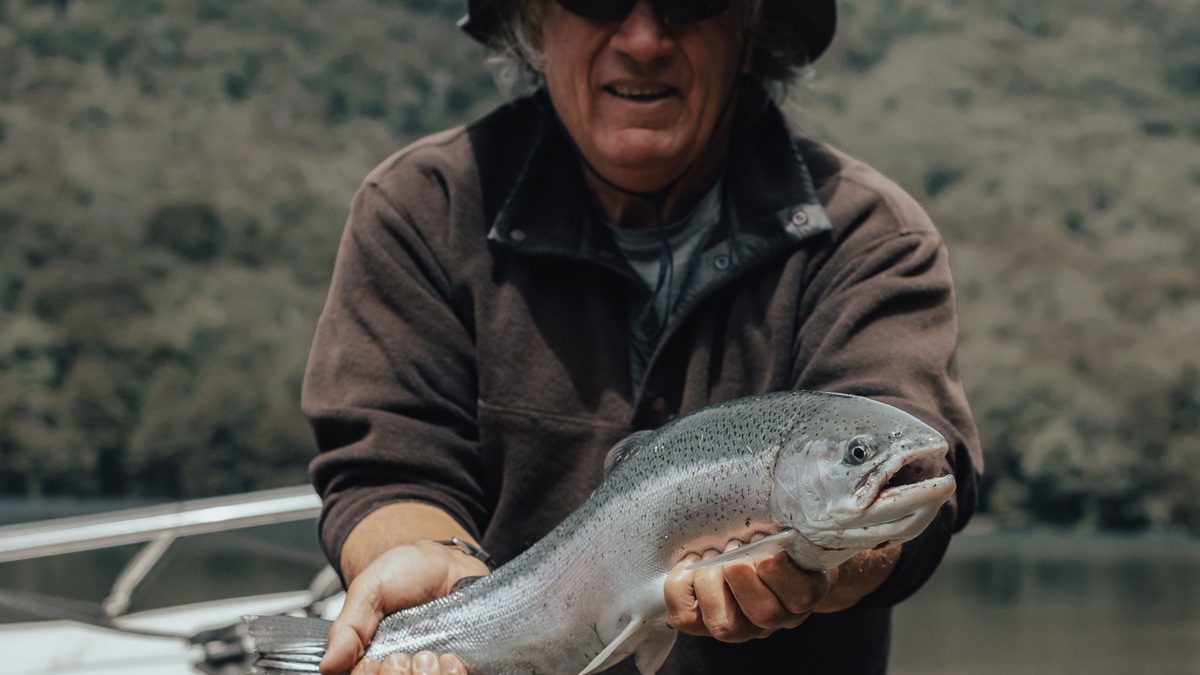
Keep the fish in the water whenever possible. Use a rubberized net or cradle and support the body horizontally. Never suspend a large trout by its jaw, because its weight can damage internal tissues and the jaw structure.
Remove the hook quickly and minimize handling. If a photograph is permitted, lift the fish only for a few seconds with one hand supporting the belly. Return it headfirst into clean water and hold it gently until it maintains balance and swims under its own power.
Deep-caught trout may experience barotrauma as pressure falls during ascent. Anglers should follow current local guidance on depth, retrieval and release devices. Avoiding unnecessary deep-water capture can be the safest option when fish cannot be released successfully.
Weather and remote-water safety
Great Bear Lake can produce large waves quickly. Its scale allows wind to build across long reaches and cold water makes immersion dangerous even in summer. Operators need seaworthy boats, communications and conservative decisions about when to remain ashore.
Travel insurance and evacuation arrangements deserve attention because communities are distant and roads do not reach most fishing areas. Personal medication should be packed with delays in mind. A satellite communicator adds resilience but cannot make unsafe weather navigable.
The best Great Bear fishing trip balances ambition with restraint. The lake can deliver a lifetime fish, yet its old trout and northern communities depend on careful treatment. Current licences, low harvest and fast releases keep the experience available for the next angler.