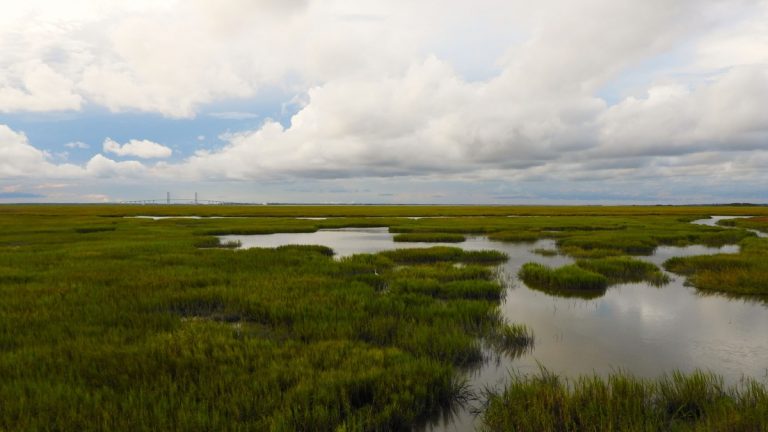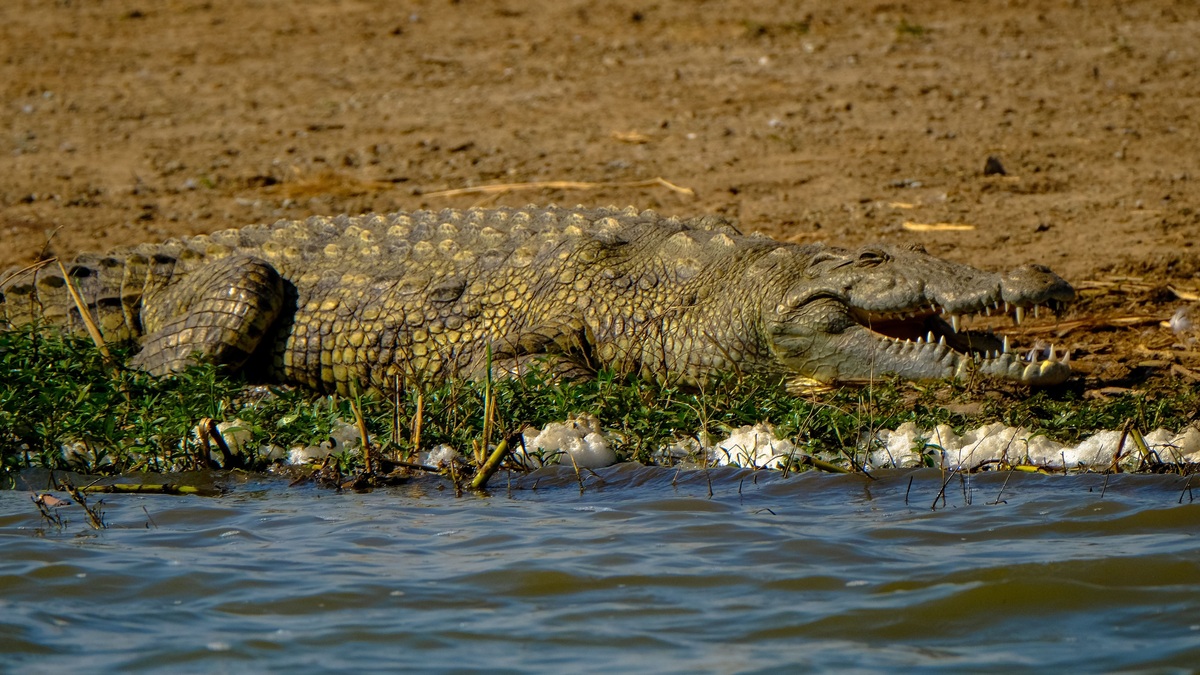
Nile crocodiles live in Lake Victoria, especially around islands, wetlands and sheltered shoreline habitat. Their presence is documented by wildlife authorities, but no recent lake-wide census supports a precise population estimate for the entire lake.
A concrete example came from Kyamuswa Island in Uganda’s Kalangala District. In September 2025, the Uganda Wildlife Authority reported capturing two crocodiles suspected in attacks, a 3.3-meter female and a 4.47-meter male. The animals were relocated to the Murchison Falls area.
The operation verifies crocodiles at one Lake Victoria locality and records a conflict response. It does not establish that crocodiles crowd every beach, nor can two captured animals reveal a lake-wide trend. Lake Victoria spans three countries. Uganda, Kenya and Tanzania each manage part of the shoreline, while habitats and monitoring effort vary among them.
The species is the Nile crocodile
The crocodile associated with Lake Victoria is Crocodylus niloticus, the Nile crocodile. It occupies freshwater systems across much of sub-Saharan Africa. Suitable habitat includes lakes and rivers as well as marshes or reservoirs.
Adults are opportunistic predators. Fish form important prey, while larger crocodiles can take birds or mammals that enter the water. Diet changes with body size and local availability, so a list from another African river should not be imposed on every Lake Victoria island.
Crocodiles depend on both aquatic and terrestrial features. Water supplies prey and refuge. Exposed banks allow basking, while suitable ground above normal water level is needed for nests.
Where crocodiles occur around the lake
Protected bays and vegetated island margins provide more cover than crowded urban waterfronts. River mouths can concentrate fish, although current and boat traffic also influence habitat use. Sandy or earthen banks may offer basking and nesting sites.
Historical work indicates that crocodiles were once more common along many parts of Lake Victoria. A Nile crocodile conservation action plan cites 1990s spotlight counts along 51.5 kilometers of shoreline that recorded only 0.12 crocodiles per kilometer, then notes limited modern population information.
Uganda’s 2026 wildlife assessment similarly says Lake Victoria crocodiles have received little systematic attention even though conflict reports occur. Local sightings are therefore stronger evidence than confident abundance claims.
Lake Victoria and the Victoria Nile are different survey areas
Some crocodile studies use the term Victoria Nile, the river flowing north from Lake Victoria through Uganda. Counts made below Murchison Falls describe a river reach toward Lake Albert, not Lake Victoria itself.
A 12-month Victoria Nile survey documented habitat and seasonal activity in Murchison Falls National Park. Those data help explain crocodile ecology, yet they cannot be transferred directly to the much larger lake.
This geographic distinction prevents an easy error. A large river count does not establish the number in Lake Victoria. The UWA relocation moved Kyamuswa animals away from the lake to the Murchison region, linking two places administratively without making them one population sample.
Why crocodiles and people come into conflict
Fishing communities work at the water’s edge and use small boats. Fish may also be handled near crocodile habitat. People enter shallow water to launch craft or collect water. Repeated overlap raises exposure even where crocodile density is low.
Large crocodiles can treat a person or domestic animal as prey. Adults may also defend close approach near a nest or young. UWA advised Kyamuswa residents to avoid known hunting areas and maintain distance from the edge.
Risk is local rather than uniform. One landing site may have heavy traffic and little cover, while a quiet island channel offers suitable basking banks. Recent verified notices from wildlife authorities are more useful than general claims about the whole lake.
What the 2025 relocation shows
UWA’s Problem Animal Control Unit captured two crocodiles suspected of attacks after community concern. Relocation removed the immediate animals while keeping them in a protected natural setting.
The report identifies sex and measured length, providing unusually specific documentation. Suspicion of involvement is not the same as forensic proof for every incident. The cautious wording should remain attached to the account.
Relocation addresses a particular conflict but cannot replace prevention. Another crocodile could use the same habitat if prey remains available. Basking sites and quiet water also influence reuse. Community reporting and targeted response must continue.
Crocodiles belong to a larger lake ecosystem
Lake Victoria supports fish, birds, reptiles and wetland mammals. Argo’s overview of Lake Victoria animals places crocodiles within that broader community rather than treating them as an isolated attraction.
As large predators, crocodiles consume prey from several parts of the food web. The magnitude of any population effect depends on abundance and diet, both poorly quantified lake-wide. It would be speculative to assign them a single controlling role without local evidence.
Shoreline wetlands also serve juvenile fish and birds. Protecting those places can support biodiversity while increasing the need for clearly marked access points that reduce dangerous overlap.
Islands create both refuge and exposure
Lake Victoria contains thousands of islands and rocky outcrops. Argo’s guide to the islands of Lake Victoria explains their geographic distribution across the three bordering countries.
Island channels can provide quiet water with nearby prey. Basking banks add another habitat feature. The same islands support fishing settlements whose residents make frequent trips by boat. Kyamuswa demonstrates how wildlife habitat and daily work can overlap closely.
Management cannot assume that every island needs the same response. Site inspections should consider recent sightings, shoreline use, nesting evidence and practical alternatives for water access.
How to interpret crocodile reports
A photograph confirms an animal at one place and time. A capture report can add measurements. A standardized survey along a defined route is needed to estimate density, while a lake-wide population estimate requires representative coverage across countries and habitats.
Reports may also confuse Lake Victoria with the Victoria Nile. Check the map, date and survey boundary before repeating a number. Historic decline evidence remains relevant context, but it is not a substitute for current monitoring.
The most defensible summary is that Nile crocodiles persist in parts of Lake Victoria, with sparse modern lake-wide data and documented local conflict. Any stronger claim needs a survey that has not yet been published for the entire lake.
Lake-wide abundance remains uncertain
The IUCN Crocodile Specialist Group action plan describes Lake Victoria as poorly documented in recent decades. It cites older shoreline sampling and concludes that modern status information is limited.
Uganda’s 2026 wildlife report includes Lake Victoria in a broader national discussion and notes that most systematic counts have focused on the Victoria Nile. A combined figure spanning several Ugandan waters cannot be treated as a Lake Victoria count because the report’s geographic components are not interchangeable.
A credible lake-wide estimate would need standardized day or night surveys across representative shoreline segments in all three countries. Surveyors would record route length and detection conditions, then account for animals missed underwater or hidden by vegetation.
Crocodile size changes ecology and risk
Young crocodiles feed mainly on small aquatic animals and fish suited to their size. Larger individuals can capture bigger prey and travel across wider habitat. The two Kyamuswa animals illustrate that adults of different sizes and sexes may use the same island region.
Length estimates from sightings are less reliable than measurements taken during capture. Distance and water exposure can distort apparent size, while only part of the body may be visible. Reports should label an estimate instead of presenting it as a measured total length.
Body size does not predict an attack by itself. Human activity at the shoreline and the animal’s local behavior also affect exposure. Wildlife officers need the exact site and recent history when choosing a response.
Practical safety near crocodile habitat
Residents and visitors should follow national wildlife-authority guidance, avoid entering water where crocodiles have been reported and keep back from vegetated edges or basking sites. Wildlife should never be fed because food conditioning can draw animals toward people.
Children and domestic animals require close supervision near the shore. Fish waste should not be discarded at a regular access point. Local authorities can identify safer landing areas and respond to repeated sightings.
Lake conditions differ across the countries described in Argo’s account of Lake Victoria’s location. Emergency contacts and legal wildlife procedures are country-specific, so current local advice takes precedence over a general article.