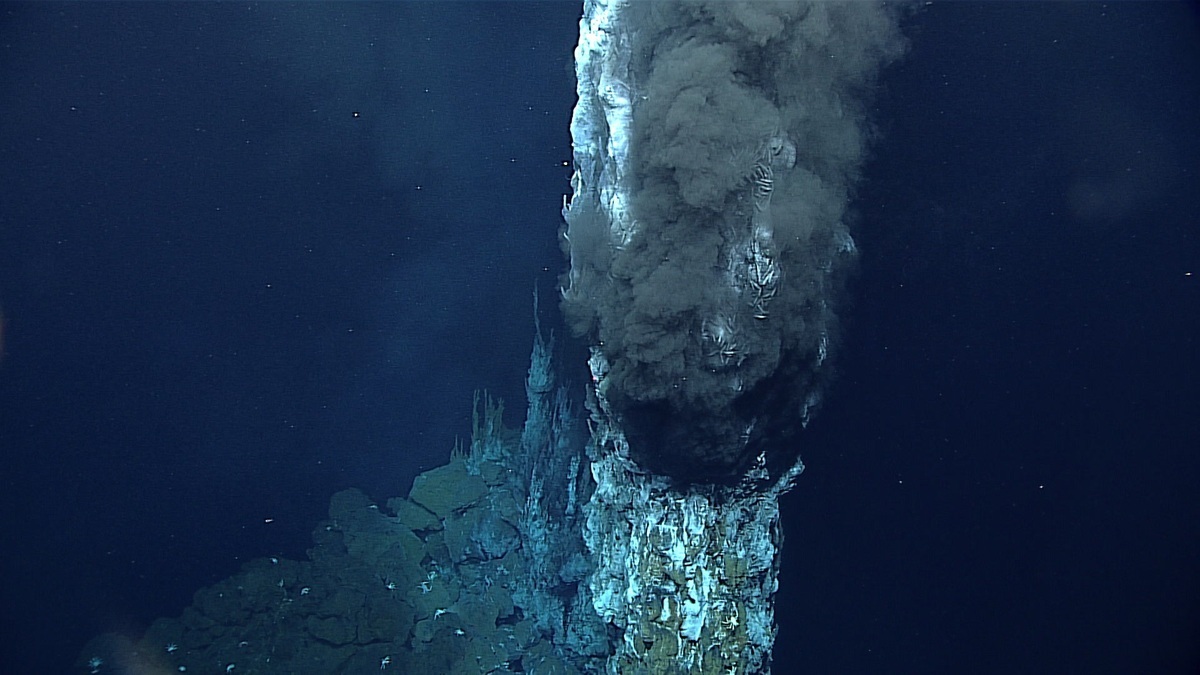
Black smokers are hydrothermal vent chimneys that emit dark plumes rich in fine metal-sulfide particles. White smokers release paler fluids containing minerals such as barium, calcium and silicon compounds. The colors describe particles formed during mixing, not smoke from combustion.
Black-smoker fluids are commonly hotter and rise more forcefully, while white-smoker fluids are often cooler and may have mixed with seawater beneath the seafloor. NOAA’s vent fact sheet links black chimneys with iron sulfide and pale chimneys with barium, calcium and silicon minerals.
Real vents span a continuum. Temperature and chemistry change as subsurface pathways open, clog or mix. A field may contain black smokers, white smokers and clear diffuse flow only meters apart.
Seawater becomes hydrothermal fluid underground
Cold seawater enters fractures in ocean crust near a volcanic heat source. As it descends, it warms and reacts with basalt or other rocks. Oxygen disappears, acidity changes and the fluid leaches metals plus sulfur-bearing compounds.
Heat makes the altered fluid buoyant. It rises through fractures and may emerge above 300 degrees Celsius. Pressure at the deep seafloor keeps this fluid liquid at temperatures that would cause boiling at the surface.
The process exchanges heat and elements between crust and ocean. Argo’s comparison of oceanic and continental crust explains the basaltic plate material through which most ridge-hosted vent water circulates.
Plume instruments sample water above a field and measure temperature anomalies, particles and chemicals such as methane or manganese. A buoyant hydrothermal plume rises until it reaches water of similar density, then spreads laterally. Following the signal can lead explorers to a vent that sonar has not resolved.
Black particles form during rapid mixing
Hot fluid can hold dissolved iron, copper, zinc and hydrogen sulfide under subsurface conditions. When it meets cold oxygenated seawater, chemical conditions change within seconds. Metal sulfides precipitate as tiny dark grains.
The rising particle cloud resembles smoke, while minerals deposited at the outlet build a chimney. NOAA’s description of hydrothermal vents identifies iron sulfide as a major source of black color.
Chimney walls develop channels that guide flow. New mineral layers can seal one route and redirect fluid through another. Fast growth makes tall structures possible, but brittle chimneys may topple and begin rebuilding.
Black-smoker plumes often carry abundant particles that sensors detect readily. A white smoker or diffuse field may produce a subtler signal. The absence of a dark plume therefore cannot rule out active circulation, especially when much precipitation occurred below the seabed.
White smokers reflect different chemistry
White-smoker fluids often carry pale particles of silica, anhydrite or barite. Calcium and sulfate form anhydrite at elevated temperature, while barium can precipitate as barite. The mixture varies among geological settings.
Some fluid has cooled or mixed below the bottom before emerging. Metal sulfides may precipitate underground, leaving fewer dark particles at the outlet. Woods Hole’s vent basics describes white-smoker flow as typically cooler and slower than black-smoker discharge.
Pale color does not mean chemically harmless or biologically inactive. White smokers still transport heat and reduced compounds that microbes can use. Their lower-temperature zones may offer extensive habitat around the chimney.
Vent deposits attract interest because sulfide minerals can contain valuable metals. Ecological value and scientific rarity accompany the mineral concentration. Baseline mapping must document active outlets, extinct structures and surrounding communities before disturbance can be assessed.
Temperature alone does not assign the color
High temperature favors strong rock-water reaction and metal transport, but source-rock composition also matters. Phase separation can divide hydrothermal fluid into chemically distinct vapor-rich and brine-rich portions. Later mixing changes what reaches each outlet.
Pressure and pH influence mineral solubility. The same vent can change appearance as its flow rate falls or subsurface plumbing evolves. Researchers therefore measure temperature and collect fluid rather than classifying a system from video alone.
Clear diffuse flow is another common outcome. Water shimmers because its temperature changes refractive properties, yet it may lack enough suspended mineral to look smoky. Diffuse outlets frequently surround the hotter chimneys.
Chimney color remains a useful field description when paired with temperature and chemistry. On its own, it cannot specify every mineral or reaction. The most accurate comparison treats black and white smokers as endpoints within a changing hydrothermal network.
Microbes use chemicals from both smokers
Vent microbes oxidize hydrogen sulfide, hydrogen or methane and use the released energy to build organic matter. Some form mats on chimney surfaces. Others live inside animals that deliver oxygen and vent chemicals to their symbionts.
Steep gradients occur across a few centimeters: hot anoxic fluid lies beside cold oxygen-rich seawater. Different microbes occupy narrow temperature and chemical zones. Animals gather where mixing provides usable fuel without lethal heat.
Communities change after eruptions, chimney collapse or flow diversion. Rapid colonizers may dominate a young outlet, while longer-lived animals settle as conditions stabilize. The plume color supplies only one clue to this shifting habitat.
Mineral precipitation occurs both inside a chimney and in its plume. Where mixing begins below the surface, dark sulfides may remain trapped in the wall while pale phases escape. Subsurface mixing explains why outlet color can change without a new heat source and why nearby chimneys supplied by one circulation cell can look strikingly different.
Scientists read smokers as geological instruments
Fluid samples reveal reaction temperatures and the rocks encountered below. Mineral layers record changing chemistry. Plumes carry tracers that can be followed away from the source to estimate heat and chemical output.
Remotely operated vehicles place temperature probes in outlets and use insulated samplers designed for hot, corrosive fluid. Cameras document structure, while sonar maps the surrounding ridge. Repeated visits reveal changes that a single dive cannot capture.
Black and white smokers are visible expressions of one hydrothermal circulation system. Their contrast comes from mineral precipitation, subsurface mixing and rock chemistry. Studying both shows how seawater reacts with the young ocean floor and feeds ecosystems far from sunlight.
White-smoker particles are not universally identical. Barite, anhydrite, silica and carbonate occur in different proportions according to source rock and fluid history. Black plumes likewise include several sulfide minerals. A color term is a field observation, while X-ray diffraction, microscopy and chemical analysis establish the mineral assemblage and its formation conditions.
Mineral layers preserve the life of a chimney
A chimney cross-section can contain concentric zones of sulfides, sulfates and silica. Minerals closest to the hot channel differ from those near cold seawater. Their textures record rapid precipitation, later replacement and repeated sealing of flow paths. The outer wall also hosts microbes living across steep chemical gradients.
Anhydrite often forms early when heated seawater supplies calcium and surrounding seawater supplies sulfate. It can provide a porous framework that later fills with metal sulfides. If flow stops and the structure cools, anhydrite may dissolve, weakening the chimney and helping it collapse.
Black-smoker deposits commonly include iron sulfides plus copper-bearing and zinc-bearing minerals. White-smoker structures may be richer in silica, barite or carbonate depending on the system. The labels describe visible discharge and cannot substitute for a laboratory mineral analysis.
Vent-fluid samplers must cope with high temperature and pressure while limiting contamination by ambient seawater. Chemical geothermometers infer reaction conditions below the bottom and paired rock samples show which elements were removed from the crust. Repeated sampling reveals whether a color change reflects cooling, mixing or a new pathway.
Scientists also distinguish ordinary white smokers from systems such as Lost City, where reactions between seawater and mantle rock produce alkaline fluids and carbonate towers without a conventional magma-heated black-smoker setting. Pale appearance alone cannot establish the geological engine.
Both smoker types are hydrothermal vents, but they differ from the lower-temperature habitats described in cold seeps vs. hydrothermal vents. Many vent fields occur near a mid-ocean ridge.