Lakes are classified as standing water, but their water is never literally motionless. The label distinguishes a lake from a river, where most flow follows a dominant channel downstream. A lake receives water and releases it again. Wind pushes its surface, waves cross the basin and density changes produce vertical movement.
The amount and pattern of motion differ among lakes. A shallow pond exposed to wind may mix frequently, while a deep sheltered lake can hold stable layers for months. Basin shape, depth, weather and the position of tributaries determine whether a current is easy to see or detectable mainly with instruments.
Why lakes are called standing water
Hydrologists often divide inland waters into lotic and lentic systems. Rivers and streams are lotic, meaning flowing, while lakes and ponds are lentic, meaning standing. The classification describes the overall form of the water body rather than a promise that every molecule remains in place.
A river confines most water to a channel with a persistent downstream direction. A lake stores water in a basin, so no single current defines the whole water body. Argo’s comparison of lakes and rivers explains how basin storage changes the pattern of flow.
Storage also gives lakes a residence time. Water may remain in a small through-flowing basin for only days. A large lake can take years or much longer to replace an equivalent volume. Residence time is an average accounting measure. Individual parcels can take faster routes near an inlet or remain in sheltered water long after the average.
Inflows and outflows create through-flow
Many lakes receive tributary streams and discharge through an outlet. Rain adds water directly at the surface. Groundwater can enter separately through the bed or shore. Evaporation removes water from the surface. Seepage and outlet flow complete a water budget that changes with weather and season. The USGS overview of lakes and reservoirs places those exchanges within the water cycle.
Inflow does not spread evenly through a lake. A cold tributary can plunge beneath warm surface water. A warmer plume may remain near the top, while water of intermediate density can settle between layers. A USGS study of circulation in Coeur d’Alene Lake describes plumes that enter at the depth where their density matches the surrounding lake water.
Currents may concentrate along one shore or follow the long axis of a narrow basin. Outlet placement also affects the route. Even lakes without a visible surface outlet can exchange water through groundwater, as Argo’s guide to seepage lakes explains.
Wind drives currents and waves
Wind transfers momentum to the lake surface. Water begins moving downwind and the resulting displacement creates pressure gradients that help drive return flow elsewhere. Shorelines redirect the current around headlands. Underwater ridges obstruct deeper flow, while Earth’s rotation influences circulation across very large basins.
Surface waves are motion without wholesale transport in one direction. Water particles mostly travel in small orbital paths as wave energy advances. Breaking waves near shore behave differently because they move water and sediment across the beach or along the coast.
Wind can also tilt a lake surface slightly by piling water toward the downwind end. When the wind weakens or changes direction, gravity draws the displaced water back. The response may continue as an oscillation rather than ending as soon as the storm passes.
Seiches make an enclosed basin slosh
A seiche is a standing wave within an enclosed or partly enclosed basin. Sustained wind can disturb the water. Rapid pressure changes and seismic motion provide other triggers. The surface then rises at one end as it falls at another, with the oscillation period controlled largely by basin dimensions and depth.
The National Ocean Service explanation compares the motion to water sloshing in a bathtub. Unlike an ordinary wind wave, a seiche can involve a large portion of a lake. Its nodes remain relatively stable while water levels rise and fall elsewhere.
USGS instruments in the Milwaukee River estuary record Lake Michigan fluctuations that rapidly reverse harbor and river currents. Large Great Lakes seiches can persist after the generating storm has passed, which makes local water levels and currents hazardous even under improving skies.
Temperature differences move water vertically
Water density changes with temperature. Sunlight warms surface water in summer and the warmer layer may float above colder deep water. The density boundary resists mixing. Temperature conditions above it can then diverge from those in the deep layer and dissolved oxygen can develop a separate profile.
Fall air cools the surface until it becomes denser and sinks. Deeper water rises in response, creating convection. Wind can complete the mixing when the density difference becomes weak enough. Seasonal turnover redistributes heat and oxygen through much or all of the water column. Dissolved material moves with the mixing water.
The USGS overview of water temperature describes the connection between temperature, dissolved oxygen and seasonal mixing. Tropical lakes may mix on a different schedule and some deep lakes seldom mix completely. Shallow lakes can alternate between mixed and layered conditions as weather changes.
Internal waves move hidden layers
A stratified lake can support waves along the boundary between its warm upper layer and cold deep layer. These internal waves may be much taller than surface waves because the density difference between the two water layers is small compared with the difference between water and air.
Wind can push the warm layer toward one shore, tilting the boundary below. When the wind relaxes, the layers oscillate. Cold deep water may rise near shore during one phase and retreat during another, changing temperature and nutrient conditions without producing a dramatic surface wave.
USGS researchers note that wind-generated circulation and internal seiches can displace large water masses horizontally and vertically. Such motion helps explain why a lake can look calm while instruments record strong changes below the surface.
Water levels change without becoming river flow
Rain can raise a lake across its entire basin, especially when snowmelt or prolonged tributary inflow adds to the volume. Wind setup and seiches create shorter local differences. Argo’s explanation of how lakes flood separates basin-wide high water from temporary piling and wave runup. NOAA’s Great Lakes water-level records show how gauges track changes over time.
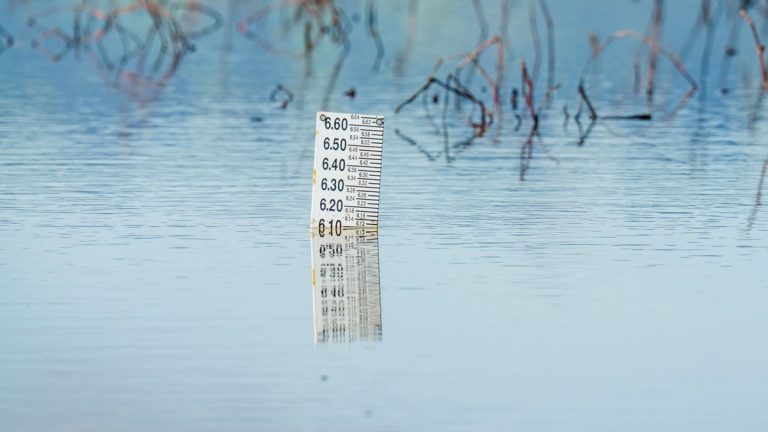
A changing level always implies movement somewhere in the system. Tributaries may be delivering water. Groundwater can cross the bed, while evaporation removes water at the surface. A gauge records the result at one location. Currents distribute the added volume or respond as water is removed across the basin.
Dams can regulate an outlet, but they do not stop circulation. Operators alter discharge while wind and density processes continue within the lake. Ice cover reduces direct wind stress in winter. Water can still flow below it and current near river mouths can weaken the cover.
Still-looking water can remain active
A calm surface means that local wind and waves are weak at that moment. It does not reveal groundwater seepage. Slow basin circulation may also remain invisible, as can motion beneath a thermocline. Scientists follow those processes with dye tracers and current meters. Temperature sensors complete the record by revealing movement between layers.
Lake motion operates across many time scales. A short-lived boat wake may remain visible for only minutes. A seiche can continue for hours, while seasonal turnover unfolds across weeks. Through-flow and deep circulation can take far longer. Different processes can overlap without producing one uniform current.
Calling a lake standing water is therefore useful as long as the phrase is understood as a classification. Lakes store water in basins instead of carrying it continuously through one channel. Inside those basins, gravity, wind, heat and the water cycle keep the water moving.