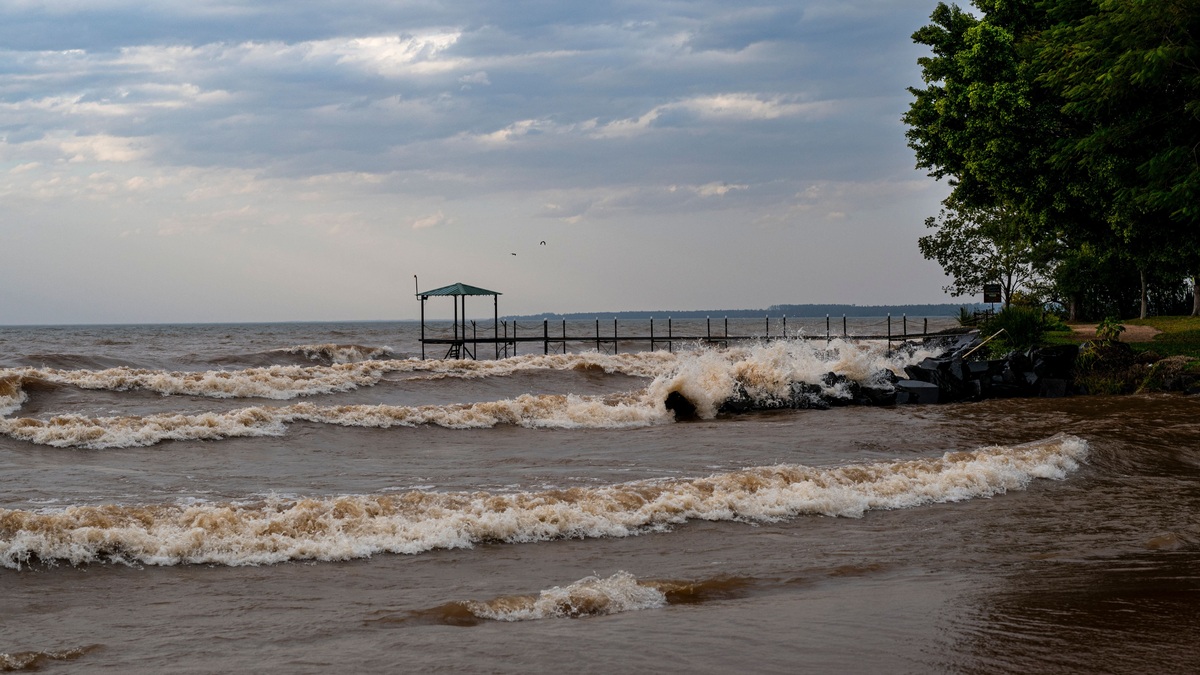
A seiche is a standing wave that makes water oscillate within an enclosed or partly enclosed basin. In a lake, the surface can rise at one end while falling at the other, then reverse as the water rocks back. Strong wind and rapid atmospheric-pressure changes are common triggers.
Seiche is pronounced roughly “saysh.” The motion resembles water sloshing in a bathtub, although lake geometry can produce periods lasting hours. It differs from ordinary wind waves because the basin-wide pattern remains in place while the water level oscillates around one or more nodes.
A standing wave has nodes and antinodes
Two waves traveling in opposite directions can combine into a standing-wave pattern. Locations with little vertical motion are nodes. The greatest rise and fall occurs at antinodes, commonly near the ends of a simple elongated basin.
The fundamental mode has one main node and opposite water-level changes at the ends. Higher modes can contain additional nodes, dividing the lake into more segments. Real shorelines and depth patterns make the motion more complex than a rectangular-tank diagram.
The NOAA seiche explanation notes that standing waves can form in basins ranging from a small cup to a massive lake. The basin constrains the motion and helps set its natural period.
Wind can start the lake rocking
Persistent wind pushes surface water toward the downwind shore. Water piles up there while the opposite end falls. When the wind weakens, gravity pulls the tilted surface back toward level. Momentum then carries it past equilibrium.
The lake continues oscillating as friction gradually removes energy. A new weather disturbance can reinforce the motion if its timing aligns with the lake’s natural period, a process related to resonance.
Atmospheric pressure can also displace the surface because lower pressure permits a slightly higher water level beneath it. A fast-moving pressure disturbance may generate a progressive wave that enters a harbor or lake and excites a seiche.
Earthquakes and other sudden disturbances can trigger standing oscillations too. The word describes the resulting basin response rather than one exclusive cause.
Basin dimensions control the period
Seiche period is the time required for a full oscillation. Longer basins and shallower average depths generally have longer fundamental periods because the long wave takes more time to cross the basin and return.
Lake shape matters. Connected bays can possess their own natural periods and underwater ridges alter wave speed. A harbor may oscillate rapidly while the larger lake rocks on a much longer cycle.
In several Great Lakes, NOAA reports four to seven hours between a seiche high and low. That interval can resemble the timing of an ocean tide, contributing to a common misidentification.
Seiches are different from tides
Tides are driven mainly by the gravitational pull of the Moon and Sun. A seiche is a free oscillation of the basin after water has been displaced. NOAA’s explanation of Great Lakes tides says the small astronomical signal is generally masked by larger changes caused by wind and pressure. A tide follows predictable astronomical cycles, whereas seiche timing depends on basin geometry. Its amplitude depends on the disturbance and the lake’s prior motion, making weather forecasts and water-level observations central to short-term warnings.
Argo’s explanation of Great Lakes connections describes how the lakes form one drainage system, yet each basin has its own geometry. The natural oscillation of one lake should not be assumed to match another.
A meteotsunami can excite a seiche
A meteotsunami is a progressive long wave generated by an atmospheric disturbance. NOAA places typical meteotsunami periods in the tsunami-frequency band from about two minutes to two hours. Its comparison describes seiche oscillations as usually longer because the motion is confined by a basin.
The processes can occur together. A pressure-driven wave can travel across open water and enter a harbor. The harbor may continue oscillating at its natural period after the wave passes. Observers may see only the local rise and fall, making the distinction difficult without records from several stations.
Ordinary storm surge is another related term. Wind can pile water against a shore for as long as forcing continues, while the seiche is the subsequent rocking response. A real event may contain both without a clean boundary in time.
Lake Erie is especially responsive
Lake Erie’s long southwest-to-northeast orientation lines up with many strong winds. Its relatively shallow basin allows water to be displaced substantially, raising levels at one end as they fall at the other. Buffalo at the eastern end can experience rapid water-level changes during favorable wind conditions.
NOAA recounts a destructive 1844 Lake Erie event associated with a reported 22-foot seiche and a breached seawall. Historical descriptions should not be used as a universal forecast. Modern impacts depend on wind and local shoreline elevation, with protective structures altering exposure. Argo’s guide to Lake Erie hazards covers the broader combination of weather and water risks. A seiche adds a basin-scale water-level change that can worsen shoreline flooding and currents even when astronomical tides are negligible.
Why a seiche can be hazardous
A rapidly rising level can flood docks and low shoreline. Reversing flows through a channel or harbor entrance may create strong currents that surprise boaters. Water that recedes can leave vessels grounded before returning. Wave height is not uniform around the lake: nodes experience little vertical movement, while antinodes can undergo much larger changes. Local harbor resonance may amplify a particular frequency beyond the response along an open shore.
Official water-level stations show the event more clearly than a single shoreline observation. Mariners should use current forecasts and warnings because a calm interval does not prove that the oscillation has ended.
How scientists detect the oscillation
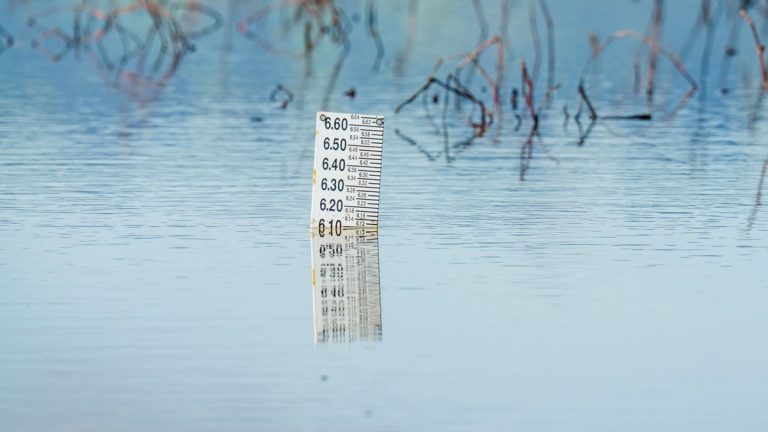
Water-level gauges record repeated rises and falls at fixed locations. When opposite ends move out of phase at a consistent period, the pattern supports a lake-wide standing wave. Pressure and wind records help identify the forcing.
A NOAA Great Lakes record of a June 2025 storm describes a meteotsunami followed by repeated oscillations at Lake Superior’s characteristic seiche period. Its water-level stations resolve the progressive event and later basin response in time.
Models use bathymetry and shoreline geometry to calculate natural modes and predict where water-level change may be largest. Observations remain necessary because friction and ice alter the real response. Changes in mean lake level add another influence.
A seiche is therefore more specific than any sudden lake rise. The repeating basin-scale oscillation distinguishes it from a passing boat wake or a gradual seasonal change. Nodes and the relation to a triggering disturbance provide further evidence.
Seiches can also move deep water
A stratified lake contains layers of different density. Wind can tilt the boundary between warm surface water and colder deep water, creating an internal seiche. The surface may move only modestly while the underwater boundary shifts by a much larger vertical distance.
Internal oscillations change the temperature and oxygen conditions experienced at a fixed depth. They can bring cold, low-oxygen water toward an intake or shoreline, then carry it away as the wave reverses. The effect depends on stratification and basin shape.
Surface and internal seiches are related basin responses, yet they need not share the same amplitude or ecological effect. Temperature profiles from moored instruments help detect the deep motion.
Forecasts combine weather with lake geometry
Wind direction matters as much as wind speed. A strong wind aligned with a lake’s long axis can displace more water than a cross-lake wind of similar strength. The duration of the forcing and its change in direction affect how much energy enters a natural mode.
Numerical models calculate water movement over mapped lake depths and compare the result with gauge observations. Local forecasts remain location-specific because a harbor can resonate differently from the open shore.
For the public, the practical response is to follow official water-level and marine warnings during strong weather. The term seiche explains the oscillation, but it does not supply a safe universal height or waiting period for returning to the water.