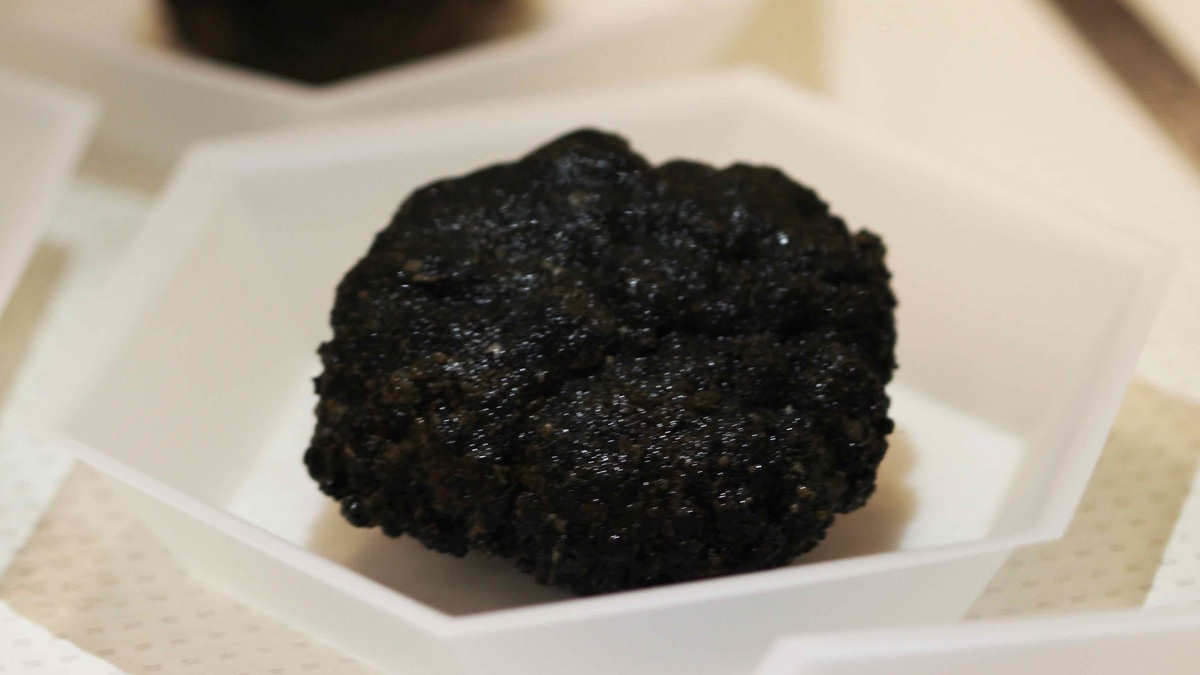
Manganese nodules are rounded mineral concretions that grow on or just below the deep seafloor. They form when iron and manganese oxides precipitate in extremely thin layers around a nucleus such as a rock fragment, shark tooth or older nodule piece. Many also concentrate nickel, copper and cobalt, which drives interest in deep-sea mining.
Growth is extraordinarily slow, commonly measured in millimeters per million years. Nodules remain exposed at the sediment surface despite continual particle deposition because bottom animals disturb the sediment and chemical processes recycle material near the water-sediment boundary.
NOAA’s overview of deep-sea mineral resources places nodules alongside cobalt-rich crusts and seafloor massive sulfides. The deposits differ in setting and formation, so their environmental risks also need separate evaluation.
A small object starts each nodule
A nodule begins when dissolved metals precipitate around a firm nucleus. Successive oxide layers build outward, creating shapes that range from nearly spherical to flattened or irregular. Cutting a nodule often reveals concentric bands around one or several centers.
Manganese and iron arrive from seawater, sediment pore water or both. Hydrogenetic growth draws metals directly from bottom water and tends to be very slow. Diagenetic growth draws manganese remobilized within sediment and can proceed somewhat faster.
Microbes may influence oxidation and precipitation, but inorganic reactions also occur. The exact contribution varies among sites. Mineral textures and chemical ratios help researchers infer which pathway dominated during different stages of a nodule’s history.
Nodules also archive changing seawater chemistry, although their slow and irregular growth complicates dating. Researchers use isotope systems and microscopic layering to estimate growth intervals. A polished section can show pauses, corrosion surfaces and renewed deposition rather than a steady annual record.
Nodules favor broad abyssal plains
Large fields occur several kilometers deep where sediment accumulates slowly. Rapid burial would cut a nodule off from oxygenated bottom water, while strong sediment flows could cover or remove it. Stable plains far from major continental sources provide favorable conditions.
The best-known concentration lies in the Clarion-Clipperton Zone of the equatorial Pacific. Other fields occur in the Indian Ocean and around the Cook Islands, although abundance, metal content and ecosystem setting differ.
Even within a field, nodules are patchy. Seafloor slope, sediment chemistry and current activity affect size and coverage. Surveyors combine photographs, acoustic mapping and physical samples to estimate abundance rather than assuming an even carpet.
Nodule density at the surface depends partly on biological mixing. Burrowing animals can expose buried pieces and keep slowly growing nodules near the sediment-water interface. The same animals are vulnerable to collector disturbance, linking the deposit’s formation to the ecosystem at risk.
Why nodules grow so slowly
Dissolved manganese concentrations in oxygenated seawater are very low. Only a tiny amount reaches and sticks to a nodule surface at a time. The oxide layers also adsorb trace metals from surrounding water, gradually enriching the deposit.
Sediment pore water can supply more manganese after organic matter consumes oxygen and reduces manganese oxides below the surface. Dissolved manganese diffuses upward and precipitates again where oxygen returns. The boundary between these chemical zones can move.
USGS research on deep-ocean mineral deposits emphasizes the geological time required for these resources. A nodule several centimeters wide may record millions of years of interrupted growth, dissolution and renewed precipitation.
Distinguishing nodules from cobalt-rich crust is important. Crusts coat exposed rock on seamounts, while nodules grow as separate objects on sedimented plains. Both accumulate manganese and iron oxides, but their geometry, metal proportions and collection methods differ.
Metal value comes from oxide surfaces
Manganese and iron form most of the mineral framework. The fine-grained oxides have reactive surfaces that capture nickel, copper, cobalt and other elements. Concentrations vary with growth pathway and local chemistry.
Diagenetic nodules often contain more nickel and copper, while slowly growing hydrogenetic material can be relatively rich in cobalt and rare earth elements. Commercial assessments therefore measure composition alongside abundance and accessibility.
A high metal grade alone does not make a viable deposit. Operations would need to collect nodules from great depth, lift them through kilometers of water and process complex ores. Equipment reliability, energy use and environmental safeguards alter the full cost.
Polymetallic nodule composition varies within a single field and even across layers of one specimen. Sampling must capture that variability rather than favoring the largest surface objects. Seafloor photography adds the spatial context lost when a dredge mixes material from its path, allowing abundance estimates to be connected with sediment texture and animal communities.
Nodules are habitat as well as ore
On soft abyssal mud, a hard nodule provides scarce attachment space for sponges and other organisms. Animals live on, beneath and between nodules. Some species appear limited to nodule-rich areas, while mobile animals use the altered terrain.
Collecting nodules removes that hard substrate and creates sediment plumes. The tracks and disturbed sediment may persist because deposition and biological recovery are slow in the abyss. Uncertainty remains about plume travel, noise and the effects of material discharged during lifting.
Baseline surveys need to document species, food webs and natural variability before mining. Short experiments cannot fully represent consequences that may unfold over decades. The nodule’s million-year formation time rules out replacement on human management timescales.
Age estimates are difficult because a nodule can stop growing, lose material and begin again. Cosmogenic isotopes, beryllium isotopes and magnetic signals offer clocks over different intervals. Researchers compare several methods with layer chemistry, since a single average growth rate can conceal long pauses inside an apparently continuous set of bands.
How scientists map and sample nodule fields
Shipborne multibeam sonar maps regional terrain, but individual nodules are too small for most broad surveys. Towed cameras and autonomous vehicles photograph the bottom at higher resolution. Image analysis estimates coverage and size across selected transects.
Box corers recover nodules with surrounding sediment, preserving relationships that a dredge can disrupt. Chemical analyses measure metals and mineral phases. Biological samples reveal the organisms associated with the hard surfaces and nearby mud.
Researchers also study sediment movement. A turbidity current can rapidly transport particles, whereas favorable nodule settings usually experience slow accumulation. Combining geology with ecology is essential because the same object is both a mineral archive and living habitat.
Mining proposals raise unresolved tradeoffs
Collectors proposed for abyssal plains would move across the bottom, gather nodules and separate much of the surrounding sediment. A lifting system would carry the material to a surface vessel. Every stage introduces disturbance, from direct habitat removal to noise and particle plumes in bottom water.
Sediment plumes could spread beyond a collector track before particles settle. Fine grains may cover filter feeders or alter feeding conditions, while discharge from processing at another depth could affect midwater organisms. Predictions depend on particle size, current speed and equipment design and field tests remain limited in duration.
The international seabed beyond national jurisdiction is administered under the United Nations Convention on the Law of the Sea framework. Exploration contracts do not by themselves settle whether commercial extraction should proceed. Regulators need environmental baselines, monitoring standards and thresholds for unacceptable harm.
Reference zones can help compare disturbed ground with similar undisturbed habitat, but abyssal ecosystems vary across space. A protected patch must represent the geology and biology of the mined area and remain outside plume influence. Rare species with small ranges make that design especially difficult.
Metal demand is only one side of the decision. Recycling, changes in battery chemistry, terrestrial mining impacts and material efficiency affect the claimed need for seabed supply. Nodule geology sets hard limits: once collected, the resource and its hard-substrate habitat will not regrow on a human timescale.
Many nodule fields lie on abyssal plains, where extremely slow sediment accumulation leaves them exposed. Argo also compares the biological and geological settings around cold seeps and hydrothermal vents.