A 2026 arXiv preprint reports that NASA’s James Webb Space Telescope has spotted strong and changing carbon monoxide emission from 55 Cancri e, a scorching lava planet about 41 light-years away. The study, submitted to Nature Astronomy, suggests that this rocky world has a hydrogen-rich atmosphere tied to gases rising from its molten interior.
Using Webb to watch the planet disappear behind its star, the team studied five secondary eclipses of 55 Cancri e. Each eclipse gave researchers a view of the planet’s dayside heat just before it slipped out of sight. Those measurements point to an atmosphere that shifts over time and carries chemical clues from below the surface.
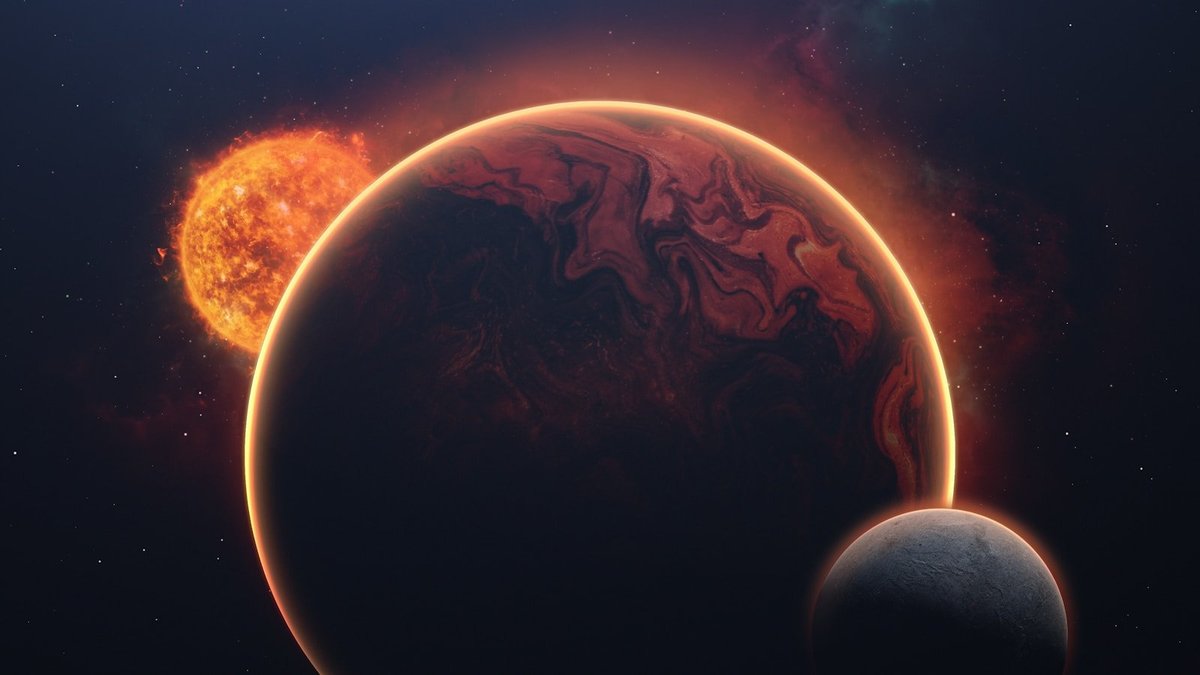
The finding adds a strange new layer to one of the most famous rocky exoplanets. 55 Cancri e is often described as a super-Earth because it is larger and more massive than our planet. Its orbit is so tight that a year there lasts less than one Earth day. Under that heat, rock on the star-facing side may melt into a vast glowing region.
Webb sees a changing atmosphere
NASA’s James Webb Space Telescope observed 55 Cancri e during five secondary eclipses. In this method, astronomers measure the combined light from the star and planet, then compare it with the star’s light alone after the planet passes behind it. The difference reveals the infrared glow from the planet’s dayside.
The study reports strong carbon monoxide emission in the planet’s upper atmosphere. That signal appears in data from Webb’s NIRCam observations, which can separate light by wavelength and expose the chemical fingerprints of gases. The measurements also suggest variability between eclipses, meaning the planet’s dayside atmosphere may change on short timescales.
That variability matters because 55 Cancri e sits in an extreme environment. The planet receives intense radiation from its nearby star. Any atmosphere there must endure fierce heating, surface melting and possible chemical exchange with a magma ocean. A steady, unchanging blanket of gas would be hard to maintain under those conditions.
The research team compared the Webb results with models of rocky exoplanet atmospheres. Many expectations for lava worlds emphasized carbon monoxide and carbon dioxide. The Webb data favored a mixture dominated by carbon monoxide with smaller amounts of carbon dioxide and a major role for hydrogen.
A super-Earth with molten dayside rock
55 Cancri e is about 1.88 times Earth’s radius and roughly eight times Earth’s mass. It orbits a Sun-like star once every 0.7 days, placing it far closer to its star than Mercury is to the Sun. At that distance, the dayside can reach temperatures high enough to melt silicate rock.
The planet is also thought to be tidally locked. One hemisphere constantly faces the star, while the other remains turned toward space. This arrangement can create sharp contrasts between the blazing dayside and the cooler nightside. On a lava world, the same pattern may shape where molten rock collects and where gases escape most easily.
Secondary eclipse spectroscopy gives astronomers a rare way to study that dayside directly. When the planet is visible beside the star, its heat contributes a tiny amount of infrared light. When it slips behind the star, that contribution disappears. Webb can measure that small change with enough precision to test atmospheric models.
For 55 Cancri e, the measured spectrum carries signs of a volatile-rich atmosphere. Volatiles are compounds that can exist as gases under planetary conditions. On this world, those gases may be linked to the molten surface and the planet’s deeper chemistry.
Hydrogen points to a hidden magma ocean
Hydrogen is the study’s most intriguing clue. The preferred models suggest an atmosphere with abundant hydrogen, along with carbon monoxide and some carbon dioxide. That mix points toward interior chemistry where hydrogen is favored over oxygen.
The paper connects the atmosphere to the planet’s internal redox state. In simple terms, redox describes how easily a material gives up or takes in oxygen and electrons during chemical reactions. On a rocky planet, that balance affects which gases emerge from molten rock.
The authors write that “the composition of their atmospheres is directly linked to their interior redox states.” In 55 Cancri e, the best-fitting models indicate a reduced magma ocean, meaning the molten interior has relatively little oxygen available for reactions compared with more oxidized rock.
That chemical setup can help explain the hydrogen-rich result. If gases are escaping from molten rock below, the atmosphere becomes a readable record of the planet’s interior. Webb is detecting light from the atmosphere, yet the signal may reveal the chemistry of rock hidden far beneath it.
This makes 55 Cancri e especially valuable. Astronomers usually cannot sample exoplanet interiors. For lava planets, molten surfaces may release gases that expose deeper material. Their atmospheres can act like chemical messengers from regions that telescopes can never image directly.
Five eclipses revealed the signal
Five separate eclipse measurements gave the team a way to look for repeatable patterns and short-term changes. A single eclipse can capture one moment in a restless atmosphere. Multiple eclipses can show whether the planet behaves consistently or shifts from orbit to orbit.
The study found evidence for variable thermal emission from the dayside of 55 Cancri e. The changes could come from fresh outgassing from the interior. They could also involve clouds that form from released gases. Those clouds may briefly change how heat escapes before they disperse.
Carbon monoxide emission is central to the interpretation. The study title highlights strong and variable stratospheric CO emission, which suggests that carbon monoxide high in the atmosphere is heated and radiating in infrared wavelengths. Such a signal gives scientists a way to probe temperature structure as well as chemistry.
The researchers compared the Webb measurements with existing models of rocky exoplanet atmospheres. The favored explanations require a steep temperature inversion, where higher atmospheric layers are hotter than layers below. Hydrogen-rich models can produce that kind of structure while matching the observed carbon monoxide and carbon dioxide balance.
There is still uncertainty. The work is a preprint and has been submitted to Nature Astronomy. Future observations could test whether the same atmospheric behavior repeats, whether clouds play a major role and how strongly the atmosphere changes during different stellar or planetary conditions.
Why lava worlds are becoming prime targets
Lava planets are becoming a growing class of exoplanets for atmospheric studies. These rocky worlds orbit extremely close to their stars and often complete a year in hours or days. Their heat can create molten surfaces, vaporized minerals and atmospheres fed by interior outgassing.
55 Cancri e is one of the best-known examples. Other lava-world candidates include K2-141 b, L 98-59 d, TOI-561 b, HD 63433 d and CoRoT-7 b. They differ in size, temperature, host star and how much of the surface may be molten.
These planets offer a natural laboratory for questions that are difficult to answer in our own Solar System. Scientists can ask how rocky planets lose original atmospheres, how new atmospheres form and how magma oceans exchange gases with space. Webb’s sensitivity makes those questions more testable than they were with earlier telescopes.
55 Cancri e also shows why repeated measurements matter. A lava planet can be chemically active and thermally unstable from one observation to the next. By watching several eclipses, astronomers can begin to separate lasting atmospheric properties from temporary weather-like events.
The new study places lava exoplanets at the center of a broader effort to connect surface, atmosphere and interior chemistry. On 55 Cancri e, Webb’s view of glowing gas may be giving scientists a glimpse of a hidden molten world that keeps rebuilding the air above it.