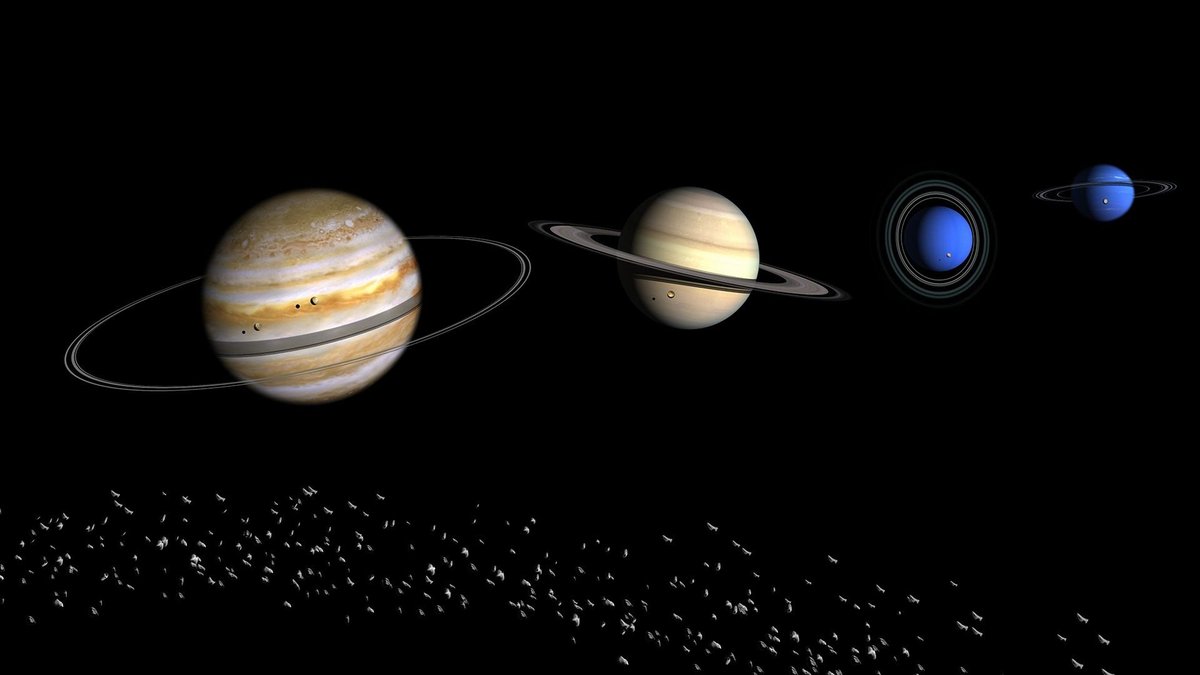
A study in Icarus study used computer simulations to replay the early outer solar system and it points to a startling possibility. One or two extra giant planets may once have orbited near Uranus and Neptune before gravitational chaos expelled them into interstellar space.
The research, led by Matthew S. Clement with collaborators including Nathan A. Kaib, André Izidoro and Rogerio Deienno, looked at how close encounters between young giant planets would have affected their moons. Those moons act like fragile witnesses. If the planets had passed too close to one another, entire satellite systems could have been scrambled, smashed, or lost.
The result adds a new constraint to one of planetary science’s biggest reconstructions. Astronomers have long suspected that Jupiter, Saturn, Uranus and Neptune moved after they formed. The new work suggests that their surviving moons may preserve clues from that violent migration, including hints of planets that vanished billions of years ago.
Simulations rewind the outer solar system
The team focused on the giant planet instability, a proposed episode when the outer planets shifted from tighter early orbits into the wider arrangement seen today. In that scenario, Jupiter, Saturn, Uranus and Neptune interacted with leftover planetary building blocks. Their gravity changed the planets’ paths over time.
To test what that history would do to moons, the researchers began with a set of simulated planetary encounter histories. They selected 122 cases that ended with giant planets in broadly realistic modern positions. Some simulations began with five giant planets. Others began with six.
Clement told Live Science that the study “systematically tested the effects of giant-planet close encounters on the orbital stability of their satellites.” That detail matters because moons are easier to disturb than planets. A planet can survive a close gravitational encounter while its satellite system is pulled into chaos.
Each simulated setup tracked the motions of giant planets and thousands of small planetesimals over millions of years. The researchers then replayed the planetary encounters with satellite systems included. This allowed them to ask a sharper question: which early solar systems could produce both the present giant planets and surviving moons around Jupiter and Uranus?
Jupiter’s moons preserve a fragile clue
Jupiter’s largest moons gave the team one of its most important tests. Io, Europa and Ganymede are locked in a famous orbital rhythm called the Laplace resonance. Io circles Jupiter four times for every two orbits by Europa and every one orbit by Ganymede.
That pattern is delicate. It likely required a long stretch of relatively calm evolution after the moons formed. A major destabilizing event could have broken the orbital rhythm by causing the moons to collide, shift, or scatter into different paths.
In the simulations, Jupiter’s moons survived most often in systems that began with two smaller extra ice giants. Those extra worlds helped shape the giant planets’ migration in a way that was less destructive for Jupiter’s regular satellites. The finding suggests that a solar system with six original giant planets can preserve Jupiter’s moon architecture more easily in some cases.
The survival rate still looked low. The study’s broader message is that Jupiter’s moon system may have passed through a narrow gravitational window. The early solar system could have taken many paths that left the planets in roughly similar places, while leaving the moons badly damaged.
Uranus may have endured a violent moon shakeup
Uranus told a different story. In the simulations, its moons were more likely to survive when the early solar system included one larger additional planet. That finding created a puzzle because the setup that favors Uranus differs from the one that most helps Jupiter’s moons.
Uranus is already one of the solar system’s strangest planets. Its rotation axis is tipped dramatically, so the planet rolls around the Sun on its side. Many scientists think a large impact early in solar system history helped produce that extreme tilt.
The Icarus study adds a second disturbance to consider. If Uranus later passed too close to another ice giant or to one of the gas giants, its moons could have been driven into unstable orbits. The paper found that encounters within certain close distances made destruction of the Uranian satellite system highly likely.
That kind of instability could have caused collisions among the moons. Such impacts may have broken bodies apart, removed volatile material and allowed debris to reassemble. The unusual composition of Miranda, one of Uranus’ major moons, has been discussed as a possible clue to this kind of disruption.
The researchers are cautious about the details. A model can show which outcomes are plausible, yet it cannot replay the exact history of the solar system with perfect certainty. Even so, the Uranian moons appear to be sensitive tracers of ancient close encounters.
One lost ice giant, or two smaller worlds
The simulations point toward two broad possibilities. In one version, the young solar system had a fifth giant planet with a mass similar to Neptune. In another version, it had six giant planets, including two extra worlds with masses between Earth and Neptune.
Those smaller bodies would fall into the broad category of super-Earths or sub-Neptune-like planets. Planets in that mass range are common around other stars. Our solar system lacks one today, which makes the possibility of vanished examples especially intriguing.
Nathan Kaib of the Planetary Science Institute told Live Science, “Given that the masses are not too different from Uranus and Neptune.” He was describing what the long-lost planets may have been like. Their physical properties may have resembled the ice giants more than rocky inner planets.
During the instability, these extra planets would have been flung among their larger neighbors through repeated gravitational encounters. One close pass could alter the path of a planet. A series of close passes could eventually send a planet beyond the Sun’s gravitational grip.
That ejection would have left the solar system with the four giant planets seen today. The missing world, or worlds, would now be drifting through interstellar space. Such free-floating planets are difficult to identify because they shine faintly and have no host star nearby.
Why the missing planets are hard to trace
The lost planets themselves have left few direct clues. Once a planet is ejected, its orbit no longer provides a record inside the solar system. Researchers have to study the survivors instead, especially objects whose present arrangement would have been easy to disturb.
That is where Jupiter’s moons and Uranus’ moons become powerful evidence. Their survival, resonances and possible disruption histories help narrow the range of early planetary encounters. The moons function like a cosmic crime scene, preserving indirect traces of forces that acted long ago.
Still, the study keeps the uncertainty front and center. The simulations identified only a small number of cases where both Jupiter’s and Uranus’ satellite systems survived the same instability. That rarity suggests the real solar system may have followed an unusually specific path.
The work also shows why one answer remains difficult. Some evidence favors two additional smaller ice giants. Other outcomes leave room for one larger lost planet. The researchers found that the number and mass of the extra ice giants strongly shaped which moon systems survived.
Future work may focus more deeply on what happens during moon disruption. Clement described one next step as studying “the actual consequences of what happens if the satellites do go unstable.” That could help researchers connect simulations to specific features on Uranus’ moons, including signs of collisions, resurfacing, or reassembly.
For now, the new study gives planetary scientists a sharper way to test ancient solar system history. The planets that remain are only part of the evidence. Around them, small moons may still carry the memory of vanished worlds.