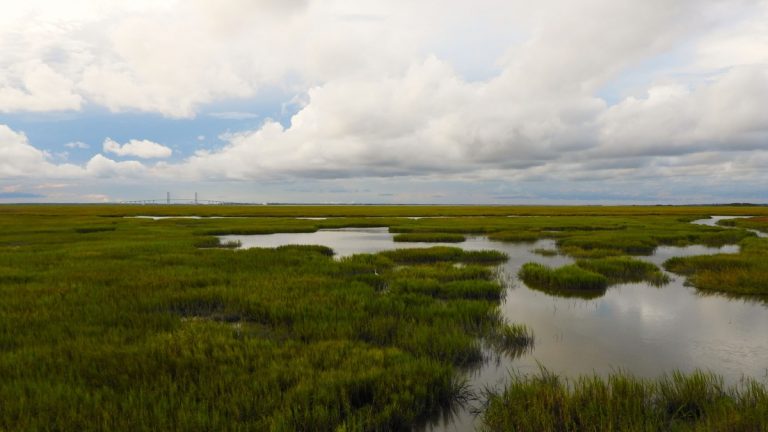
Plants in the Great Lakes occupy several different habitats. Submerged species grow below the surface, floating-leaved plants reach the light and emergent plants root in shallow water while extending stems into the air. Coastal wetlands add sedges, grasses, shrubs and trees along the changing boundary between land and lake.
The five lakes are too deep and energetic for rooted plants across most of their open bottoms. The greatest variety occurs in protected bays and drowned river mouths, along with marshes where light reaches the sediment. The Great Lakes Coastal Wetland Monitoring Program divides vegetation into wet meadow, emergent and submerged zones because each supports a different biological community.
Submerged plants form underwater habitat
Common waterweed (Elodea canadensis) is a native submerged plant with leaves arranged in whorls. It photosynthesizes below the surface and provides structure used by invertebrates and young fish. Coontail (Ceratophyllum demersum) is another widespread native that often floats without true roots.
Pondweeds are a diverse group rather than a single kind of weed. Native species such as clasping-leaf pondweed (Potamogeton richardsonii) grow in suitable shallow water across the upper Midwest. Their leaves slow small currents and create surfaces for algae and invertebrates. Fish then feed within the plant bed.
Water depth sets a practical lower boundary for rooted growth because less light reaches the bottom as depth and turbidity increase. Clear water can support plants farther offshore than cloudy water at the same depth. Wave action imposes another limit by disturbing sediment and breaking stems in exposed reaches.
Floating leaves capture light at the surface
White water lily (Nymphaea odorata) anchors in soft sediment and sends long stalks to floating leaves. Its flowers and round pads are familiar in quiet coves, but heavy waves limit where it can persist. Bullhead pond lily (Nuphar variegata) tolerates similar sheltered conditions and has yellow flowers.
Duckweeds are much smaller. Individual plants float on calm water and reproduce rapidly when nutrients and temperature allow. A covering of duckweed is not automatically evidence of an invasive species. Native species occur in the basin and identification may require details too small to judge from a distant photograph.
Floating leaves create shade beneath a pad while leaving open water between stems. Insects visit flowers above the surface and animals shelter among submerged stalks. A patch can expand or contract as water levels change, so its absence in one season does not prove that the plant has disappeared from the wetland.
Emergent plants hold the shoreline together
Hardstem bulrush and related bulrushes root in shallow sediment while their stems rise above the water. The flexible stands absorb wave energy, hold sediment and give fish access to flooded cover. Wild rice grows in gently moving or shallow water in parts of the upper Great Lakes basin and has deep cultural importance to Anishinaabe peoples.
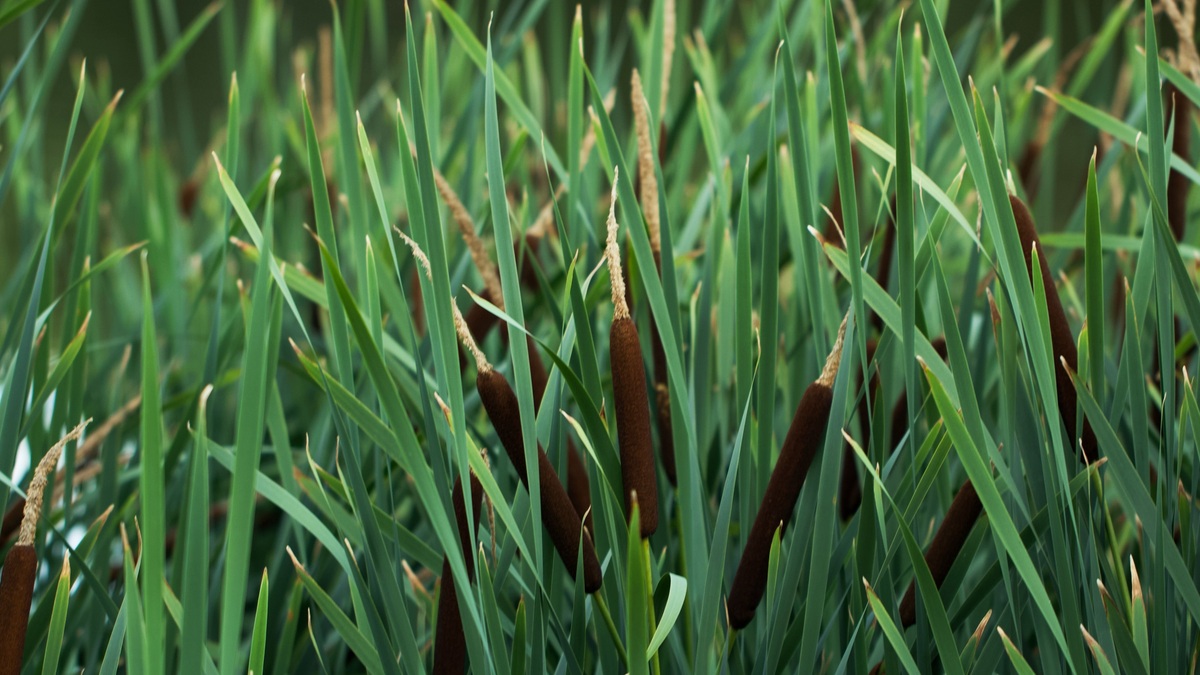
Broadleaf cattail (Typha latifolia) is native to North America. Its dense rhizomes stabilize wet ground and its stems provide nesting habitat. Cattail identity matters because narrowleaf cattail is nonnative in much of the region and hybrid cattail, Typha × glauca, can spread aggressively. The National Park Service cattail research explains these distinctions.
Wild rice should also be understood as more than shoreline scenery. Manoomin is a culturally important food and living relative in Anishinaabe communities. Water-level regulation, wakes and poor water quality can damage stands, so restoration requires attention to hydrology and community knowledge rather than planting seed alone.
Wet meadows connect lake and land
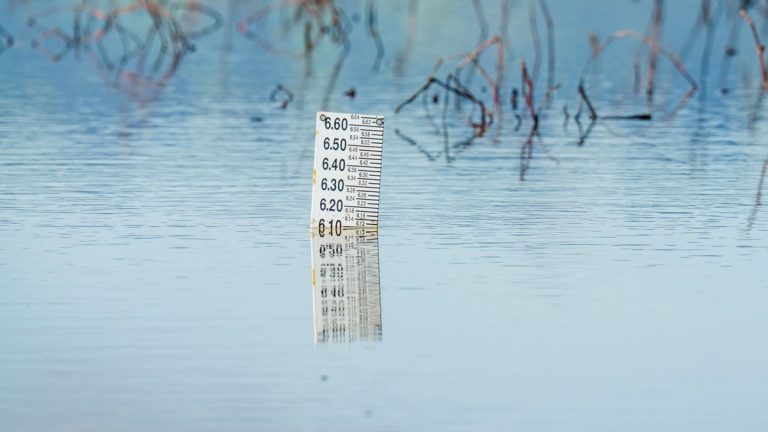
Water levels in the Great Lakes rise and fall over seasons and longer cycles. A low-water interval exposes sediment where annual plants may germinate. Higher water later removes some woody growth and reopens shallow habitat. Coastal wetland diversity partly depends on this movement rather than a fixed shoreline.
Lake sedge (Carex lacustris), bluejoint grass and other moisture-tolerant species occupy wet meadows. Farther landward, red-osier dogwood and willows can become common. The exact community changes with soil, wave exposure and the length of flooding. A plant typical of a sheltered Lake Erie marsh may be absent from a rocky Lake Superior coast.
Plants support the Great Lakes food web
Aquatic plants produce organic matter and release oxygen while growing. Their physical structure is equally important. Leaves offer refuge from predators, stems collect small prey and submerged beds create spawning surfaces. More than 80 fish species use Great Lakes coastal wetlands during some part of their life cycle, according to EPA monitoring.
Plant beds also influence water clarity. Roots and rhizomes secure sediment, while stems reduce the energy reaching the bottom. Nutrients taken into plant tissue may later return to the water as leaves decay. The outcome depends on water exchange and decomposition, so vegetation is one part of wetland chemistry rather than a universal filter.
Seasonal dieback is normal for many species. Annual shoots collapse while rhizomes or seeds survive winter. Managers compare repeated surveys at similar times of year because a spring visit and a late-summer visit can produce very different impressions of abundance.
Waterfowl eat seeds and use marsh cover, while muskrats cut stems and open channels through dense stands. These interactions create patches rather than a uniform wall of plants. A healthy wetland can include open water beside emergent vegetation and submerged beds.
Invasive plants can replace diverse communities
Invasive Phragmites, a nonnative lineage of common reed, can form tall single-species stands along Great Lakes shores. Michigan’s Phragmites program warns that dense growth crowds native plants and reduces access. The region also has native common reed, so correct identification should precede treatment.
Eurasian watermilfoil (Myriophyllum spicatum) spreads through fragments and can make thick surface mats. Purple loosestrife invades wetlands, while European frog-bit floats in sheltered water. Nonnative status alone does not prove harm, but an invasive designation reflects demonstrated ecological, economic or health impacts.
Plant communities differ among the five lakes
Monitoring from 2011 through 2018 found that coastal wetland vegetation in Lakes Superior, Michigan and Huron generally scored better than vegetation in Lakes Erie and Ontario. The lower-lake wetlands experienced more human disturbance, nutrient runoff and invasive plants. Individual healthy and degraded wetlands still occur around every lake.
The monitoring program uses an index of biotic integrity built from characteristics of the plant community. It is an ecological indicator, not a simple species count. A wetland with many disturbance-tolerant or invasive plants may receive a poorer assessment than a site with fewer species that represent an intact native community.
Lake depth, water temperature and shoreline geology help explain local differences. Readers can place these habitats within the formation of the Great Lakes. Glacial basins created rocky exposed coasts in some areas and low, sediment-rich margins in others. Those physical settings determine where roots can anchor.
How to observe plants without spreading them
Photographing the whole plant, leaf arrangement and any flowers gives an expert more information than a close-up of one leaf. A location and water depth are also useful. Mobile identification apps can suggest possibilities, but a University of Minnesota Extension test found that aquatic plants can challenge automated identification.
Boats, anchors and trailers can carry fragments to another water body. Cleaning visible vegetation and draining water reduces that risk. Chemical or mechanical removal may require a permit and can harm native beds when applied broadly. Local natural-resource agencies should confirm the species before control begins.
Great Lakes plants belong to a larger connected system. Argo’s overview of how the Great Lakes are connected explains the water routes available to drifting seeds and fragments. The article on fish in Lake Michigan shows some of the animals that use vegetation as nursery and feeding habitat.