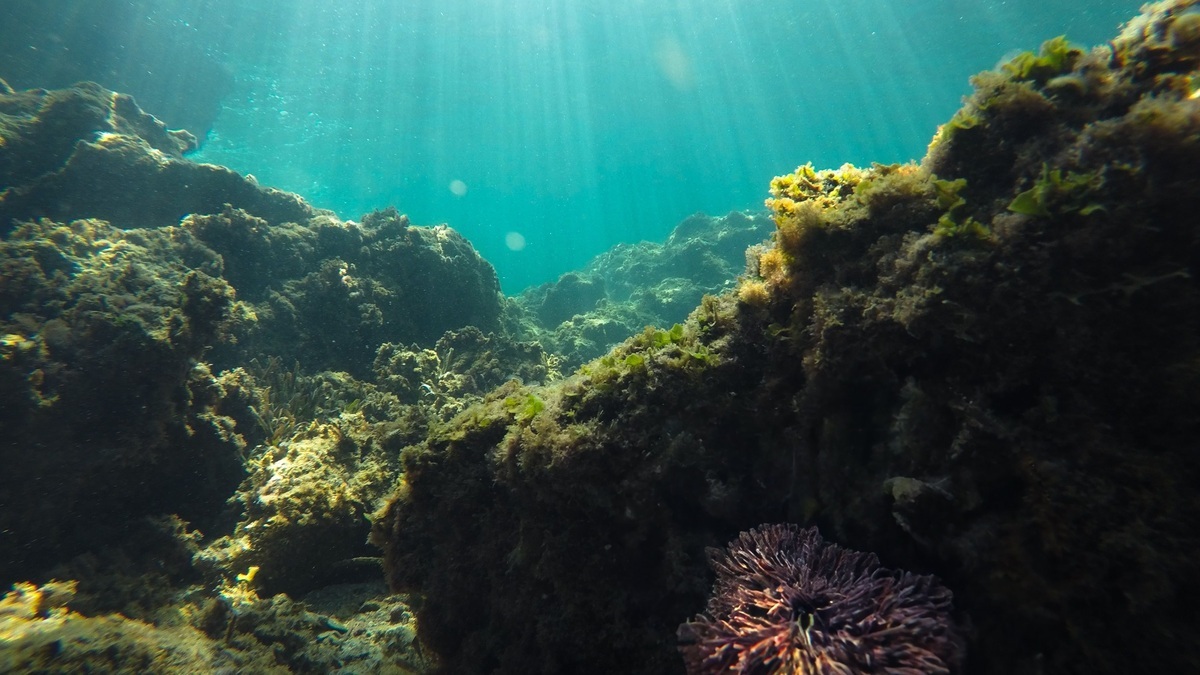
The photic zone is the part of a body of water that receives sunlight. The aphotic zone lies below the reach of useful sunlight and remains dark apart from bioluminescence. Their boundary is governed by light, not by one universal depth, so it shifts with water clarity, season and the amount of light at the surface.
Oceanographers often divide the illuminated water further. The upper euphotic layer receives enough light for photosynthesis to exceed respiration over time. Beneath it, a disphotic or twilight layer retains faint light that animals can see but plants cannot use for sustained net growth. NOAA’s account of light in the ocean explains why red wavelengths disappear first while blue-green light travels farther.
The aphotic zone begins once sunlight becomes biologically negligible. It contains most of the ocean by volume and includes water from the lower twilight region through the deepest trenches.
Water removes colors at different rates
Sunlight entering the sea is absorbed and scattered by water molecules, dissolved material and suspended particles. Long red wavelengths are absorbed rapidly. Blue light penetrates clear open-ocean water more effectively, giving underwater scenes their familiar color.
Phytoplankton, sediment and colored dissolved organic matter shorten the light path. Coastal water can become dark within a few meters after runoff or a bloom, while exceptionally clear tropical water carries measurable light much deeper.
Light attenuation is measured with underwater radiometers or estimated from optical sensors. Researchers report the depth where light falls to a chosen fraction of its surface value, commonly one percent for a practical euphotic-zone boundary.
Optical boundaries also influence remote sensing. Ocean-color satellites estimate pigments and suspended matter from light leaving the upper ocean, but they cannot see directly into the aphotic interior. Researchers use those surface patterns to plan profiles, then compare the measured attenuation with plankton and particle concentrations through depth.
A profiling radiometer measures downwelling light at several wavelengths as it descends. Scientists compare those readings with surface irradiance to calculate attenuation coefficients. Chlorophyll fluorescence and particle sensors collected on the same cast help explain why two stations with equal surface sunlight can have very different photic depths.
Photosynthesis sets the productive limit
Phytoplankton require enough photons to fix carbon, but they also use energy through respiration. The compensation depth occurs where photosynthetic production balances respiratory loss. Below it, a population cannot maintain positive growth by photosynthesis alone.
The compensation depth changes with species, nutrient supply and mixing. A cell carried rapidly between bright and dim water experiences an average light history rather than the intensity measured at one point. A fixed one-percent rule is therefore an operational approximation.
Most marine primary production occurs in the euphotic zone. Sinking cells and waste export a portion of that production downward as marine snow, connecting the sunlit surface with animals and microbes living in darkness.
Ultraviolet radiation occupies only the upper illuminated water because it is absorbed strongly, yet it can damage plankton DNA and alter dissolved organic molecules. Organisms use protective pigments or move deeper during intense daylight. The photic zone contains its own vertical light niches rather than one uniform illuminated habitat.
Life below sunlight uses imported or chemical energy
Aphotic communities depend heavily on organic matter made above. Bacteria consume sinking particles, zooplankton intercept them and larger animals hunt the consumers. Food becomes sparse with depth because particles are eaten and decomposed repeatedly during descent.
Hydrothermal vents and cold seeps provide a second route. Chemosynthetic microbes use hydrogen sulfide, methane or hydrogen as energy sources. Their local production supports dense communities even on a dark seafloor far below photosynthetic light.
NOAA’s deep-ocean overview describes the environmental pressure and darkness that dominate this vast habitat. Darkness does not mean the water is empty or biologically inactive.
The supply from above changes with surface productivity. A spring bloom can send a distinct pulse of marine snow into dark water, while a nutrient-poor gyre exports much less. Deep communities experience the history of the illuminated layer through the timing, size and composition of those falling particles.
Darkness also contains chemical boundaries. Respiration consumes dissolved oxygen as organisms process organic matter and weak circulation may produce an oxygen minimum. The depth of that chemical feature can cross the photic boundary because light absorption and water ventilation follow different controls.
Eyes and light organs reveal the transition
Animals in the twilight zone may have large sensitive eyes, reflective tissues or upward-facing vision that detects silhouettes. Many produce their own light. Bioluminescence can attract prey, confuse predators and signal to mates where sunlight is weak or absent.
Below the useful range of sunlight, red coloration can act as camouflage because no red illumination remains to reflect. Some predators generate red bioluminescence and can illuminate prey that lack sensitivity to those wavelengths.
Daily vertical migrants cross the boundary. They feed near the surface at night and retreat to dim water by day. Their movement transfers carbon to depth through respiration and waste, so the light gradient affects global biogeochemistry as well as vision.
The boundary moves through space and time
Storms stir sediment and reduce coastal clarity. Seasonal plankton blooms absorb light, while sea ice and snow shade polar water. Sun angle changes by latitude and season. The photic depth can therefore shift without any change in the seabed.
Scientists map clarity with Secchi disks, profiles and satellite ocean-color observations. Satellites see only the upper surface, so ships and autonomous instruments are needed to establish the full vertical optical profile.
Light also interacts with oxygen. Photosynthesis supplies oxygen near the surface, while respiration consumes it below. Argo’s explanation of an oxygen minimum zone shows how sinking organic matter and weak ventilation create a separate chemical boundary that does not always match the light boundary.
In polar seas, snow-covered ice can reduce underwater light even while the sun remains above the horizon. Melt ponds and openings later create bright patches that phytoplankton exploit. WHOI’s description of the sunlit ocean zone provides the broader setting for this shifting optical habitat.
Photic and aphotic are functional labels
The labels describe available light in open water and can also be applied to lakes. They should not be confused with pelagic depth-zone names such as epipelagic or mesopelagic, which use conventional depth ranges. The lower photic boundary can move within those ranges.
A seafloor can lie within the photic zone in shallow water, allowing seagrass or algae to grow on the bottom. Deeper benthic habitat is aphotic. The terms identify illumination, while benthic and pelagic identify whether a habitat is on the bottom or in the water column.
Photic versus aphotic is therefore a comparison of energy conditions. Above the boundary, sunlight can support photosynthesis. Below it, ecosystems depend on exported organic matter, predation or chemical energy. Measuring the transition helps researchers estimate productivity, animal habitat and carbon transport.
Clear-water depth alone cannot predict photosynthesis because light quality changes as well as intensity. Accessory pigments let different phytoplankton absorb blue-green wavelengths with different efficiency. Researchers pair spectral light profiles with pigment analysis, then estimate which organisms can photosynthesize at each depth instead of treating all visible photons as equivalent. The result links optical physics to the actual depth of carbon fixation. A measurement made at noon also cannot stand for the whole day. Integrating light over daylight hours gives a better estimate of the energy available to cells carried up and down by turbulence. Cloud cover can also change the daily total without moving the optical boundary.
The light boundary cuts across depth layers rather than replacing them. Compare the sunlit epipelagic zone with the dimmer mesopelagic zone.