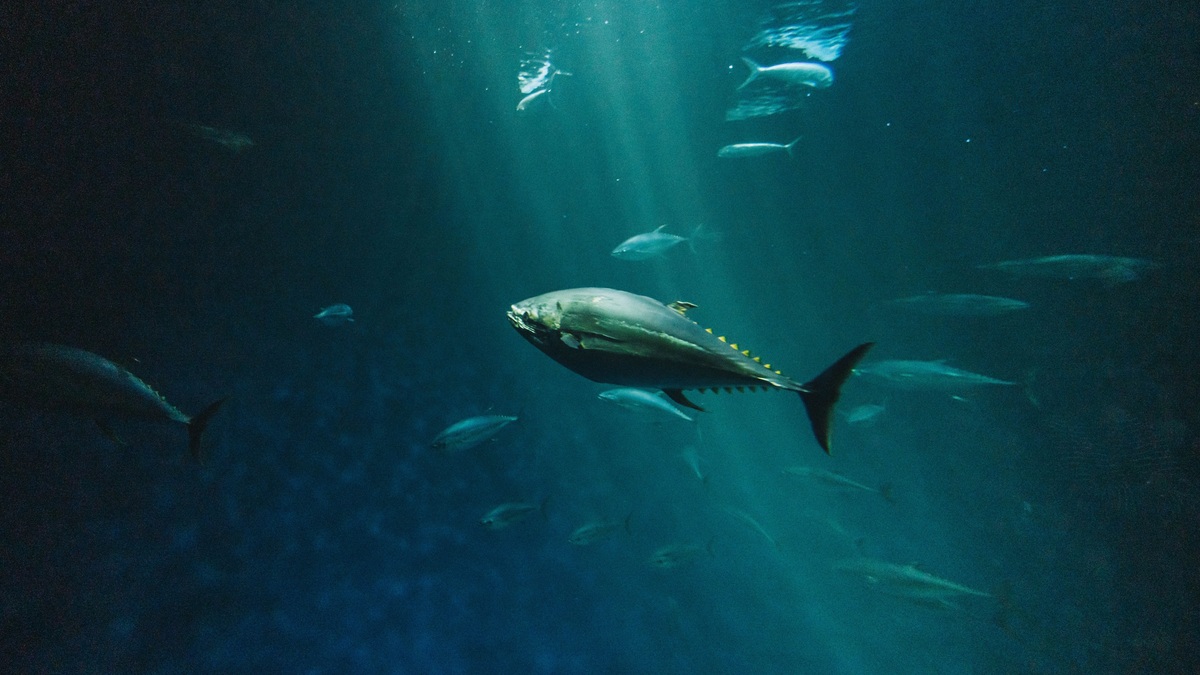
The Pacific Ocean food web begins with organisms too small to see from a boat and ends with animals that can cross entire ocean basins. Sunlit surface waters support phytoplankton, microscopic algae that convert light and dissolved carbon dioxide into living tissue. Zooplankton graze on those cells, small fish eat the grazers and larger hunters draw energy upward through many overlapping feeding paths.
A food web is more accurate than a food chain because most marine animals eat more than one kind of prey. A juvenile salmon and an adult tuna occupy different places in the network, while squid can act as both hunters and prey. The Pacific also contains distinct food webs in coastal kelp forests, the open ocean, polar waters and the deep sea.
Arrows in a scientific food-web diagram point from food toward the consumer, showing the direction energy moves. They do not mean every encounter ends in predation. The strength of each connection changes as populations migrate, reproduce or respond to ocean conditions, which is why researchers measure diets repeatedly rather than drawing a permanent chart.
Phytoplankton capture the first usable energy
Most Pacific food webs depend on phytoplankton in the upper, illuminated layer. NOAA describes these microscopic algae as the base of several aquatic food webs. They need sunlight and nutrients such as nitrate and phosphate, so their growth varies with season, latitude, currents and the supply of deeper water to the surface.
Coastal upwelling can deliver nutrient-rich water into the sunlit zone. The result may be a burst of primary production that supports zooplankton and fish. The effect is especially important along productive margins such as the California Current. Argo’s explanation of why deep ocean water rises toward the surface describes the physical process behind many of these productive areas.
Phytoplankton do more than feed animals. Their photosynthesis releases oxygen and some of the carbon they take up later sinks as cells are eaten or die. The Pacific’s biological network is therefore connected to the planet’s carbon cycle as well as its fisheries.
Different phytoplankton flourish under different conditions. Diatoms build rigid silica shells and often respond quickly when nutrients become available. Small cyanobacteria can dominate warm, nutrient-poor tropical water. Satellite measurements of ocean color reveal surface chlorophyll across broad regions, but ships still collect water to identify organisms and measure productivity directly.
Zooplankton connect algae to fish
Zooplankton include drifting animals and the larvae of larger species. Copepods, krill and many gelatinous organisms graze on phytoplankton or prey on smaller plankton. In a simple pathway, phytoplankton feed krill, krill feed fish and fish support seabirds or marine mammals. Real feeding relationships branch in many directions.
Timing can be as important as abundance. Fish larvae need prey of the right size during a narrow stage of development. If a phytoplankton bloom and the following zooplankton increase occur too early, young fish may miss the richest feeding period. Ocean temperature and currents can change that match.
Krill illustrate how one consumer can support very different hunters. Fish and seabirds feed on them and baleen whales can filter enormous numbers from the water. Copepods are smaller but often more abundant. Both groups package energy captured by algae into prey large enough for bigger animals to use.
NOAA’s Pacific food-web research follows primary production, zooplankton and fish larvae because survival at these lower levels affects future fish populations. A weak link near the bottom can reduce the energy available much higher in the web.
Micronekton fill the difficult middle
Between plankton and familiar predators lies a group called micronekton. It includes small swimming fish, crustaceans, cephalopods and jellies, often no longer than about 20 centimeters. Many spend daylight hours in dark midwater and rise at night to feed, a daily movement that transports carbon and energy through the water column.
Scientists have difficulty sampling this layer with standard nets. Some animals detect approaching gear, while fragile bodies may be damaged. NOAA researchers found an unusual window into the midwater community by examining lancetfish stomachs. Their prey often remains recognizable because digestion is slow.
The NOAA lancetfish project has identified prey from 97 families. The work helps researchers compare what commercial species such as tuna and swordfish eat with what nets collect. It also shows why the middle of the food web cannot be reduced to a single step between plankton and predators.
Many micronekton perform diel vertical migration, rising toward the surface after sunset and descending before daylight. The daily journey reduces exposure to visual predators while allowing feeding in productive upper water. Because migrating animals respire and release waste at depth, the movement carries carbon below the surface layer.
Large predators depend on many pathways
Tuna, billfish, sharks, seabirds and marine mammals occupy upper trophic levels, but the label apex predator depends on the ecosystem and life stage being considered. A large shark may have few natural predators as an adult, while its young remain vulnerable. Killer whales can hunt animals that otherwise sit near the top.
Predators integrate changes from below. A tuna may follow squid or schooling fish across broad areas, while seabirds reveal prey near the surface. Readers can explore individual examples in Argo’s list of ocean predators at the top of the food chain. Their size conceals how strongly they depend on microscopic production.
Removing a predator can also change lower levels through a trophic cascade. In Pacific kelp forests, sea otters eat sea urchins that graze on kelp. Where otter predation is strong, kelp can persist more readily. NOAA uses this relationship to explain how a change near the top can propagate through an aquatic food web.
Even an apex predator’s role varies by place. A salmon shark is a high-level hunter in the North Pacific, while tuna, toothed whales and other sharks share upper positions in tropical waters. Scientists use diet records and tracking data to determine which pathways dominate instead of assigning one universal ladder to the entire ocean.
Currents and climate continually rearrange the web
The Pacific is not one uniform ecosystem. Equatorial currents, coastal upwelling, seasonal mixing and polar ice create different nutrient conditions. El Niño can suppress upwelling in parts of the eastern Pacific, reducing the flow of nutrients into surface waters. Fish and their predators may shift range as the productive zones move.
Ocean warming changes metabolism and habitat boundaries. Acidification can affect shell-building plankton, while low-oxygen zones restrict where many animals can live. These pressures interact, so scientists increasingly study whole ecosystems rather than managing each commercial species in isolation.
The network also includes decomposers. Bacteria recycle organic matter, returning nutrients that can support new growth. Sinking particles feed deep-water organisms far below the sunlit zone. Pacific food webs therefore move energy vertically as well as from prey to predator, linking the bright surface to the deep seafloor.
Scientists monitor this movement with stomach-content studies, stable isotopes and biochemical tracers. Each method describes a different timescale. A stomach records recent meals, while chemical signatures in tissue can integrate diet over weeks or months. Combining them helps distinguish a temporary feeding event from a durable change in the ecosystem.
Human harvest adds another pressure. Ecosystem-based fisheries management considers prey availability and habitat conditions alongside the abundance of a target fish. The approach recognizes that a tuna population cannot be understood without the micronekton it eats or the plankton production that ultimately supports that prey.