A lake ecosystem contains far more than fish. Microscopic algae capture sunlight, zooplankton graze in open water, rooted plants shelter animals near shore and microbes break down organic matter on the bottom. The organisms differ among lakes because depth, temperature, nutrients, oxygen and water clarity create distinct habitats.
Ecologists describe lakes as lentic ecosystems, meaning bodies of standing water. Even so, their water is never ecologically still. Wind mixes the surface, seasonal temperature changes rearrange oxygen and streams deliver material from the watershed. Each process changes which organisms can live in a particular place.
Species also differ with latitude and lake history. A recently formed volcanic crater lake starts with a different biological community from an old floodplain lake connected to a river. Colonization continues through flowing water, animal movement and windblown resting stages.
Producers supply food and oxygen
Phytoplankton are microscopic algae suspended in the water. Along with attached algae and aquatic plants, they use photosynthesis to build organic matter from carbon dioxide and water. They form the productive base of most lake food webs and release oxygen while light is available.
Rooted plants are most common in shallow areas where sunlight reaches the bottom. Water lilies place leaves at the surface, while submerged plants grow beneath it. These plants provide refuge for young fish and surfaces for algae, insects and snails. Their stems also slow water movement near shore.
Nutrient supply sets limits on production. Nitrogen and phosphorus occur naturally, but excessive inputs can fuel dense algal growth. The National Park Service explains how fertilizer runoff can contribute to harmful blooms and oxygen loss. Cyanobacteria are bacteria capable of photosynthesis, not true algae, despite the common name blue-green algae.
Production changes through the year. Spring light and mixing can favor a plankton bloom before dense summer layers develop. Aquatic plants expand as water warms, then die back in cold climates. Consumers respond to these pulses, so the abundance measured on one sampling day is a snapshot rather than a permanent census.
Zooplankton and invertebrates occupy the middle
Zooplankton include tiny crustaceans and rotifers that drift or swim weakly. Many consume phytoplankton, while predatory forms eat other zooplankton. Their numbers can rise quickly when food is abundant and fish larvae often depend on them during early growth.
Insects connect water with land. Mayfly and dragonfly nymphs spend much of their lives underwater before emerging as winged adults. Midges, beetles and caddisflies occupy different sediments or vegetation. Freshwater mussels filter particles from the water and snails graze on algae attached to rocks and plants.
Crayfish and worms process material on or within the bottom. Collectively, these benthic invertebrates provide food for fish, amphibians and birds. Their presence can also reveal water quality because some species tolerate pollution or low oxygen better than others.
Freshwater sponges and microscopic protozoans are easy to overlook, yet they occupy the same web. Sponges filter suspended particles. Protozoans graze on bacteria or tiny algae, transferring microbial production to larger zooplankton. A complete lake food web includes this microbial loop as well as the animals visible from shore.
Fish fill several feeding roles
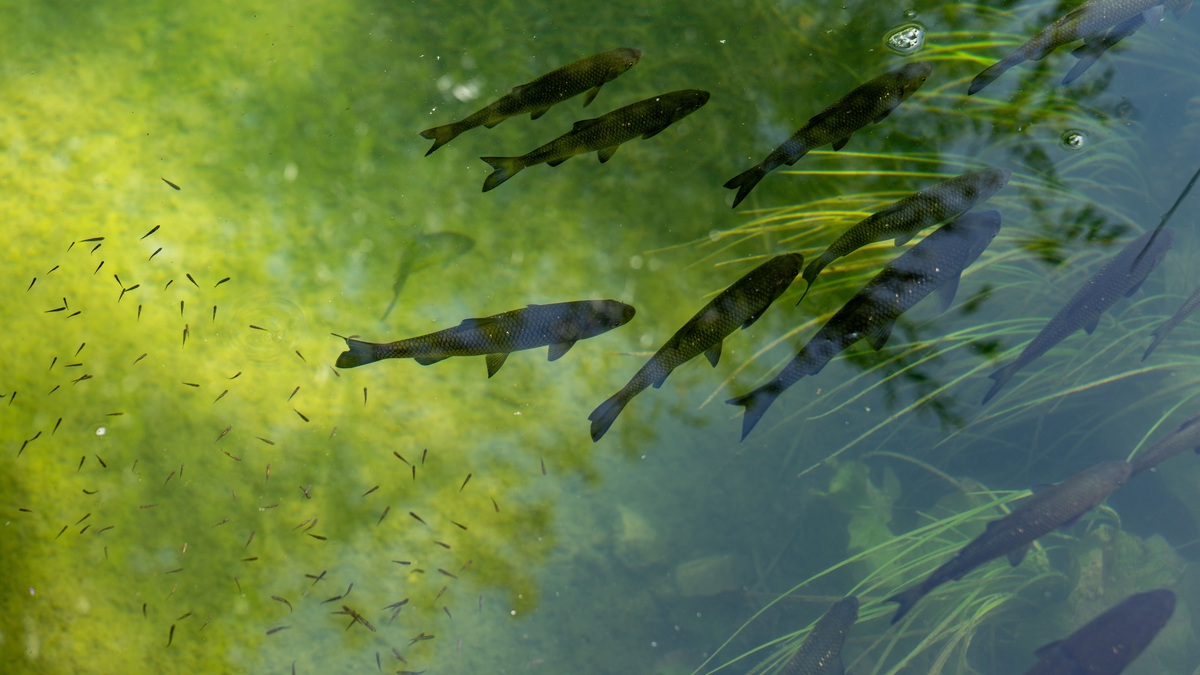
Lake fish cannot be placed at one trophic level. Minnows may eat plankton or insect larvae. Bass and pike prey on fish, while suckers feed near the bottom. Diets often change as a fish grows, which allows one species to link several parts of the food web.
Cold-water fish such as trout need suitable temperatures and enough dissolved oxygen. Warm-water species can occupy shallower, warmer habitat, but every fish has physiological limits. Invasive species can alter those relationships by consuming unfamiliar prey or competing with native animals. Released pets are one route into lakes, as Argo’s report on goldfish disrupting lake ecosystems shows.
Fish-eating birds and mammals extend the web beyond the shoreline. Ospreys take fish near the surface, while loons dive. Otters hunt fish and invertebrates. Nutrients then move between water and land through feeding, waste and decomposition.
Amphibians link the two environments in another way. Tadpoles may graze algae or consume detritus before adult frogs leave the water and eat terrestrial insects. Turtles use lakes for feeding and shelter, while reptiles in colder regions depend on suitable bottom habitat to survive winter.
Lake zones create different communities
The littoral zone is the shallow area where enough light reaches the bottom for attached plants. It usually contains the greatest variety of habitats. The limnetic zone is open, sunlit water away from shore, where phytoplankton and free-swimming zooplankton dominate.
Deep water below the well-lit layer is called the profundal zone. Little photosynthesis occurs there, so animals depend on organic material produced above or washed in from land. The benthic zone is the lake bottom at any depth. Bacteria and fungi are especially important there because they decompose dead tissue.
The boundaries move with water clarity and lake level. A clear lake may support plants at greater depth than a turbid lake. Shallow ponds may receive light across most of the bottom, one reason the National Park Service distinguishes many ponds from larger, murkier lakes.
Small habitat features add complexity within each zone. Fallen trees create cover and feeding surfaces, while gravel beds offer different shelter from soft mud. Nearshore wetlands can serve as nurseries before young fish move into open water. Removing shoreline vegetation therefore affects organisms far beyond the plants themselves.
Seasonal mixing redistributes oxygen
Many temperate lakes separate into layers during summer. The warm upper epilimnion mixes with wind and receives oxygen from the atmosphere. Below the thermocline lies colder water called the hypolimnion. The density difference limits mixing between them.
Decomposers continue consuming oxygen in deep water as organic matter sinks. If the lower layer receives no replacement oxygen, concentrations can fall enough to exclude fish. The EPA’s dissolved-oxygen guide explains how oxygen usually declines with depth during summer stratification in productive lakes.
Cooling surface water can erase the density barrier in autumn, allowing wind to mix the lake. Spring turnover can produce another mixing period after ice melts. The exact cycle depends on climate and lake shape, so tropical, polar and very shallow lakes may behave differently.
Decomposers close the nutrient cycle
Bacteria and fungi digest dead algae, plant fragments, animal remains and waste. Their activity releases nutrients into water or sediment, making those elements available for future growth. Without decomposition, much of a lake’s nitrogen and phosphorus would remain locked in dead material.
Decomposition can also intensify oxygen loss when large algal blooms die. Nutrient-rich lakes may produce abundant biomass at the surface, followed by heavy microbial demand below. The result helps explain why a lake can look productive while deep habitat becomes unsuitable for oxygen-sensitive organisms.
Every lake community is therefore a moving network rather than a fixed species list. Light determines where producers can grow, temperature and oxygen restrict animals and decomposers return material to circulation. Watershed changes reach into the same network because a lake receives water, sediment and nutrients from the land around it.
Scientists survey organisms with nets, traps, water samples and environmental DNA. DNA fragments shed into water can reveal species that evade direct capture, although detection alone does not show population size. Repeated sampling across seasons is needed because plankton blooms, insect emergence and fish movement can change the apparent community.
Lake type provides useful context for those observations. A nutrient-poor oligotrophic lake usually has clear water and relatively low algal production. A eutrophic lake supports more plant or algal growth and may lose deep-water oxygen during decomposition. Argo’s overview of how excess nutrients trigger blooms follows one route by which human activity can shift the balance.
Those organisms depend on the nearshore conditions described in what a lakeshore habitat is. Their ecological role also helps explain why lakes matter.