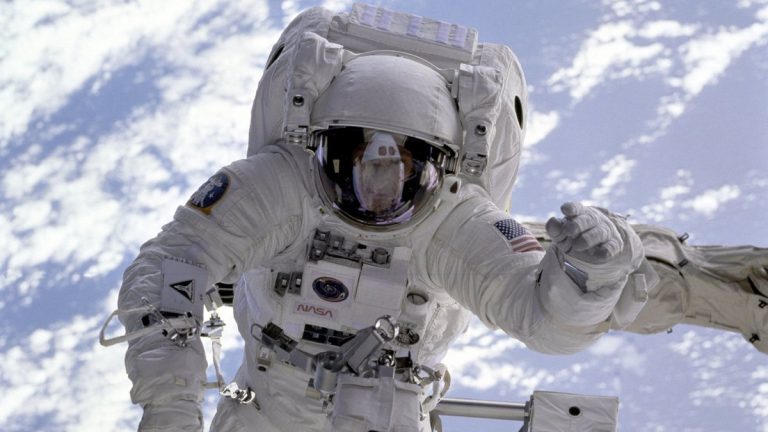
A strange challenge can await astronauts after they survive the heat and force of reentry. Once their capsule reaches the ocean, rolling waves may trigger nausea at the same time the crew must check equipment, communicate with recovery teams and prepare to leave the spacecraft.
Researchers have tested a possible way to ease that problem: show crewmembers where the capsule is about to move. In a ground experiment, people who saw anticipatory visual cues one second before each simulated wave were more likely to complete an hour of motion and experienced a slower rise in stomach-related symptoms.
The study, published on June 2, 2025, in npj Microgravity, was led by Taylor L. Lonner and colleagues at the University of Colorado Boulder. The results suggest that a small amount of advance warning could help the brain prepare for motion during the difficult return from microgravity.
Why returning astronauts can become sick
People on Earth normally use gravity as a steady reference. The inner ear senses acceleration and head movement, while the eyes provide another stream of information about direction. The brain combines these signals to estimate which way is up and how the body is moving.
During spaceflight, weightlessness changes that relationship. Signals that once indicated a tilt relative to gravity have a different meaning in orbit, so the nervous system gradually adjusts. After landing, the brain must again learn how to interpret movement under Earth’s gravity. Researchers call the sickness that can occur during this return entry motion sickness.
Capsule landings can make the problem worse because the ocean moves the vehicle after the crew has passed through another major gravity change. Rocking, rolling and sideways motion may produce sensory conflict, a mismatch between expected movement and the signals arriving from the eyes and inner ear. Symptoms can include nausea, poor balance, sweating, tiredness and general discomfort.
How the team simulated a splashdown
The researchers needed to reproduce two parts of an astronaut’s return without sending participants into orbit. First came an altered-gravity experience designed to disturb the balance system. Wave-like movement followed immediately afterward, recreating some of the motion expected inside a capsule floating at sea.
Participants spent about one hour exposed to a force of 2Gx in the Human Eccentric Rotator Device, a centrifuge that created a force roughly twice normal gravity along the body’s front-to-back direction. When the centrifuge stopped, the volunteers moved to the Tilt Translation Sled, which combined sideways travel with rolling motion for as long as one hour.
The experiment compared three conditions. A control group received no useful Earth-fixed visual reference and kept the head and torso restrained. A second group could move the head and upper body while trying to remain upright. The third group was restrained but received visual information showing present movement and the movement expected one second later. The complete experimental details are available in the paper’s open-access record.
A virtual view of the next wave
All participants wore a Meta Quest 2 virtual-reality headset. For the anticipatory group, the headset displayed an Earth-fixed forest scene that moved in a way consistent with the participant’s actual motion. The stable visual setting gave the brain a reference for tilt and sideways travel.
An overlay added the advance warning. A magenta human-like figure moved along a yellow track to show where the participant would be one second in the future. A black arrow indicated the expected direction and relative strength of the combined pull caused by gravity and acceleration.
Advance information could help the brain form a more accurate prediction before the body feels each movement. As the paper’s abstract explains, “Enabling the brain to form a better expectation of sensory stimulation, anticipatory cues reduce the incidence of nausea.” The cue therefore served as a preview of the next physical sensation rather than a simple picture of the current scene.
Visual cues slowed the rise of nausea
Participants reported nausea every minute using four levels: none, slight, moderate and severe. Every five minutes, they also completed the Motion Sickness Questionnaire, which covered a wider range of symptoms. Researchers tracked anxiety separately to see whether worry or distress could help explain changes during the simulated waves.
The overall questionnaire scores did not differ significantly among the three groups. A closer analysis of stomach-related symptoms found a clearer result. Gastrointestinal symptoms developed more slowly in the anticipatory-cue group than in either the control group or the group using active posture.
The strongest practical difference appeared in how many people could tolerate the entire session. Ninety percent of the anticipatory-cue group completed 60 minutes of wave-like motion without reaching sustained moderate nausea. The figure was 33 percent in the control group and 53 percent among participants using active posture.
Most people receiving advance cues stayed at slight nausea rather than progressing to moderate nausea. Anxiety rose slightly during wave motion and then returned toward its starting level during recovery, with no notable difference among the groups. Ocular symptoms also followed a similar course across all three conditions, suggesting that the main benefit appeared in nausea-related symptoms rather than general headset discomfort.
Why active posture showed limited benefit
The team expected active postural control to give participants greater command over their motion. Volunteers in this group kept their heads and torsos free and were instructed to use their neck and upper body to keep the head aligned with Earth’s vertical direction as the sled rolled.
Active movement can sometimes improve a person’s estimate of where the body is going because the brain knows which movement it has commanded. Drivers, for example, often have more information about an approaching turn than passengers. The researchers tested whether a similar sense of control could help during a simulated astronaut landing.
The active-posture condition did not significantly reduce the development of motion sickness compared with the control condition. Head and torso movement may have added more signals for the brain to interpret while the balance system was already disturbed by the centrifuge. Earlier motion-sickness research has also found that head movement under unusual force conditions can increase discomfort.
Keeping the head upright proved difficult during prolonged rolling and sideways motion. Individual posture strategies also varied, which may have reduced the consistency of the intervention. A more structured movement method, added training, or a different restraint arrangement could produce another outcome, although each possibility would require further testing.
Balance recovered within an hour
Motion sickness was only part of the experiment. The researchers also measured standing balance because astronauts may need to move safely soon after landing. A person who feels well enough to leave a capsule can still have trouble controlling posture after the nervous system has adapted to weightlessness.
Across all three groups, participants swayed more after the wave-like motion. The increase was statistically significant, showing that the simulated landing affected the balance system even when nausea remained mild. Anticipatory cues did not produce a clear improvement in this part of the test.
After one hour of recovery, balance performance had returned to a level equivalent to the starting measurement. The result suggests that the disturbance created by the ground simulation was temporary, although actual astronauts may respond differently after days or months in microgravity.
Balance recovery and nausea relief may therefore require separate tools. Visual warnings could help a crewmember tolerate capsule motion, while physical support and postflight rehabilitation could address unsteady standing. Mission planners must consider both problems when deciding how quickly a crew can begin demanding tasks after splashdown.
How future capsules could use motion warnings
A working version of crew capsule motion warnings would need accurate information about the vehicle’s movement. Sensors could measure roll and sideways acceleration, while software predicts where the capsule will be a short time later. A display could then present the expected direction before the crew feels the motion.
The experiment used a one-second preview, yet the best warning time remains unknown. A cue arriving too late may offer little preparation, while one arriving too early could become difficult to connect with the coming movement. Researchers also need to determine whether a full virtual scene is required or whether a simpler visual signal could provide enough information.
Mission designers would also have to place the cues where astronauts can see them while wearing helmets, using restraints, or completing landing procedures. Any system must avoid blocking alarms and flight information. The study authors’ publication record is also listed by CU Boulder, which identifies the work as a collaboration involving experts in aerospace engineering, human performance and spatial orientation.
Similar technology could have uses on Earth. Passengers in autonomous cars, aircraft cabins, ships and virtual-reality systems can become sick when they cannot predict movement. A clear preview of an approaching turn or roll may help some people prepare, although each setting has different motion patterns and safety needs.
Limits of the ground-based experiment
The experiment recreated selected parts of a spaceflight return and its participants had not spent time in microgravity. A centrifuge can disturb how the balance system interprets gravity, but it cannot reproduce every biological change caused by living in orbit. Real astronauts may also face fatigue, dehydration, heavy equipment and the physical stress of reentry.
The simulated sea motion followed a controlled profile. Ocean waves around a landed capsule can vary in direction, timing and strength, while wind and recovery operations may introduce additional movement. Future tests could examine a wider range of sea states and evaluate whether cues remain useful when the motion becomes less predictable.
Participant dropouts also complicate motion-sickness studies because the people who feel worst often stop first. In this experiment, sustained moderate nausea was itself a stopping point and an important measure of whether the countermeasure helped. Technical dropouts further reduced the available data at some times.
The strongest findings concerned gastrointestinal symptoms and the ability to finish the wave session. Overall motion-sickness questionnaire scores showed no significant group difference and the visual system did not prevent the temporary decline in balance. Larger studies, astronaut testing and capsule-based trials would be needed before advance cues become operational equipment.
Even with those limits, the experiment gives engineers a concrete idea to examine. A one-second glimpse of upcoming movement helped many participants remain below moderate nausea during a difficult hour of simulated waves, offering a possible way to make the final stage of a space mission safer and easier to manage. Broader mission context is available from NASA’s Human Research Program and NASA’s International Space Station overview.