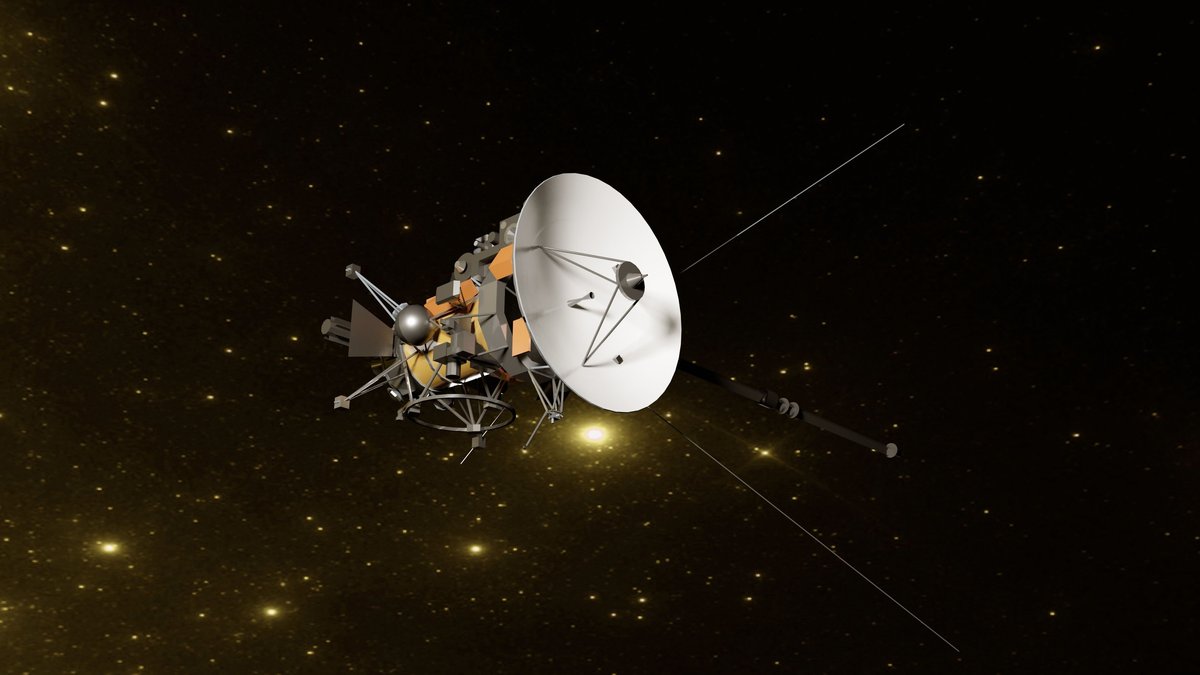
NASA’s official New Horizons announcement marks a quiet milestone from one of the most remote spacecraft ever operated. After its longest hibernation period yet, the probe has awakened in good health far beyond Pluto and is preparing to return science data from the Kuiper Belt.
The confirmation arrived on June 23 at the Johns Hopkins Applied Physics Laboratory in Laurel, Maryland. Flight controllers learned that the spacecraft had followed stored commands uploaded to its main computer last July and safely ended a 321-day hibernation period that began on August 7.
That simple health report carried an extraordinary sense of distance. New Horizons is now about 5.9 billion miles, or 9.5 billion kilometers, from Earth. At that range, even radio signals moving at light speed took about 8 hours and 52 minutes to reach the mission operations center through NASA’s Deep Space Network station near Madrid, Spain.
A record-long sleep ends in the Kuiper Belt
NASA’s New Horizons spacecraft has spent much of its long voyage cycling between active operations and hibernation. This latest sleep was the longest in the mission’s history. It lasted nearly a year and helped conserve spacecraft resources during a long cruise through the outer solar system.
Mission teams use hibernation to reduce wear and simplify operations when a spacecraft is traveling through deep space. During these periods, the ground team pauses routine commanding and data retrieval. The spacecraft continues to monitor itself and follows onboard instructions designed for long-distance operation.
For New Horizons, this approach has become a vital part of survival. The probe launched in January 2006 and has been operating for more than two decades. It now works in a region where sunlight is faint, signals take hours to cross space and every watt of power matters.
The latest wake-up shows that the spacecraft can still execute stored commands at a tremendous distance. It also gives the mission team a fresh opportunity to check the spacecraft’s health and prepare for another stretch of science observations.
The signal took nearly nine hours to arrive
Johns Hopkins Applied Physics Laboratory, known as APL, serves as the mission operations center for New Horizons. On June 23, flight controllers there received the long-awaited confirmation that the spacecraft had awakened safely. The message had traveled across billions of miles before reaching Earth.
NASA’s Deep Space Network handled that connection through its station near Madrid. The network is built for distant missions that need powerful antennas and careful scheduling. At New Horizons’ current distance, even a basic status signal becomes a long conversation with deep space.
The 8-hour and 52-minute one-way travel time affects every part of mission planning. A command sent from Earth today reaches the spacecraft many hours later. A reply then needs nearly the same amount of time to return.
Because of that delay, New Horizons relies heavily on stored command sequences and onboard autonomy. The spacecraft has to recognize certain conditions and respond safely before engineers on Earth can react. That ability becomes more important as the probe travels farther from the Sun.
APL mission operations manager Alice Bowman said the spacecraft checked in throughout the long sleep. “Every status report through this hibernation period was ‘green,’ meaning all was well aboard New Horizons each and every week.”
Science continued during hibernation
Even during hibernation, New Horizons remained scientifically active. NASA reported that the spacecraft kept gathering and storing measurements from instruments designed to study the distant environment through which it is flying.
The spacecraft’s heliospheric plasma sensors continued operating around the clock. These include Solar Wind at Pluto, also known as SWAP and the Pluto Energetic Particle Spectrometer Science Investigation, known as PEPSSI. Together, they help track particles and plasma in the outer reaches of the Sun’s influence.
New Horizons also continued collecting dust measurements with the Venetia Burney Student Dust Counter. That instrument detects tiny grains moving through space. Such measurements help researchers understand the dusty environment of the Kuiper Belt and the distant solar system.
The outer heliosphere is a vast region shaped by the solar wind, energetic particles and material from interplanetary space. New Horizons offers a rare perspective because it is moving through that region directly. Its measurements come from a place few spacecraft have ever reached.
Data collected during hibernation stayed stored onboard until the spacecraft woke up. With active operations resumed, the mission team can begin downlinking the stored science and spacecraft health information in planned stages.
What New Horizons will send home next
The first items expected from the spacecraft are health and safety data. These reports allow engineers to assess how New Horizons performed during its long sleep. They also help the team confirm that instruments and spacecraft systems are ready for the next round of operations.
After those checks, the team will begin receiving data from the three scientific instruments that kept working through hibernation. That downlink will give scientists a look at conditions in a distant part of the Kuiper Belt during the 321-day sleep.
In about three weeks, the spacecraft’s Alice ultraviolet spectrograph is scheduled to observe hydrogen gas in the outer heliosphere. Hydrogen is an important tracer in this region because it can reveal how the Sun’s bubble of influence interacts with the surrounding interstellar environment.
At the same time, SWAP, PEPSSI and the dust counter will continue collecting measurements. The spacecraft and instrument teams will also conduct a series of checkouts. These tests are practical and important, especially for a spacecraft operating far beyond its original Pluto encounter.
The ground team is also upgrading software used to support operations from Earth. NASA said those ground-system improvements are intended to make spacecraft maintenance easier. Testing is already underway and is expected to continue through the year.
A spacecraft built for the outer dark
New Horizons is now operating with updated autonomy logic for conditions farther from the Sun. These changes help the spacecraft handle the realities of deep-space exploration. Power output gradually decreases over time and the radio travel time keeps growing as the spacecraft recedes from Earth.
Autonomy matters because New Horizons cannot depend on instant instructions from mission control. If something needs attention, the spacecraft must follow onboard logic while engineers wait through the long signal delay. That onboard decision-making helps protect the mission during cruise periods.
Hibernation also helps the spacecraft manage limited resources. Long cruise operations can be demanding even when a probe is healthy. By reducing activity during quieter phases, the team can keep essential systems ready for planned science work.
The spacecraft’s distance adds another challenge. Signals grow weaker as they spread across space. NASA’s Deep Space Network provides the antenna power and sensitivity needed to keep New Horizons connected from billions of miles away.
Despite those constraints, the probe remains an active scientific platform. Its role has expanded from a flyby spacecraft into a long-duration explorer of the distant solar system. Each successful wake-up helps extend that story.
From Pluto to the edge of the heliosphere
New Horizons began its journey in January 2006 with a record-setting launch. It flew past Jupiter in February 2007 and used that encounter to gain speed. The flyby also returned views of the giant planet and its moons.
The mission became historic in July 2015 when it carried out the first exploration of the Pluto system. That encounter transformed Pluto from a distant point of light into a world with mountains, plains, haze layers and surprising complexity.
In January 2019, New Horizons completed the first close exploration of a Kuiper Belt object, Arrokoth. That small world gave scientists a close look at a primitive body from the early solar system. The encounter helped researchers study how planetesimals may have formed in the cold outskirts of the Sun’s domain.
Since then, the spacecraft has continued studying the Sun’s outer heliosphere and additional Kuiper Belt objects. Its current work is quieter than a dramatic flyby, yet it addresses big questions about the boundary region where the solar wind meets the broader galactic environment.
The new wake-up confirms that New Horizons is ready for another chapter. Nearly 6 billion miles from Earth, it is still listening, still measuring and still sending back pieces of a region humans have barely begun to explore.