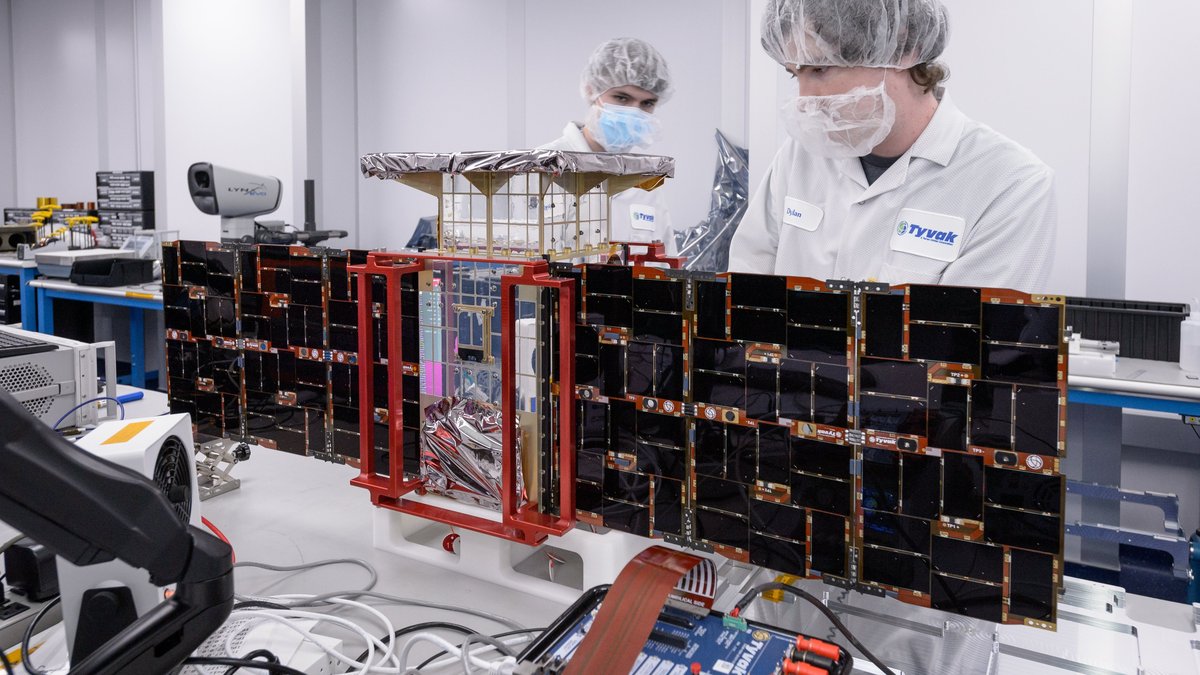
NASA’s CAPSTONE announcement closes a small spacecraft mission with large implications for the Moon. The microwave-sized spacecraft tested navigation and communications tools that could help future missions operate near the Moon with fewer instructions from Earth.
The mission’s full name is the Cislunar Autonomous Positioning System Technology Operations and Navigation Experiment. That mouthful describes a practical goal. Future lunar spacecraft will need to know where they are, share data through patchy links and keep working when Earth is out of reach. CAPSTONE gave NASA a way to try those ideas in lunar space.
The spacecraft launched in June 2022 and became the first U.S. commercial mission at the Moon. It also became the first spacecraft to fly and characterize a three-body lunar orbit that uses the combined gravity of Earth and the Moon. That path reduces the fuel needed to maintain a stable route near the Moon.
CAPSTONE finishes its extended lunar test
CAPSTONE completed its NASA extended mission activities in June 2026 after serving as a testbed for lunar navigation, communications, networking and flexible spacecraft software. NASA says the extended mission turned an already successful spacecraft into a working laboratory for technologies that future Moon missions may need.
The spacecraft is owned and operated by Advanced Space. NASA’s Research and Technology Mission Directorate managed the mission through the Small Spacecraft and Distributed Systems program at NASA’s Ames Research Center in California’s Silicon Valley. The mission also drew support from NASA’s Small Business Innovation Research program.
During its primary mission, CAPSTONE tested operations in a lunar orbit shaped by the pull of Earth and the Moon. During its extension, NASA used the same spacecraft to host new applications after launch. That approach showed how existing hardware can keep producing useful technology data after a mission reaches its first goals.
Greg Stover, director of the Advanced Research and Technology Division within NASA’s Research and Technology Mission Directorate, said the value came from testing several systems together. “Operating multiple experiments simultaneously aboard the same spacecraft allows NASA to evaluate how these technologies perform together in a real lunar environment.”
A tiny spacecraft became a deep-space lab
The extended mission used CAPSTONE as a software-defined platform. In simple terms, NASA could test new capabilities through software and onboard systems already flying near the Moon. That made CAPSTONE a lower-cost way to evaluate ideas in the environment where they must eventually work.
NASA’s SCaN Division, short for Space Communications and Navigation, will use data from the mission to support future experiments. SCaN focuses on the systems that let spacecraft communicate with Earth and with one another. Around the Moon, those systems must work across long distances and with changing lines of sight.
The two main extended mission experiments focused on autonomous navigation and deep-space communications. One tested Navigation, Guidance and Control software known as autoNGC. The other tested delay-tolerant communications that can keep data moving even when a signal drops.
That combination matters because future lunar activity will involve more spacecraft, more ground systems and eventually more people. A spacecraft that can make navigation decisions onboard can reduce pressure on mission teams. A spacecraft that can preserve and forward data can reduce the cost of interruptions.
Sun Hur-Diaz, principal investigator for the autoNGC technology development project at NASA Goddard Space Flight Center, summed up the reason for flying the software at the Moon. “To really demonstrate that something works, you have to fly it.” He added, “The real environment is key.”
Autonomous navigation gets a lunar trial
autoNGC is designed to help a spacecraft determine where it is, where it is going and how to reach its target. The system aims to do this without waiting for constant commands from controllers on Earth. Portions of the software had flown in Earth orbit before and CAPSTONE marked its first test at the Moon.
The Moon creates a tougher proving ground than low Earth orbit. Spacecraft there deal with longer communications delays, changing geometry and more limited contact windows. During the extended mission, NASA also evaluated how autoNGC performed when contact with Earth was especially scarce.
That scarcity became a useful test when NASA’s Deep Space Network antennas were supporting the Artemis II crewed test flight around the Moon. CAPSTONE’s communications opportunities dropped to only a few passes per week. The spacecraft still needed to keep track of itself during those gaps.
To do that, autoNGC used a star tracker camera to image the Moon, Earth and other celestial bodies. This technique is called optical navigation. By comparing what the camera saw with what it expected to see, the spacecraft could estimate its own position onboard.
NASA reported that this camera-based approach sometimes outperformed ground-based methods for real-time onboard navigation. That result gives mission planners another reason to develop spacecraft that can use their own sensors for position information. It also points toward future deep-space missions that spend long periods beyond steady contact with Earth.
Deep-space internet survives signal gaps
CAPSTONE also tested delay/disruption tolerant networking, or DTN. The concept is built for places where communication links come and go. Around the Moon, a spacecraft may lose signal because of terrain, orbital geometry, antenna availability, or mission operations back on Earth.
DTN handles those interruptions by storing information when a connection is unavailable. Once a link returns, the system forwards the data automatically. That simple idea becomes powerful in deep space, where waiting for a perfect connection can slow operations and add risk.
In one CAPSTONE demonstration, engineers began sending data from the spacecraft to Earth. The connection ended before the transfer finished. CAPSTONE stored the remaining data until the next communications opportunity, then resumed the transmission on its own. NASA says every piece of data made it home.
Ben Anderson, a systems engineer for the Near Space Network at NASA Goddard, described the kind of lunar scenario this could support. “This technology allows that data to be automatically retransmitted once communications are restored.”
The mission also reached a technical first for NASA’s communications work. CAPSTONE became the first spacecraft to fly the latest DTN protocols beyond Earth orbit. It also became the first to run them in NASA’s core Flight System, an open-source framework that can be used on spacecraft.
Why this matters for Artemis
The CAPSTONE results fit into a larger shift in lunar exploration. NASA’s Artemis plans call for sustained human activity at and around the Moon. That future will require spacecraft and surface systems that can keep operating during delays, signal gaps and busy network periods.
Autonomous navigation could help spacecraft reduce their dependence on ground teams for routine positioning decisions. That would be valuable for lunar orbiters, landers, relays and future systems traveling between Earth and the Moon. It could also help missions respond faster when conditions change.
Resilient networking could become equally important for astronauts and robotic explorers. A crew member moving behind a hill or descending into a crater could lose direct connectivity for a time. DTN-style systems would let data wait safely and continue moving when a path opens again.
CAPSTONE also gave NASA more information about a near rectilinear halo orbit, the type of path associated with future lunar exploration architectures. The orbit is shaped by the gravitational relationship between Earth and the Moon. It can provide a useful vantage point while requiring relatively little fuel for stationkeeping.
After nearly four years of technology maturation, NASA’s activities on CAPSTONE concluded in June 2026. Advanced Space will continue to use the spacecraft as a technology development testbed. For NASA, the mission has already shown how a small commercial spacecraft can keep answering big questions after its first assignment is complete.