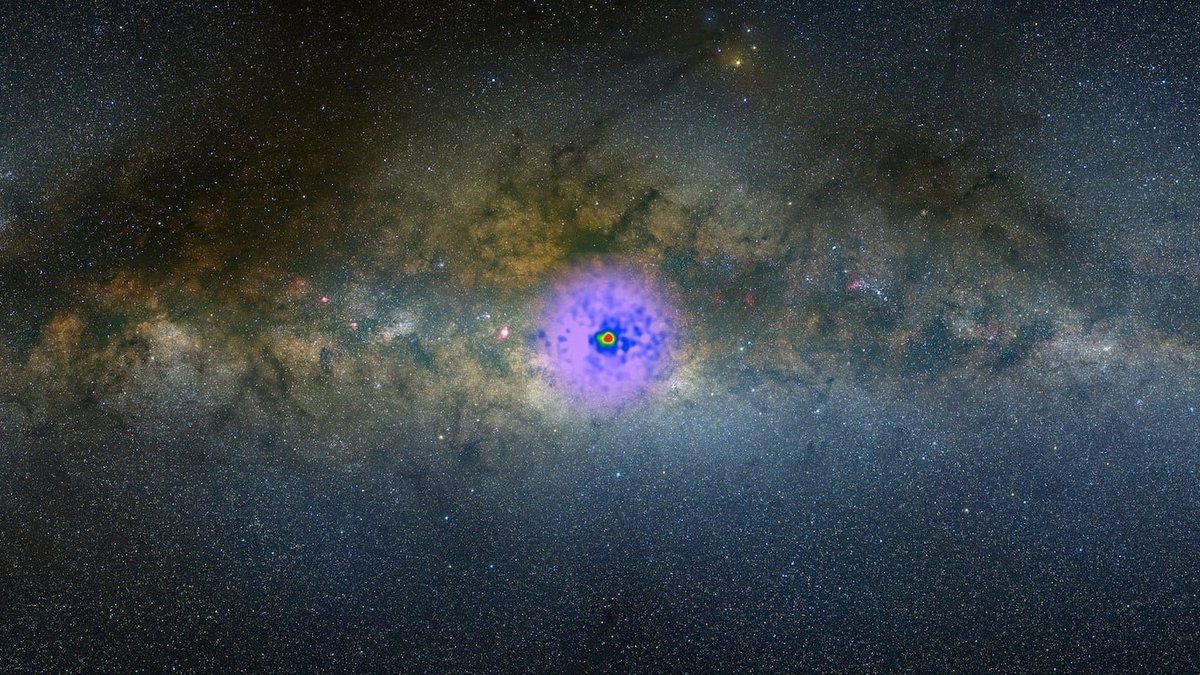
Researchers at the University of Vienna and Lawrence Berkeley National Laboratory have used machine learning to revisit a mysterious gamma-ray glow near the center of the Milky Way. Their study, published in Physical Review Letters, found that dark matter remains a plausible explanation for the signal known as the Galactic Center Excess.
The finding reopens one of astronomy’s most stubborn puzzles. For years, many analyses had leaned toward a population of faint neutron stars as the likely source. The new work adds information that earlier statistical tests left out, the energy of each gamma-ray photon. That extra layer changed the picture in a way that keeps dark matter firmly in the discussion.
The team trained a machine-learning method on more than one million simulated gamma-ray observations. By studying both where photons appeared and how much energy they carried, the system could compare possible sources of the glow with greater detail than spatial maps alone.
A strange gamma-ray glow near the galactic center
The Galactic Center Excess is a faint glow of gamma rays around the heart of the Milky Way. It appears roughly spherical and stretches across thousands of light-years. Gamma rays are the highest-energy form of light, so this signal points to violent processes in a crowded region of space.
At the center of the galaxy, stars, gas clouds, black hole activity and high-energy particles all overlap in the same patch of sky. That makes the glow difficult to separate from everything around it. “Interpreting the signal is particularly difficult because the Galactic Center is an exceptionally bright and crowded region of the gamma-ray sky,” said Florian List, a study author and researcher at the University of Vienna.
Two leading ideas have shaped the debate. One involves annihilating dark matter, a process in which dark matter particles destroy each other and release gamma rays. The other points to many small astrophysical sources that are too dim or too packed together to be seen one by one.
Among those possible sources are millisecond pulsars. These are rapidly spinning neutron stars, the dense remains of massive stars that exploded as supernovae. They can emit beams of radiation like cosmic lighthouses. If enough of them sit near the galactic center, their combined light could look like a smooth glow.
The missing clue in earlier analyses
Earlier studies often focused on the positions of gamma-ray photons. This approach asks whether the glow looks smooth or grainy. A smooth pattern can fit dark matter. A grainier pattern can suggest many unresolved point sources.
That spatial clue is powerful, yet the new study found that it leaves out a critical piece of information. Each photon also has an energy. The pattern of those energies can help distinguish one physical source from another.
For a general reader, the idea is similar to identifying a distant city at night. A blurred image may show where the light comes from. The color and brightness of the lights can say more about what produced them. In gamma-ray astronomy, energy plays a similar role.
The University of Vienna team and collaborators argued that the energy distribution of the photons should be analyzed together with their positions. That required a method able to handle complicated simulated skies. The researchers turned to neural networks and simulation-based inference, tools that can learn patterns across large sets of mock observations.
How machine learning changed the picture
The researchers built their analysis around more than one million simulated gamma-ray observations. These simulations allowed the machine-learning system to learn how different kinds of sources would appear to a gamma-ray telescope.
Instead of relying only on the shape of the glow, the model examined spatial and spectral information at the same time. In this context, spectral information means the energies of the detected photons. That shift gave the team a more complete way to compare dark matter and point-source scenarios.
The result was striking. When photon energy was included, the point-source explanation became much more constrained. Earlier analyses had pointed toward relatively bright unresolved sources. The new work found that any such sources would need to be extremely faint.
“Our new analysis shows that the sources would have to be so faint that they would be almost indistinguishable from the emission expected from annihilating dark matter,” said Nick Rodd, a study author and scientist at Lawrence Berkeley National Laboratory.
That statement captures the central shift. The analysis keeps the point-source idea possible, while making it look far closer to a dark-matter-like signal than many earlier interpretations suggested. The glow’s origin remains unresolved, yet the evidence against dark matter has weakened.
Why the pulsar explanation got harder
The pulsar idea remains important because millisecond pulsars are real objects with known gamma-ray behavior. They exist in the Milky Way and can emit high-energy radiation. A large hidden population near the galactic center could plausibly contribute to the excess.
However, the new analysis raises the bar for that explanation. If millisecond pulsars are responsible, the study suggests that at least 35,000 such sources would need to be clustered in the center of the Milky Way. That number is much larger than the few hundred to few thousand sources assumed in some earlier work.
The problem comes from faintness. Bright pulsars would create a more noticeable point-source pattern. The new energy-aware analysis indicates that the sources would have to be so dim that they blur into the kind of smooth emission expected from another process.
This does not remove pulsars from consideration. It gives astronomers a sharper target. Future surveys and models can ask whether such a large and faint pulsar population can form, survive and remain hidden in the inner galaxy.
That question reaches beyond one gamma-ray mystery. It touches the history of stars near the Milky Way’s center, the formation of neutron stars and the way dense stellar populations evolve over billions of years.
Dark matter stays in the race
Dark matter is thought to make up a large share of the universe’s matter, yet it has so far been detected through gravity rather than direct light. It helps explain how galaxies rotate and how large cosmic structures form. Its particle nature remains unknown.
Some theories predict that dark matter particles can self-annihilate. If that happens in dense regions such as the galactic center, the process could release gamma rays. The Galactic Center Excess has attracted attention because its shape and energy range have long seemed compatible with some dark matter models.
The new Physical Review Letters study supports a cautious view. The result does not identify dark matter as the source of the glow. It shows that one major argument favoring ordinary astrophysical point sources has become less decisive when photon energies are included.
“The origin of the Galactic Center Excess is one of the longest-running debates in astrophysics,” said List. The new analysis explains why the debate continues. The same glow can still be interpreted through more than one physical pathway.
That matters because dark matter searches often depend on indirect clues. A signal in gamma rays needs to be tested against every plausible astrophysical source. If a pulsar population can explain the glow, astronomers need to know what that population looks like. If it cannot, dark matter becomes more compelling.
What scientists need to test next
The next step is to make the competing explanations harder to hide from the data. Better models of the galactic center could improve estimates of the background gamma-ray emission. That background comes from cosmic rays interacting with gas, dust and radiation fields.
More detailed pulsar population studies will also be essential. Researchers can test whether tens of thousands of extremely faint millisecond pulsars are realistic in the Milky Way’s central region. They can compare that idea with what is known from radio surveys, gamma-ray catalogs and stellar evolution models.
Future gamma-ray observations may add another route. If telescopes can resolve more individual sources near the galactic center, they could reveal whether a large hidden pulsar population is really there. Improvements in analysis methods may also help scientists extract more information from existing data.
The study also shows how simulation-based inference can sharpen old questions. By training on many synthetic skies, researchers can test scenarios that are difficult to separate with traditional methods. In a crowded region like the galactic center, that kind of approach can reveal which assumptions matter most.
For now, the Milky Way’s central glow remains a cosmic clue without a final answer. The new machine-learning analysis gives scientists a clearer way to weigh the evidence and it keeps one of the universe’s deepest mysteries alive at the center of our own galaxy.