Researchers at Texas A&M have tested a dramatic way to improve oil-spill cleanup, controlled fire whirls that burn upward like giant rotating flames. In large-scale field experiments, the team found that these spinning fires can consume crude oil faster and produce less soot than conventional in-situ burning.
The work, published in Fuel, points to a possible future tool for responders facing offshore oil spills. Today, crews often try to stop a slick from spreading by igniting the oil on the water. That method can reduce the amount of crude reaching shorelines, yet it can also send thick smoke into the air and leave residue behind.
The Texas A&M team, working with collaborators including researchers from the University of California, Berkeley, created a fire whirl in a controlled field setup. The spinning column reached nearly 17 feet high and showed a striking combination of heat, speed and cleaner combustion.
“Our goal is to harness the chaotic nature of fire whirls as a powerful, precise restoration tool,” said Elaine Oran, a professor of aerospace engineering at Texas A&M University.
Fire whirls turn burning oil into a vertical vortex
A fire whirl forms when heat and airflow combine into a rotating column of flame. The motion pulls oxygen into the burning zone and concentrates the fire into a narrow vertical shape. For oil on water, that vertical structure can change how quickly the fuel vaporizes and burns.
In a conventional in-situ burning operation, oil burns as a relatively broad pool fire. Flames spread across the slick and parts of the fuel can remain unburned. The smoke can be heavy because combustion is incomplete.
With fire whirls, the vortex acts like a natural air pump. It draws in oxygen along the flame column, which can make the fire hotter and more efficient. That hotter flame can help break down the crude more completely before it spreads farther across the water.
The idea sounds extreme because fire tornadoes are often associated with wildfires and disaster scenes. In this study, the researchers treated the same physics as an engineering challenge. Their goal was controlled combustion that could remove oil while reducing some of the pollution tied to ordinary burning.
A field test built a 17-foot flame
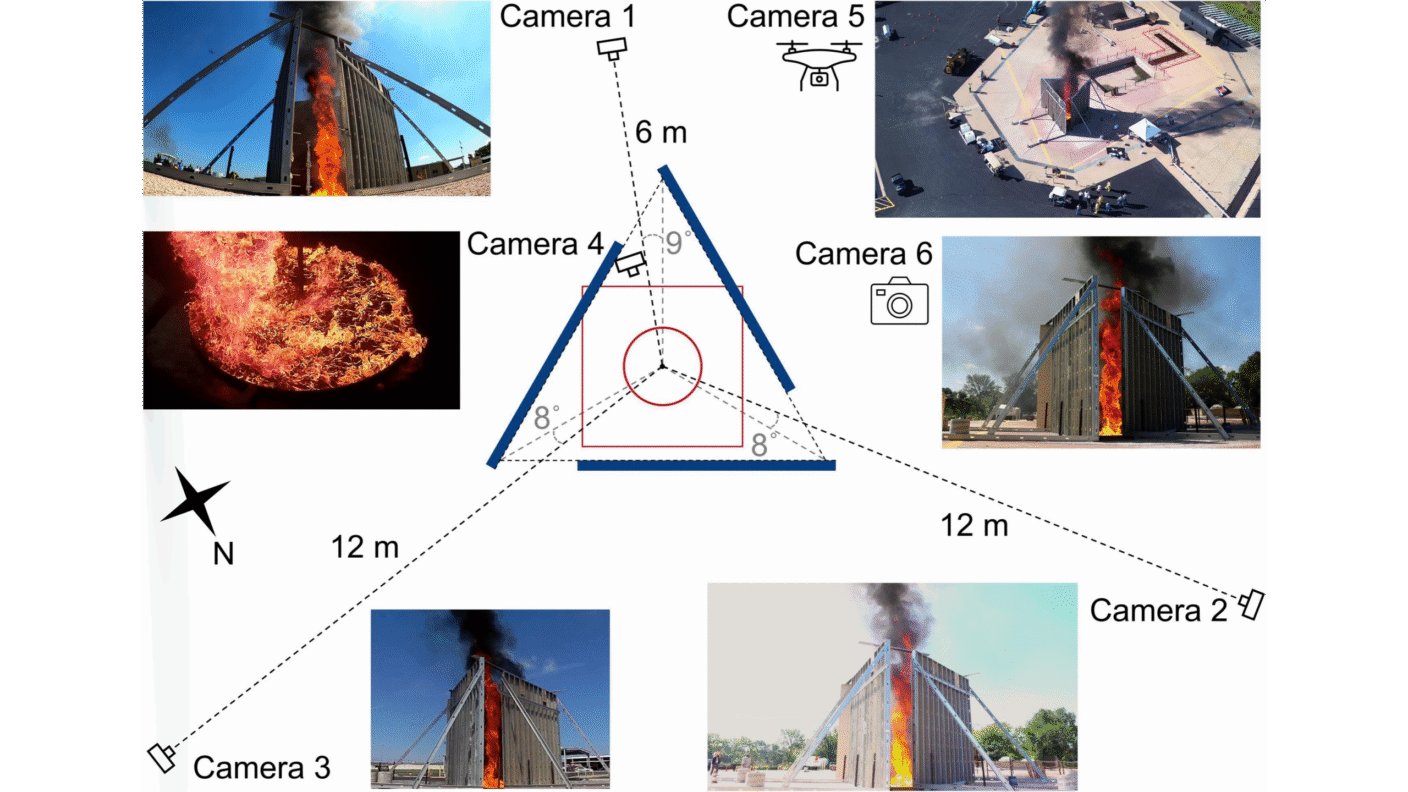
The experiment took the concept beyond small laboratory flames. Supported by the Bureau of Safety and Environmental Enforcement, the researchers ran field-scale tests at the Texas A&M Engineering Extension Service Brayton Fire Training Field.
The team used a 1.5-meter-wide pool, about 5 feet across, coated with crude oil. Around it, they placed three 5-meter-high walls, about 16 feet tall. The walls were arranged to guide air into a rotating flow around the burning oil.
Once the crude was ignited, the setup produced a fire whirl that rose nearly 17 feet. The researchers then compared its performance with a more familiar fire pool. They also tested how the system responded under different wind conditions.
This scale matters because oil-spill response happens in rough, open environments. Small demonstrations can reveal useful physics, while larger tests begin to show whether a method can survive the messy conditions responders face outside a lab.
The field setup still simplified the ocean. It used walls, a controlled pool and measured wind conditions. Those constraints gave the researchers a safer way to study flame behavior before considering open-water designs.
The vortex burned hotter and cleaner
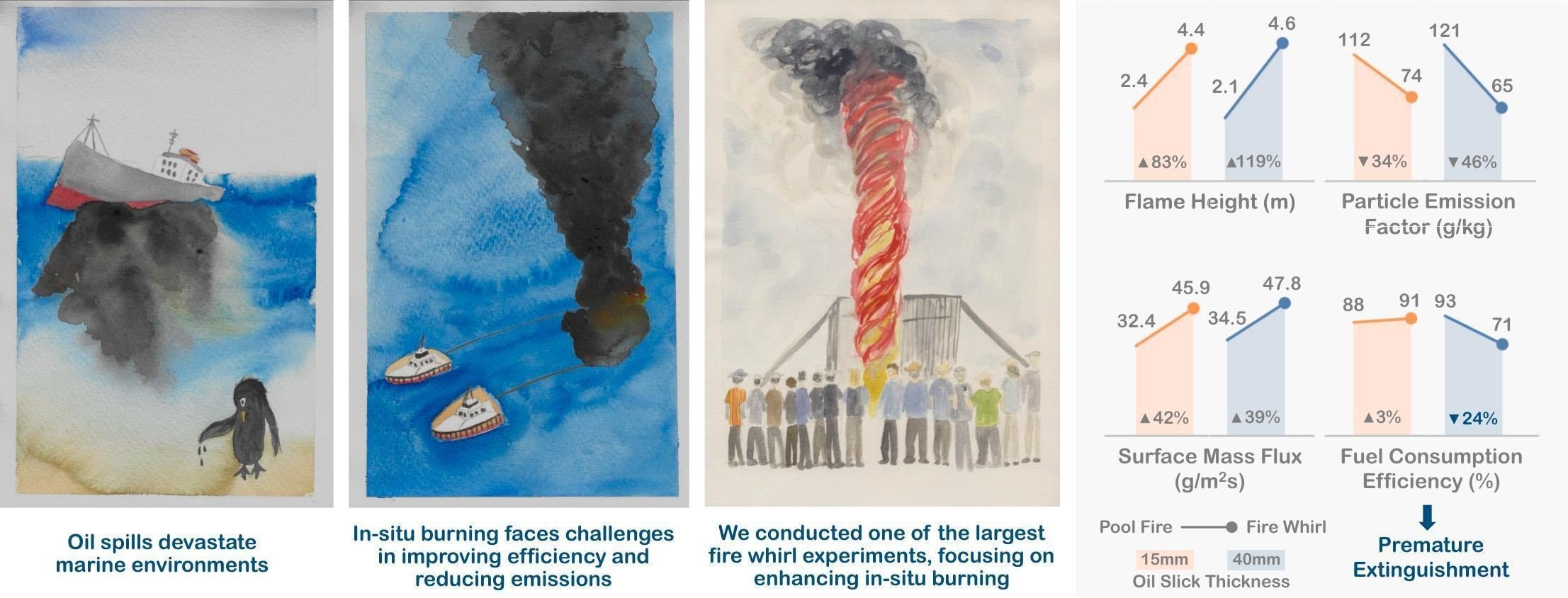
The results showed why the approach has attracted attention. According to Oran, “The fire whirls burned the oil about 40 percent faster, cut soot emissions by 40 percent and achieved up to 95 percent fuel consumption efficiency.”
The vortex also reached higher temperatures than the comparison fires. The fire whirls burned at roughly 1,900 degrees Fahrenheit, or about 1,000 degrees Celsius. Conventional fire pools in the study were closer to 1,300 degrees Fahrenheit, or about 700 degrees Celsius.
That extra heat helps explain the faster burn rate. Crude oil has to vaporize before it can burn efficiently. A hotter flame can transfer energy back to the slick more effectively, which helps feed the fire and reduce leftover fuel.
Lower soot emissions are especially important for spill response. Dense black smoke can create health risks and complicate emergency operations. A cleaner burn could make ignition a more useful option in situations where crews already plan to burn oil to protect coastlines or sensitive habitats.
The study also reported strong fuel consumption under favorable conditions. Up to 95 percent of the oil was consumed in some tests. That level of removal would be valuable during a spill, although the result depends on the stability of the whirl and the conditions around it.
Wind and oil thickness still matter
Field tests also revealed the limits of the method. Fire whirls need the right balance of airflow, heat and fuel. If that balance shifts, the rotating column can weaken or collapse.
“Fire whirls are incredibly powerful and can be incredibly beneficial,” Oran said. The same experiments showed that they can also be sensitive to their surroundings.
Wind conditions were one of the central challenges. A steady vortex relies on organized airflow. Stronger wind can disturb that structure and push the flame away from the stable pattern needed for high efficiency.
Oil thickness also affected performance. A thicker slick can change how heat moves through the fuel and water below it. In some situations, the fire can extinguish early, which reduces the advantage of the whirl.
The wall configuration introduced another practical question. The walls helped create the vortex, yet open ocean spills would need a deployable system that can guide airflow at sea. Any future design would have to work around waves, shifting winds and the size of real spill areas.
Why the method could change spill response
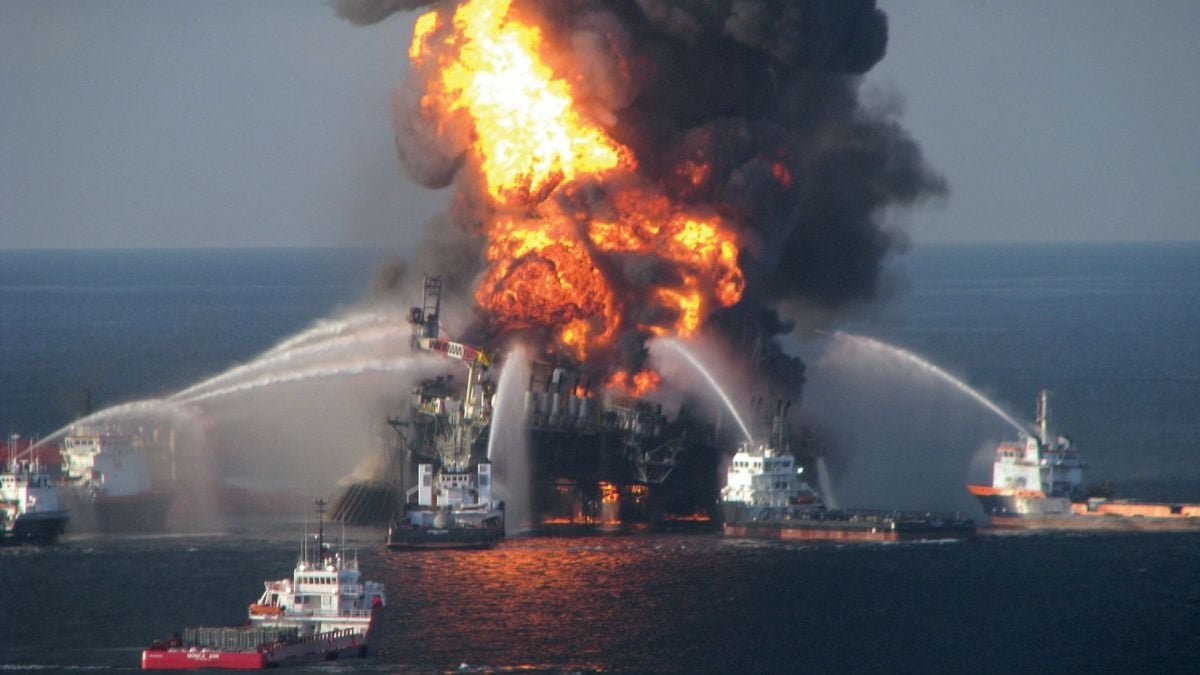
The Deepwater Horizon disaster in 2010 showed how devastating offshore oil spills can become. The event killed 11 people and released oil across a vast area of the Gulf of Mexico. It also shaped later efforts to improve offshore safety and spill response.
In that context, oil spill remediation remains a hard engineering problem. Mechanical collection can be slow. Dispersants have trade-offs. Burning can act quickly, although smoke and residue limit when responders can use it.
Fire whirls could give responders a more efficient version of a tool they already understand. The research suggests that a carefully controlled vortex may burn more oil in less time while sending fewer particles into the air.
Future systems might use mobile structures that guide airflow over an ignited slick. These structures would need to be deployable, stable and safe for crews. They would also need to perform in changing marine conditions.
The Texas A&M study makes the case for more testing rather than immediate deployment. Researchers still need to explore larger scales, open-water behavior and designs that can create a stable vortex without a fixed field setup.
Still, the experiment gives a striking glimpse of how dangerous fire behavior can be redirected. By turning a spreading burn into a vertical vortex, scientists may have found a way to make oil-spill fires faster, cleaner and easier to control.