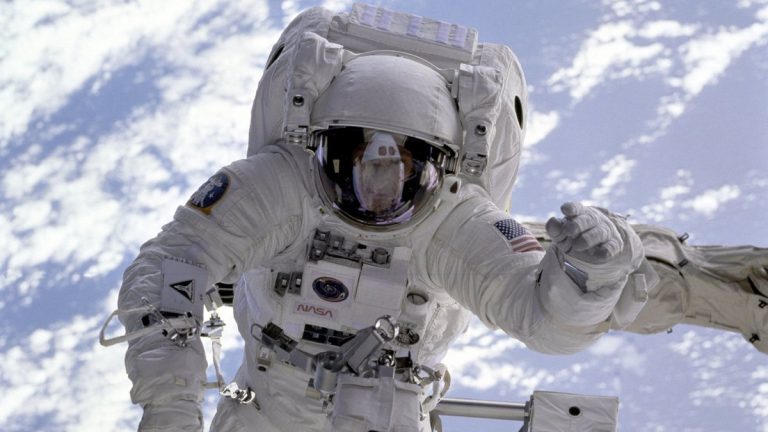
Why would highly trained pilots struggle with a familiar landing after months in orbit? A small simulator study found that experienced astronaut pilots made unusual control errors soon after returning from the International Space Station, even though they had practiced the same maneuver many times before launch.
The research, published in Scientific Reports on October 11, 2024, followed five astronauts who spent about five to seven months aboard the station. Their first simulated T-38 landings after returning to Earth showed problems with altitude control, navigation and touchdown conditions.
The difficulty faded quickly. Every pilot completed another landing on the same day and overall performance returned to preflight levels within about four days. The findings suggest that the brain may need a short period to readjust to gravity before crews handle demanding manual flight tasks.
Five astronaut pilots faced a T-38 landing test
The study involved five experienced astronaut pilots, all men, who served aboard the International Space Station between October 2012 and June 2015. Their missions lasted from 146 to 200 days, with an average stay of almost 170 days.
Four participants were military test pilots. The fifth was an experienced NASA pilot with extensive time in the T-38, a fast training aircraft used by the US military and NASA. Their existing skills allowed researchers to study changes in performance without asking the astronauts to learn an unfamiliar aircraft first.
The pilots completed several sessions before launch and three sessions after landing. Researchers collected baseline results during three preflight visits. Postflight tests took place shortly after the astronauts returned to Houston, then around four days and eight days after their return.
The experiment formed part of a broader NASA-backed project examining how long-duration spaceflight affects complex vehicle operation. A Mount Sinai research record lists the work by Steven T. Moore, Tiffany R. Sims, Valentina Dilda and Hamish G. MacDougall.
The first landing after Earth return caused problems
On the first postflight attempt, four of the five pilots recorded touchdown measurements that fell about two to three standard deviations outside their own preflight averages. In simple terms, their landings were unusually different from the performances they had produced before going to space.
Several pilots had trouble maintaining the planned altitude during turns. Navigational mistakes also affected their position as they approached the runway. The resulting differences included excessive touchdown speed, an unusual height while crossing the runway threshold and landing farther along the runway than expected.
One simulated landing produced an outcome the researchers considered potentially dangerous. Other landings remained manageable, although they still showed clear departures from each pilot’s normal pattern. The PubMed record summarizes the finding as a temporary decline during the first landing attempt on the day of return.
Most participants completed the test roughly 25 hours after their spacecraft touched down in Kazakhstan. One astronaut was tested about 36 hours after landing because of mission scheduling. During that interval, the astronauts also endured long travel, medical checks and the physical strain of returning to Earth’s gravity.
Banking turns challenged the returning crews
The simulator reproduced an overhead approach to runway 17R at Ellington Field in Houston. The virtual aircraft began five kilometers north of the runway, flying south at 300 knots indicated airspeed and an altitude of 1,500 feet.
Pilots followed a familiar pattern that required a series of banking turns. They had to hold altitude during the early part of the maneuver, reduce speed, lower the landing gear and line up for the final descent. Maintaining control throughout the turn demanded close coordination between vision, motion sensing and hand movements.
The full-motion T-38 simulator used X-Plane 9.0 software and a platform that could move in six directions. The aircraft model responded to pilot commands while the cabin provided physical movement, helping the test feel closer to actual flight than a stationary desktop program.
Researchers removed much of the navigational workload by starting every pilot in the same position, already aligned with the runway. The test therefore focused on aircraft control, especially the ability to maintain speed and altitude while banking.
Gravity changes may disrupt motion sensing
Living in microgravity changes the way the brain interprets movement. On Earth, organs in the inner ear use gravity as a steady reference. They help the brain judge whether the head and body are tilted, moving forward or changing direction.
During months in orbit, gravity no longer provides the same reference signal. The brain adapts by relying differently on information from the eyes and inner ear. Once an astronaut returns, Earth’s gravity suddenly becomes a strong part of every movement again and the nervous system must adjust its calculations.
The researchers proposed that a weakened response to gravitational and visual tilts contributed to the landing errors. A banked aircraft creates both a tilted visual scene and a physical sense of roll. A pilot whose brain is still readjusting may have greater difficulty judging the correct bank angle or holding a precise altitude.
Earlier measurements cited by the team found a 24 percent decrease in one eye movement response linked to tilt sensing among returning station crew members. The measurements were taken two to three days after landing, which suggests that the effect may have been stronger during the first hours back on Earth.
Multitasking ability also declined
Flying an aircraft requires many actions to happen together. A pilot watches speed and altitude while controlling the aircraft, preparing the landing gear and judging the runway approach. Even a familiar pattern places steady demands on attention.
The astronauts completed a separate battery of tests measuring reaction time, visual ability, manual control and short-term memory. They also performed a task that combined mouse tracking with entering four-digit codes using the other hand.
Results from the broader group showed reduced dual-tasking ability on the day of return. Fine hand control also declined and the astronauts reported greater sleepiness. Reaction time and basic visual sharpness remained close to their earlier levels.
A related operator-proficiency study involving eight astronauts found that returning crew members had more trouble keeping a simulated car in its lane. The sleep-restriction comparison group did not show the same overall pattern after being kept awake for about 30 hours, indicating that fatigue alone could not explain the spaceflight results.
A second landing brought rapid improvement
The strongest sign of rapid readjustment appeared during the second simulator run. As the study abstract reported, “all pilots successfully completed a second landing attempt on the same day.” Exposure to the task may have helped the brain reconnect familiar control movements with Earth’s restored gravity signals.
Practice could provide several forms of useful feedback. The pilot sees how the horizon moves during a bank, feels the simulator cabin roll and observes how each control input changes the flight path. A single run gives the nervous system fresh information about movement under gravity.
The result raises the possibility of using short refresher sessions before astronauts operate demanding equipment after landing. A carefully designed simulator could allow crews to test their balance, attention and vehicle-control skills in a controlled setting.
Rapid improvement does not guarantee that every astronaut or every task will recover at the same speed. A spacecraft landing near the Moon or Mars may involve unfamiliar terrain, communication delays and limited chances to repeat a maneuver. Training plans would need to account for the demands of each mission.
Performance recovered within four days
By roughly four days after return, the group’s simulated piloting performance had returned to its preflight range. Driving results from the wider research project followed a similar recovery pattern.
The full study record reports that most of the pilots produced normal touchdown measurements during the later sessions. One participant recorded an unusual landing several days after return, which shows that individual changes did not follow exactly the same schedule.
A four-day recovery period is short compared with a six-month station mission, yet many important activities occur immediately after landing. Crews may have to leave a capsule, respond to an emergency or operate transport equipment while their senses are still adapting.
Future mission planners could use performance checks to decide when an astronaut is ready for a specific task. Such checks may be more useful than relying on a fixed waiting period because recovery can vary between crew members.
The small study leaves important questions
Five participants provide a limited view of astronaut performance. Spaceflight research often involves small groups because few people travel to orbit, crew time is tightly controlled and mission schedules determine when testing can happen.
The researchers also had limited time with each participant. Every session lasted about one hour and included cognitive tests, motion measurements, driving, a Mars rover simulation and the T-38 task. Each astronaut completed only a small number of landings.
The simulator supplied physical motion, although the team did not record the cabin’s exact movements during every landing. Precise motion data could help future researchers connect a pilot’s control input with the forces felt inside the cabin.
All five pilots were experienced and all were male. A larger and more varied group would show whether experience level, age or other individual factors influence recovery. Future work could also compare different mission lengths and test astronauts during flight to track how their skills change before they return.
Researchers used a one-tailed statistical test because they expected spaceflight to impair performance. Combined with the small group, this choice calls for careful interpretation. The experiment offers evidence of a temporary effect while leaving its size and frequency uncertain across the wider astronaut population.
Moon and Mars crews may need new safeguards
Current spacecraft use extensive automation, yet astronauts still need manual control skills when equipment fails or a planned sequence cannot continue. Past missions have shown that crews may need to take over during docking problems and other emergencies.
Artemis lunar missions will expose astronauts to changing gravity conditions as they travel between Earth, orbit and the Moon. Mars crews would spend many months in low gravity or weightlessness before approaching a distant planet where immediate help from Earth would be impossible.
A pilot reaching Mars could face a demanding landing task soon after a long cruise. Mars has about 38 percent of Earth’s surface gravity, so the brain would need to adapt again to a new relationship between visual movement and physical tilt.
Possible safeguards include simulator practice during the journey and automated systems that monitor crew inputs. Missions could also divide tasks between crew members according to their recovery and recent performance. Vehicle designs may provide clearer visual references during banking, descent and touchdown.
The T-38 experiment suggests that postflight sensorimotor recovery can be fast, especially after a pilot repeats a familiar task. Longer missions and unfamiliar planetary environments will require broader testing. Protecting manual flight skill will remain part of preparing humans to land safely far from Earth.