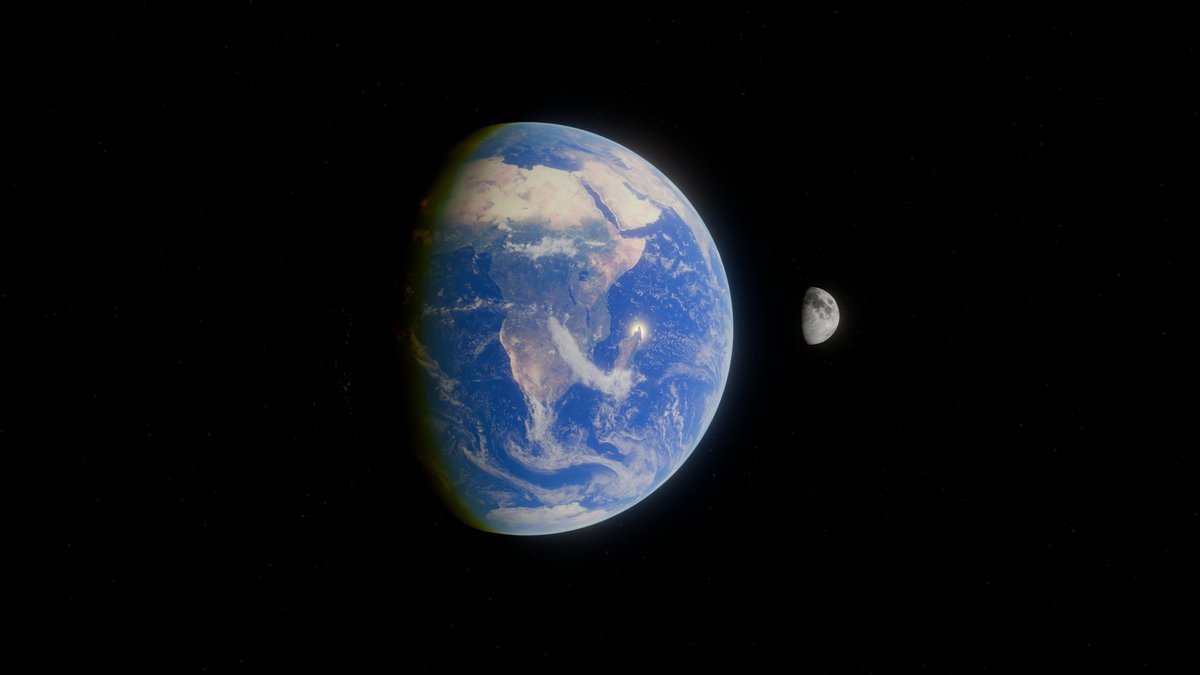
NASA has brought together decades of evidence in an official Moon formation overview that traces our satellite to one of the most violent events in Solar System history. About 4.5 billion years ago, a planetary body roughly the size of Mars may have struck the young Earth. The collision launched molten and vaporized rock into orbit, where it eventually gathered into the Moon.
The explanation is known as the giant-impact hypothesis. It accounts for several unusual features of the Earth-Moon system, including the Moon’s small metallic core and its close chemical resemblance to Earth. Rocks returned by Apollo astronauts have provided the strongest physical evidence.
That evidence also contains a stubborn mystery. Lunar and terrestrial rocks have almost identical isotope signatures, even though many collision models predict that the Moon should contain large amounts of material from the impactor. Researchers continue to test increasingly energetic versions of the event as they work to explain how the two worlds became so chemically similar.
A Moon born from collision
The early Solar System was filled with growing worlds. Dust and rock orbiting the young Sun collided repeatedly, producing larger bodies through a long process of planetary assembly. Earth emerged from this turbulent environment, though its growth was far from finished.
During the planet’s early history, an object now called Theia approached the proto-Earth. The name comes from the Titan in Greek mythology who was the mother of Selene, the goddess of the Moon. Scientists have never identified an intact piece of Theia, so its size and composition must be reconstructed through computer simulations and chemical evidence.
In the leading scenario, Theia delivered a glancing impact with enormous energy. The collision melted and vaporized rock from both bodies. Some material escaped, while a large amount remained trapped by Earth’s gravity and formed a hot disk around the planet.
Droplets and fragments within that disk began colliding. Gravity drew the orbiting debris together until it became a single companion world. The newborn Moon remained extremely hot and may have been covered by a global magma ocean hundreds of kilometers deep.
NASA summarizes this violent history in a striking sentence: “Earth’s Moon was born out of destruction.” The same impact would have transformed Earth, mixing its interior and changing how quickly the planet rotated.
Why the giant-impact theory prevailed
Before Apollo, scientists considered several possible origins. Earth might have captured a fully formed Moon that passed nearby. The two worlds might have grown side by side from the same region of the early Solar System. Another proposal suggested that a rapidly spinning Earth shed material that became the Moon.
Each idea faced significant physical problems. Capturing such a large object into a stable orbit would require a way to remove a tremendous amount of energy. Formation beside Earth could have produced a Moon with a larger iron core. A world torn directly from Earth also proved difficult to reconcile with the system’s motion.
The decisive evidence arrived with the Apollo lunar samples. Astronauts collected 382 kilograms, or 842 pounds, of rock and soil during six surface missions between 1969 and 1972. Those materials gave laboratories their first direct record of the Moon’s early history.
Many samples showed that the Moon had once been molten. Light-colored rocks rich in anorthosite appeared to have floated to the surface of an ancient magma ocean. Other samples contained relatively small amounts of elements that vaporize easily, a pattern consistent with formation during a high-temperature event.
The Moon’s internal structure offered another clue. Earth’s iron-rich core makes up a substantial share of its mass, while the lunar core accounts for only a small percentage of the Moon. A giant collision could have launched large quantities of rocky mantle material into orbit while much of the iron remained inside Earth.
The isotope puzzle
Oxygen isotopes act like chemical fingerprints. Oxygen atoms can contain different numbers of neutrons, creating stable forms with slightly different masses. The ratios of these forms vary among meteorites, planets and other Solar System materials.
When scientists measured oxygen in lunar samples, they found ratios remarkably close to those in terrestrial rocks. Similar relationships have also appeared in measurements of several other elements. NASA describes the central finding plainly: “The chemical composition of Moon and Earth rocks are very similar.”
This resemblance creates one of the largest challenges for a simple impact model. Early simulations often produced a Moon dominated by debris from Theia. If the impactor formed in a different part of the Solar System, its isotope fingerprint would probably have differed from Earth’s.
Researchers have explored collisions energetic enough to mix material from both worlds into a shared cloud of vapor. Such an event could erase much of the original chemical difference before the Moon condensed. Other models examine Theia forming from material with a composition already close to Earth’s.
The exact speed, angle and energy of the collision remain open questions. As NASA notes, “Any improvements to the giant impact theory or a new theory would need to explain what we observe of the Moon today.” That requirement includes the isotope match, the Moon’s orbit, its low iron content and the total angular momentum of the Earth-Moon system.
How the Moon reshaped Earth
Once the Moon formed, its gravity began changing Earth. The most visible result is the tide. Lunar gravity pulls more strongly on the side of Earth facing the Moon and less strongly on the far side, helping produce two broad tidal bulges.
Earth’s rotation carries coastlines through these bulges. Local geography, ocean depth and the shape of seafloors then modify the timing and height of each tide. The Sun also contributes, though the Moon has the larger tide-generating influence because it is much closer.
Friction associated with lunar tides gradually removes rotational energy from Earth. Over geological time, this process has lengthened the day. The transferred energy pushes the Moon into a wider orbit and laser measurements show that it continues to move away by roughly 3.8 centimeters each year.
The Moon also affects the direction of Earth’s spin axis. Our planet is tilted by about 23 degrees relative to its path around the Sun. That Earth’s axial tilt produces the seasons by changing the angle and duration of sunlight received by each hemisphere during the year.
Gravitational interactions involving the Moon help limit how strongly this tilt varies. The stabilization occurs over extremely long periods and works through the slow wobble of Earth’s rotating axis. A steadier tilt tends to produce a more consistent pattern of seasons across geological time.
The debated link to life
The Moon’s possible role in life’s history arises from this influence on Earth’s tilt. In 1993, astronomer Jacques Laskar and his colleagues published calculations in Nature suggesting that a moonless Earth could experience large and chaotic changes in its orientation.
In those simulations, the planet’s tilt could shift by many tens of degrees over long timescales. Such changes would reorganize sunlight across the globe. Polar regions could receive intense seasonal heating, while tropical and temperate climate zones could migrate dramatically.
This result inspired the idea that the Moon gave evolution a more stable planetary setting. Relatively moderate variations in tilt may have helped oceans and long-lived climate systems persist. Tides could also have created changing coastal environments where water, minerals and organic compounds interacted.
Later modeling led by Jack Lissauer produced a more restrained picture. A moonless Earth still experienced wider changes in tilt, though the modeled range could remain limited for hundreds of millions of years. Outcomes depended on the starting conditions and the gravitational influence of the other planets.
The Moon’s contribution to climatic stability is supported by orbital mechanics. Its importance to the origin or survival of complex life remains uncertain. Evolution unfolded through a vast network of influences that included liquid water, atmospheric chemistry, plate tectonics, solar energy and biological adaptation. The Moon may have improved Earth’s long-term stability without serving as a single requirement for habitability.
Fresh clues from future missions
Apollo transformed lunar science, yet its samples came from a limited group of sites on the Moon’s near side. Those rocks contain an extraordinary record, though they cannot fully represent the composition and geological history of an entire world.
Lunar meteorites broaden the available evidence because impacts can launch rocks from many regions of the Moon. Their original locations are usually unknown, which limits the geological context that scientists can recover. Carefully documented samples collected from new landing sites would offer both chemistry and a known place within the lunar landscape.
NASA’s Artemis program is designed to return astronauts to the lunar surface and explore regions Apollo never reached. Material from the south polar area could help researchers examine ancient crust, impact deposits and the products of the Moon’s long thermal evolution.
New measurements of the lunar interior could also sharpen models of the Moon-forming impact. Seismometers placed across widely separated regions would help determine the size and structure of the core. Those findings could reveal how heat and dense materials moved through the young Moon after it formed.
Fresh samples may eventually show whether the close isotope relationship between Earth and the Moon extends across previously unexplored terrain. More precise ages could narrow the timing of the collision and the formation of the first lunar crust. Together, these clues could turn a broadly accepted origin story into a far more detailed account of the event that created Earth’s companion.