Oklahoma has no official “cleanest lake” ranking. State monitoring does, however, identify lakes with low turbidity, deep Secchi visibility or relatively low algal productivity during specific survey periods. Broken Bow, Sooner, Carl Albert and Sportsman are among the stronger documented examples in the Oklahoma Water Resources Board lake report, but they cannot be ranked as permanently safest or cleanest from one dataset.
A defensible list uses the same state indicators for every lake, states the sampling period and rejects any claim that clear water automatically means safe water. OWRB measures stations across different lake zones, while the Oklahoma Department of Environmental Quality determines whether waters support designated uses and maintains the official impaired-water list.
Reservoirs dominate the Oklahoma comparison and their upstream arms often differ from open water near a dam. The shortlist therefore reflects whole-lake summaries or named zones in the state report. One attractive shoreline photograph is not monitoring evidence.
How this comparison uses Oklahoma monitoring
The OWRB WATER monitoring program samples about 80 lakes on a quarterly five-year rotation. A typical reservoir has three to five stations representing riverine, transitional and open-lake zones. Larger reservoirs may have additional arms sampled because conditions vary within one waterbody.
The primary comparison here is the state’s chlorophyll-based trophic-state index, supported by average turbidity and Secchi depth. OWRB classifies values below 40 as oligotrophic, 41 to 50 as mesotrophic, 51 to 60 as eutrophic and values above 60 as hypereutrophic. Lower productivity often accompanies clearer water, but the index measures a biological response to nutrients rather than every possible contaminant.
The OWRB Beneficial Use Monitoring Program lake report supplies lake-specific summaries. Its 2018 – 2019 statewide sample included no oligotrophic lakes; eight were mesotrophic, 20 eutrophic and 12 hypereutrophic. The strongest examples below are therefore relative standouts within monitored periods, not pristine-lake declarations.
Broken Bow Lake has some of the clearest measured water
Broken Bow’s state summary reported average turbidity of 2 nephelometric turbidity units and an average Secchi depth of 228 centimeters. Chlorophyll-a was 5 milligrams per cubic meter, producing a trophic-state index of 46, in the mesotrophic range.
Those measurements make Broken Bow one of the clearest large-lake examples in the report. The reservoir’s different arms and inflow zones should not be assumed identical. A lake-wide visitor can encounter clearer open water and more turbid conditions nearer a tributary after rainfall.
Mesotrophic does not mean contaminated. It describes moderate biological productivity. Broken Bow’s low turbidity and deep Secchi reading support its reputation for visibility more directly than the trophic label alone.
Sooner Lake scores well for low algal productivity
Sooner Lake’s summary reported a trophic-state index of 43, average turbidity of 3 units and an average Secchi depth of 194 centimeters. Chlorophyll-a was 3 milligrams per cubic meter. Together, those figures indicate relatively clear water with modest algal biomass during that sample period.
The TSI value was close to the low end of the mesotrophic band. Its prior reported value was 41, suggesting consistency across the two stated assessments, though two summary values are not a guarantee of every future year.
Sooner is a useful candidate because multiple indicators point in the same direction. A single deep Secchi reading can be influenced by weather, while the chlorophyll and turbidity results provide independent context.
Carl Albert and Sportsman provide smaller-lake examples
Carl Albert’s state summary showed a trophic-state index of 45 with average Secchi visibility of 125 centimeters and average turbidity of 5 units. Its chlorophyll concentration was 4.25 milligrams per cubic meter. Those values place it among the report’s lower-productivity mesotrophic lakes.
Sportsman Lake also received a mesotrophic classification, with a TSI of 44 in the report’s statewide table. The summary associated it with a smaller surface area than major reservoirs, which is important because monitoring intensity and watershed influence differ with scale.
Neither lake should be placed above Broken Bow or Sooner as a universal rank. The samples were collected under a program designed to assess beneficial uses, not to stage a tourism contest. Comparable metrics still reveal credible candidates without implying certainty the data do not contain.
Why Tenkiller and Arbuckle need a qualified description
Tenkiller and Arbuckle are widely associated with clear-looking water and OWRB summaries reported excellent clarity ratings at sampled sites. Their chlorophyll results tell a more complicated story. Tenkiller’s main-lake summary included 215-centimeter Secchi visibility but a TSI of 51, at the eutrophic threshold, while the Illinois River arm had different conditions.
Arbuckle showed low average turbidity and an excellent clarity rating, yet its TSI was 57, in the eutrophic range. Clear water and algal productivity do not always move together because mineral particles, basin shape, season and nutrient response affect the indicators differently.
These reservoirs deserve mention as visually clear destinations, but including them in an unqualified “cleanest” rank would ignore the state’s biological data. Visual clarity and trophic status describe different parts of water quality, so neither can support an unqualified ranking alone.
State impairment status answers a different question
The Oklahoma DEQ Integrated Report is the official source for assessed uses and impaired waters. Oklahoma’s 2024 report and 303(d) list received EPA approval in May 2026. A waterbody may be listed for one pollutant or use while supporting others.
Absence from the 303(d) list is not a blanket certification that every location is safe on every day. Some waters lack enough data and conditions can change between reporting cycles. Likewise, a listed impairment does not mean every activity is prohibited throughout the whole lake.
The OWRB lake-monitoring fact sheet explains why fixed stations and probabilistic monitoring serve different purposes. Fixed sites track particular lakes; randomized sampling estimates statewide condition. Combining their conclusions without preserving that distinction would produce a misleading ranking.
The probabilistic network found that only a small share of Oklahoma lake acres were oligotrophic under the Carlson method. Low-productivity water is uncommon in the statewide sample, which makes the mesotrophic examples useful without converting them into claims of pristine condition.
Clear water is not a safety test
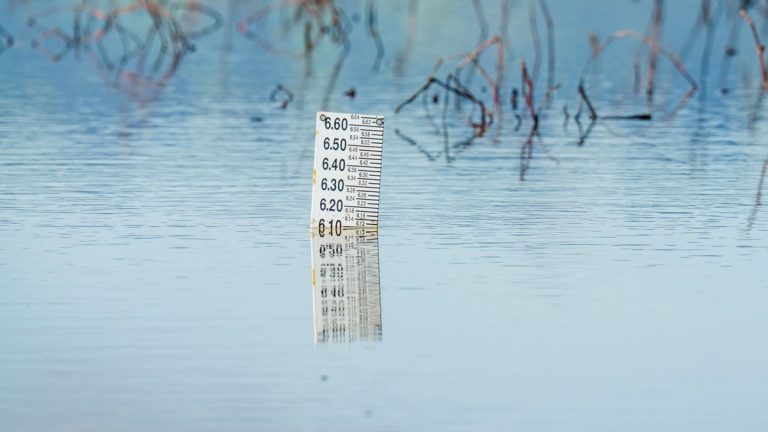
A Secchi disk records visibility. It does not test bacteria, cyanotoxins, mercury or every chemical pollutant. Pathogens are microscopic and a lake can look transparent while a temporary advisory is active.
Before swimming, visitors should check current state and local advisories. Fish consumption requires separate guidance because contaminants accumulate in tissue rather than changing the appearance of the water. No visual inspection can replace those checks.
Oklahoma lakes also change after storms, during algal blooms and as reservoirs rise or fall. A monitoring summary describes measured conditions, not a live guarantee. Argo’s list of Oklahoma’s largest lakes provides geographic context, while its guide to clear lakes across the United States illustrates why clarity must be defined before comparisons are made.
For another example of why physical setting changes interpretation, Argo’s saltwater-lake explainer shows how basin hydrology can produce chemistry unlike a typical freshwater reservoir. Oklahoma comparisons likewise need to respect natural color, sediment and watershed differences.
The most supportable answer
Broken Bow stands out for the deepest average Secchi visibility among the major examples reviewed here. Sooner combines low turbidity with a low mesotrophic TSI. Carl Albert and Sportsman also fall toward the cleaner end of the state report’s productivity scale.
Those names form a monitored-data shortlist, not a permanent order. Sampling cycles, station placement and weather prevent a fair claim that one lake wins every year. Readers can reproduce the approach by downloading OWRB results, choosing a common period and comparing TSI with turbidity and Secchi depth.
State monitoring supports Broken Bow, Sooner, Carl Albert and Sportsman as documented low-turbidity or lower-productivity candidates. Current advisories and designated-use assessments remain necessary before anyone translates “cleanest” into “safe today.”