- Updated
Verified July 29, 2026: this registry lists lunar spacecraft whose continued operation could be confirmed from a recent statement by NASA, the spacecraft operator, or the responsible national space agency. Four missions currently meet that test: NASA’s Lunar Reconnaissance Orbiter, the commercially operated CAPSTONE spacecraft, India’s Chandrayaan-2 orbiter, and South Korea’s Danuri orbiter. “Active” here means the spacecraft is communicating and remains available for science, engineering, navigation, or operational work; it does not mean every instrument operates continuously.
The Moon now hosts a mixture of government science orbiters, commercial technology demonstrators, relay infrastructure, short-lived landers, and dormant hardware. Those categories are easy to blur. This tracker therefore separates a spacecraft’s present operational status from the historical success of its original mission. A lander that completed one lunar day is not counted as active merely because it remains physically on the surface, while an orbiter operating years beyond its original design life is counted when its operator still describes it as operational.
Active lunar missions
| Mission | Operator | Location and type | Current work | Status evidence |
|---|---|---|---|---|
| Lunar Reconnaissance Orbiter (LRO) | NASA | Low lunar orbit; science and reconnaissance orbiter | Maps terrain, temperature, composition and radiation; supports landing-site and polar-resource studies. | NASA lists LRO as an active mission; page updated May 21, 2026. |
| CAPSTONE | Advanced Space | Near-rectilinear halo orbit; technology testbed | Commercially operated platform for continued cislunar navigation, timing and technology work after NASA’s experiment program concluded. | Advanced Space says the original CAPSTONE is currently operating around the Moon, July 24, 2026. |
| Chandrayaan-2 orbiter | Indian Space Research Organisation (ISRO) | Approximately 100-kilometre polar lunar orbit; science orbiter | Continues observations of lunar composition, volatiles, topography, exosphere and polar regions. | ISRO’s spacecraft registry labels the orbiter operational; the 2025–26 annual report describes sustained scientific exploration. |
| Danuri (KPLO) | Korea Aerospace Research Institute / Korea AeroSpace Administration | Polar lunar orbit; science and technology orbiter | Observes terrain, resources, magnetic fields and permanently shadowed regions, and tests deep-space communications. | KASA extended operations through 2027; KARI describes Danuri as currently carrying out its mission. |
What the four missions are doing
Lunar Reconnaissance Orbiter
LRO is the longest-lived spacecraft in the confirmed registry. It entered lunar orbit in 2009 and has outlasted its original exploration assignment by many years. Its continuing value comes from repeat coverage: new images can reveal fresh impact craters, document landing sites, refine topographic maps, and help planners distinguish illuminated terrain from permanently shadowed areas near the poles. NASA says LRO data support both science and the selection of places where robotic or human missions could land safely. Its age is also a caveat: an active designation is a present status, not a guarantee of operation through any particular future date.
CAPSTONE
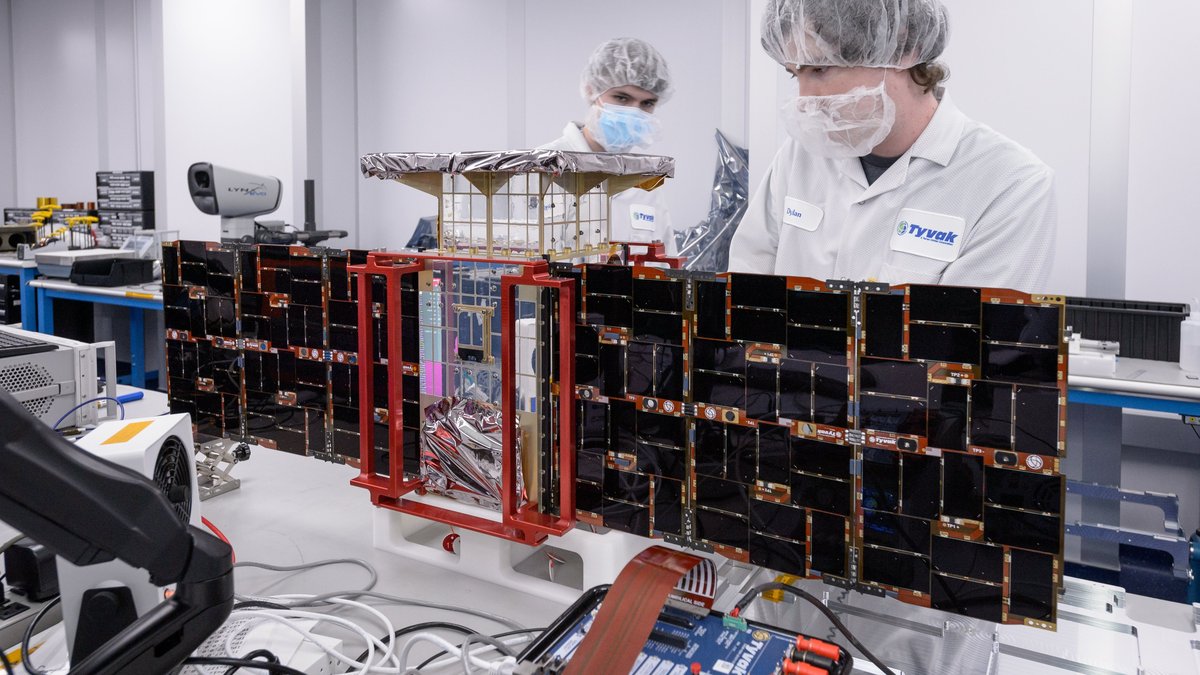
CAPSTONE is a small commercial spacecraft that pioneered the near-rectilinear halo orbit planned for future cislunar infrastructure. NASA’s CAPSTONE activities ended in June 2026 after the mission achieved its primary and extended objectives, but the spacecraft itself did not automatically become inactive. NASA said its owner, Advanced Space, would continue using it as a technology-development testbed; Advanced Space subsequently described it as currently operating around the Moon. The distinction matters: this tracker lists the spacecraft as active under its commercial operator, while treating the NASA-sponsored phase as complete. NASA’s account of that transition is available in its July 2026 mission review.
Chandrayaan-2 orbiter
Chandrayaan-2 launched in 2019 with an orbiter, lander and rover. Contact with the Vikram lander was lost during the landing attempt, but the orbiter remained healthy and became a long-duration lunar observatory. ISRO now classifies Chandrayaan-2 as operational specifically in its orbiter configuration, while classifying Chandrayaan-3 as not operational after its successful surface campaign. That avoids a common source of confusion: a mission can contain components with very different outcomes and lifetimes. ISRO’s 2025–26 reporting places Chandrayaan-2 in a roughly 100-kilometre polar orbit and says the mission continues returning science on lunar volatiles and composition.
Danuri
Danuri, also called the Korea Pathfinder Lunar Orbiter, is South Korea’s first lunar mission. It entered lunar orbit in December 2022. Its payload includes Korean instruments and NASA’s ShadowCam, which images extremely dim terrain inside permanently shadowed polar regions. In February 2025, KASA approved another two-year extension, allowing operations through 2027 after analysis of the spacecraft’s condition and remaining fuel. An extension is an authorized operating window rather than a promise that a spacecraft cannot fail earlier, so this page will continue checking for newer operator notices.
How missions enter this tracker
ARGO.net uses a conservative, source-led method. A mission enters the active table only when a recent primary source from the operator or responsible agency indicates continued operations. Launch announcements alone are insufficient. So are old mission pages that describe planned lifetimes without confirming that the spacecraft survived. For multinational projects, the organization responsible for current flight operations is preferred over a participating instrument team.
The tracker includes orbiters, active surface spacecraft, relay satellites and technology demonstrators whose principal operating environment is the Moon or cislunar space. It excludes future missions, launch vehicles, completed sample-return craft, spent stages, impactors, silent landers and hardware that is merely present on the surface. Crewed missions are included only while the flight itself is in progress. Proposed launch dates are especially volatile and belong in an upcoming-missions calendar rather than this active registry.
Coverage caveats
This is a verified registry, not a claim that only four functioning spacecraft exist near the Moon. Some operators publish status updates less often or provide more information in languages and channels that are difficult to authenticate consistently. China’s Queqiao-2 relay and Chang’e-4 surface mission, for example, have strong earlier official documentation, but ARGO.net did not find a sufficiently recent English-language operator status statement to label each component active on July 29, 2026. Their omission is not evidence that they have stopped working. They will be added when a current primary-source confirmation is available.
“Operational” can also cover reduced activity. Lunar spacecraft may enter safe mode, pause observations during eclipses, alternate instruments, or perform maintenance and collision-avoidance manoeuvres. Communications delays and agency publication schedules mean a public status page may lag engineering reality. For urgent mission information, readers should use the linked operator pages.
Update log
- July 29, 2026: Tracker launched. Confirmed LRO, CAPSTONE, Chandrayaan-2 orbiter and Danuri from recent operator or agency sources. Distinguished CAPSTONE’s continuing commercial operation from the completed NASA phase.