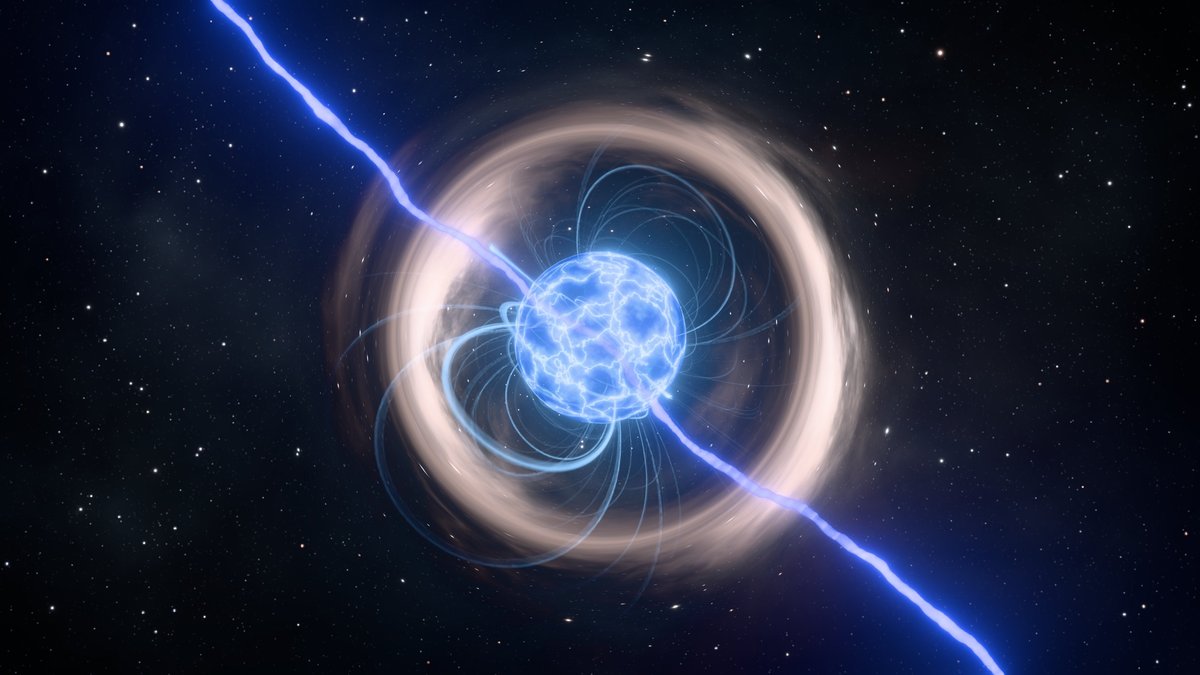
A Caltech study in The Astrophysical Journal Letters describes an astronomical mystery with a startling possible solution. A massive star may have exploded as a supernova and produced two unusually small neutron stars. Those dense remnants could have collided hours later, creating a second blast inside the debris of the first.
The candidate event, called AT2025ulz, appeared in a galaxy about 1.3 billion light-years away. Its earliest light resembled the glow of a kilonova, which occurs when compact stellar remnants collide. Within days, the object brightened again and developed the features of a supernova.
Researchers led by Mansi Kasliwal of the California Institute of Technology call the proposed combination a superkilonova. The interpretation remains preliminary because it depends on connecting one optical eruption with a gravitational-wave signal that carried substantial uncertainty. If future observations uncover the same sequence, astronomers may have found a previously unseen route through the final moments of a massive star.
The double explosion astronomers may have caught
Supernovae and kilonovae arise from different physical events. A supernova can erupt when a massive star exhausts its nuclear fuel and its core collapses. The explosion scatters newly formed elements such as carbon and iron into space while leaving a dense remnant behind.
A kilonova begins with two compact objects, usually neutron stars, spiraling together. Their collision ejects neutron-rich material that can forge some of nature’s heaviest elements. Gold, platinum and uranium can form through rapid chains of nuclear reactions within this expanding debris.
AT2025ulz may connect these two kinds of cosmic explosion in one rapid sequence. According to the proposed scenario, the supernova produced two neutron stars at close range. They quickly lost orbital energy through gravitational waves, collided and triggered a kilonova while the original supernova debris was still expanding.
The August 2025 gravitational-wave alert
The story began on August 18, 2025, when the LIGO detectors in Louisiana and Washington registered ripples in spacetime. The Virgo detector in Italy also contributed to the observation. The candidate signal, designated S250818k, appeared consistent with two compact objects merging.
Astronomers treated S250818k as a subthreshold candidate rather than a confirmed gravitational-wave discovery. Its initial analysis produced an estimated false-alarm rate of 2.1 events per year and a 70 percent probability that the signal originated from terrestrial noise. A separate follow-up analysis assigned it roughly a 29 percent probability of being a binary neutron-star merger. Those figures could change with improved offline processing, but the available evidence does not establish that S250818k came from an astrophysical merger.
If the signal was astrophysical, its estimated chirp mass was approximately 0.87 solar masses. The analysis placed at least one component below the Sun’s mass with greater than 99 percent confidence under that assumption. The remarkable mass estimate therefore depends on the signal being real, a distinction that is central to the proposed superkilonova interpretation.
An alert sent astronomers searching the broad region of sky associated with the signal. A few hours later, the Zwicky Transient Facility at Caltech’s Palomar Observatory found a rapidly fading red point of light. The object was first cataloged as ZTF25abjmnps and later received the official transient name AT2025ulz.
Observatories around the world joined the campaign. These included the W. M. Keck Observatory in Hawaiʻi and the Fraunhofer telescope at Germany’s Wendelstein Observatory. Together, the instruments tracked the object’s brightness, color and spectrum as it changed from night to night.
Three red days, then a blue rebound
For roughly three days, AT2025ulz behaved like the famous 2017 kilonova associated with GW170817. Its light faded quickly and appeared strongest at red wavelengths. That pattern can emerge when heavy elements in kilonova debris absorb much of the blue light while allowing more red light to escape.
GW170817 remains the only kilonova confirmed beyond ambiguity through both gravitational waves and electromagnetic observations. The 2017 event gave astronomers a benchmark for identifying neutron-star mergers through light. AT2025ulz initially seemed to follow that benchmark.
Its evolution soon changed direction. The object began growing brighter, its color shifted toward blue and hydrogen appeared in its spectrum. Those features matched a stripped-envelope core-collapse supernova, an explosion involving a massive star that had lost much of its outer material before its core collapsed.
The shift led some astronomers to consider the optical source a supernova that happened to appear near the gravitational-wave localization region. Kasliwal’s team continued examining the event because its early red glow, unusual later behavior and possible connection to a low-mass merger formed a highly unusual combination.
How one collapsing star could create two neutron stars
The superkilonova hypothesis requires a rare stellar collapse. A rapidly spinning massive star reaches the end of its life and undergoes a supernova explosion. During that collapse, its core somehow produces two compact remnants rather than a single neutron star or black hole.
The researchers describe more than one possible route. A rapidly rotating core could split through a process resembling fission. Another possibility involves a neutron star forming inside a dense disk of leftover material. Part of that disk could then condense into a second compact object.
Either route would place the newborn remnants extremely close together. Their orbit would shrink as they radiated energy through gravitational waves. The pair could merge within hours, producing a kilonova before the surrounding supernova had time to fade.
This scenario draws on theoretical work by Columbia University astrophysicist Brian Metzger and other researchers. Models have explored how rapid rotation might produce exceptionally light neutron stars during stellar collapse. AT2025ulz offers a possible observational example, though the available data cannot establish the entire sequence on their own.
Why the subsolar mass matters
Neutron stars pack more mass than the Sun into an object roughly the size of a city. Observed examples commonly weigh around 1.2 to 3 solar masses. A subsolar neutron star would occupy a largely unexplored region of the compact-object population.
The gravitational-wave analysis indicated that at least one object involved in S250818k had less mass than the Sun. That estimate has broad uncertainty because the signal was relatively weak. Its unusual value still provides one of the strongest clues supporting the proposed superkilonova mechanism.
A compact object born through the standard death of an isolated massive star is expected to retain more than a solar mass. Rapid rotation and fragmentation could distribute the collapsing core’s material between two smaller remnants. Their later collision would create the gravitational-wave signal detected by LIGO and Virgo.
The distance also matters. Ordinary supernovae in galaxies 1.3 billion light-years away are generally too symmetrical to produce gravitational waves strong enough for current detectors to identify. A compact merger offers a clearer explanation for a detectable signal from such a distance.
How supernova debris could hide a kilonova
The changing appearance of AT2025ulz may reflect layers of ejecta moving at different speeds. A neutron-star merger could initially produce a fast, red kilonova that remained visible for several days. Meanwhile, material expelled by the earlier supernova would continue expanding around it.
As the event evolved, the larger volume of supernova debris could dominate the light reaching Earth. Hydrogen and other spectral features from that material would become easier to see. The longer-lived supernova would also explain why the object brightened again and turned bluer.
In this picture, the kilonova becomes buried within a developing supernova. Astronomers would first observe the short-lived merger glow. They would later see the slower explosion surrounding it, much as a bright inner flash can disappear behind a growing cloud.
This overlap could make other superkilonovae difficult to recognize. A survey that begins observing several days after an explosion might record only the supernova phase. The earlier evidence of a compact merger could already have faded, leaving an apparently familiar stellar explosion behind.
The chance-coincidence question
The researchers describe AT2025ulz as a candidate because the connection between the light and gravitational waves remains uncertain. The LIGO-Virgo localization covered a broad area of sky. A supernova could have erupted within that region during the same period by coincidence.
A single event provides limited statistical leverage. Its unusual mass estimate and early red light support the superkilonova interpretation. Its later supernova spectrum also fits the proposed mechanism. Each piece carries uncertainty and alternative explanations remain possible.
The first five days of light do not uniquely identify a kilonova. An independent analysis found that both kilonova emission and shock cooling from a supernova could reproduce the early luminosity and color changes, with its statistical comparison favoring shock cooling. Continued observations then became incompatible with ordinary kilonova models and increasingly resembled a supernova. The result weakens the early red glow as standalone evidence for a merger while leaving the more complicated superkilonova scenario open.
Testing the idea requires a population of comparable events. Repeated detections would let astronomers ask whether early red transients consistently appear alongside low-mass gravitational-wave signals and later develop supernova features. Their locations, timing, spectra and brightness changes could then be compared with theoretical predictions.
Finding no additional examples would also be informative. It could indicate that AT2025ulz was an exceptionally rare event or a chance coincidence. Improved gravitational-wave analysis may further clarify the properties of S250818k and the likelihood that it came from the same galaxy as the optical eruption.
How astronomers can test the superkilonova idea
Wide-field surveys will play a central role because the first kilonova-like phase may last only a few days. The Vera C. Rubin Observatory in Chile is designed to scan large areas of sky repeatedly. Its observations could reveal faint transients early enough for astronomers to watch their colors evolve.
Other planned facilities will add different kinds of evidence. NASA’s Nancy Grace Roman Space Telescope can study distant explosions at infrared wavelengths. NASA’s UVEX mission will examine the ultraviolet sky, while Caltech projects such as the Deep Synoptic Array-2000 and the Antarctic Cryoscope are expected to broaden searches across other wavelengths.
More sensitive gravitational-wave observatories could eventually detect compact mergers across a much larger volume of the universe. When combined with rapid optical follow-up, those measurements would help researchers identify events involving unusually low-mass objects and search for an accompanying supernova.
Kasliwal summarized the observational challenge: “Future kilonovae events may not look like GW170817 and may be mistaken for supernovae.” Catching the first hours of these explosions may reveal whether AT2025ulz represents a new class of stellar death or a singular cosmic puzzle.