The ALMA Observatory has announced a finding that could widen the search for the engines behind some of the Universe’s most elusive particles. Using ALMA observations, astronomers studied a dust-hidden galaxy called JCMT0402−0424, nicknamed Shadow Blaster and found that its extreme brightness appears to come from intense star formation in a compact core.
The galaxy sits in the same region of the sky as the high-energy neutrino event IC 210922A, detected by the IceCube Neutrino Observatory on September 22, 2021. That connection gives astronomers a rare target in the hunt for where cosmic neutrinos are born. These ghostly particles can cross galaxies and planets with very little interaction, which makes them powerful cosmic messengers and difficult clues to trace.
The result is especially striking because previous neutrino-producing galaxies have often involved supermassive black holes. Shadow Blaster points to a different kind of environment, a dense, dusty, rapidly star-forming galaxy seen as it was about 11 billion years ago. In that early era, known as cosmic noon, galaxies across the Universe were building stars at furious rates.
ALMA traces a ghost particle to Shadow Blaster
High-energy neutrinos are among astronomy’s hardest messengers to pin down. They carry energy from violent cosmic places, yet they rarely collide with atoms along the way. That lets them preserve information from their birthplace, but it also means detectors need enormous volumes of material to catch even a small number of events.
The IceCube Neutrino Observatory uses Antarctic ice as that detector. When a neutrino interacts in or near the ice, it can create a flash of light that instruments buried deep below the surface can record. The event called IC 210922A had an estimated energy of roughly 750 teraelectronvolts, far beyond everyday particle energies.
After that detection, astronomers searched the sky region from which the particle seemed to arrive. An international team including researchers from MITOS Science Co., LTD., National Central University, Chung Yuan Christian University, Tohoku University, Fukui University of Technology and the National Astronomical Observatory of Japan followed up with ALMA and other telescopes.
The target that stood out was JCMT0402−0424, an exceptionally bright submillimeter galaxy about 11 billion light-years away. The team gave it the nickname Shadow Blaster because dust hides it at optical wavelengths while it shines strongly in longer-wavelength light that can pierce through that veil.
ALMA’s view was critical because this galaxy is bright in the millimeter and submillimeter bands. Those wavelengths trace cold dust and gas, the raw ingredients of star formation. They also reveal galaxies that ordinary optical telescopes can miss when dust blocks starlight.
A cosmic lens magnified the distant galaxy
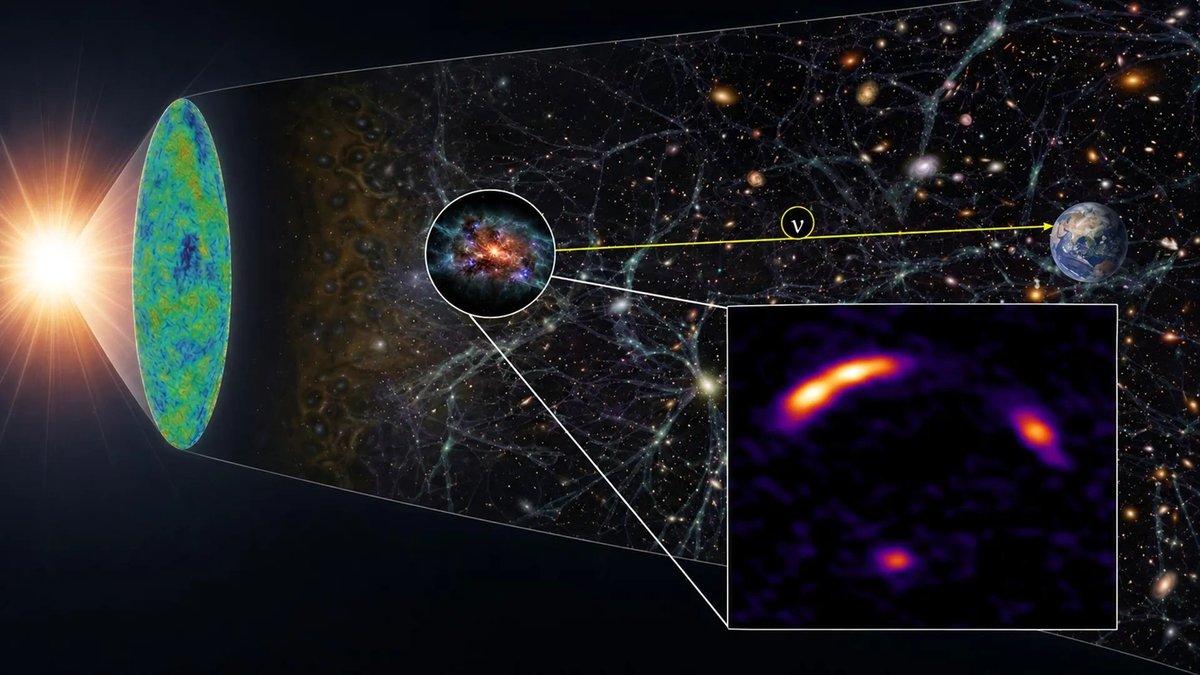
The key to the discovery was a fortunate alignment in deep space. A massive foreground galaxy lies between Earth and Shadow Blaster. Its gravity bends the path of light from the more distant galaxy, creating a natural magnifying glass known as a gravitational lens.
In the ALMA data, that lensing effect split Shadow Blaster into four distorted images. To a telescope, the galaxy appears as multiple arcs rather than a single neat object. For astronomers, those distortions are useful. They enlarge the background galaxy and allow finer details to be reconstructed.
The research team combined ALMA’s high-resolution data with lens modeling to recover Shadow Blaster’s true structure. That step matters because the observed images are warped by gravity. Lens modeling works like a cosmic correction map, helping astronomers infer what the galaxy would look like without the foreground galaxy’s magnifying effect.
With that reconstruction, the team could peer into a galaxy from a much earlier chapter of cosmic history. The light from Shadow Blaster began its journey when the Universe was only a few billion years old. That timing places the galaxy in an era when star formation across the cosmos was near its peak.
This alignment turned a distant, dust-obscured galaxy into a usable laboratory. Without the lens, its compact inner region would have been far harder to study in detail. With the lens and ALMA together, the galaxy became bright enough and large enough on the sky to probe its hidden core.
The signal points to extreme star formation
ALMA revealed that Shadow Blaster’s energy is linked to a compact, dusty starburst rather than an obvious active galactic nucleus. In practical terms, the galaxy’s gas and dust appear to be heated mainly by massive young stars forming in large numbers.
That detail changes the scientific story. Many earlier neutrino candidates have involved active galaxies with powerful jets, where matter falling toward a supermassive black hole can accelerate particles to extreme energies. Shadow Blaster suggests that galaxies packed with star formation can also create conditions that may generate high-energy neutrinos.
In a starburst galaxy, massive stars form rapidly and live short lives. They blow strong winds, explode as supernovae and stir the surrounding gas. Those processes can accelerate cosmic rays, which are high-energy particles that travel through space. When cosmic rays collide with dense gas or radiation inside a crowded galaxy, they can produce neutrinos.
The team also considered other possible counterparts within the neutrino localization region. According to the ALMA announcement, Shadow Blaster stood out because of its position, rarity and dense gas-rich core. The researchers still treated the connection cautiously, since a chance alignment between the galaxy and the neutrino direction remains possible.
That caution is important. A single neutrino event gives astronomers a patch of sky rather than a pinpoint source. Shadow Blaster is described as the most plausible electromagnetic counterpart candidate identified in that region. Future detections and follow-up campaigns will be needed to test whether galaxies like it truly make a meaningful share of the high-energy neutrino sky.
A compact core packed with gas and dust
At the heart of the result is a very small and very intense region. The lens-corrected ALMA view showed a dense compact starburst core only about 1,500 light-years across. For a galaxy-scale structure, that is a tight volume in which to concentrate so much gas, dust and star formation.
That compactness matters for neutrino production. When energetic particles are accelerated in a dense environment, they have many chances to collide before they escape. Each collision can trigger particle cascades that produce neutrinos. A gas-rich core can therefore behave like a thick target for cosmic rays.
The galaxy’s dust also explains why this system was hidden from ordinary optical views. Dust grains absorb visible and ultraviolet starlight, then reradiate the energy at infrared and submillimeter wavelengths. That makes Shadow Blaster faint or invisible in some bands while bright in the wavelengths that ALMA can detect.
Dusty star-forming galaxies are common during cosmic noon, the period when the Universe formed stars most rapidly. Many of them are difficult to study because their most active regions are buried. ALMA is built for this problem, since it can detect the glow from dust and molecules that reveal where stars are forming behind the obscuring material.
The compact core also gives theorists a concrete environment to model. If cosmic rays are accelerated by supernovae, stellar winds, or other starburst-driven processes, the density of the core will shape how efficiently neutrinos are produced. Shadow Blaster offers a rare observational test of those ideas at cosmological distance.
Starburst galaxies may help explain cosmic neutrinos
The broader implication reaches beyond one distant galaxy. The study connected Shadow Blaster to a class of compact, dust-rich galaxies that were abundant when the Universe was making stars at its fastest pace. If many of those galaxies behave similarly, they could add up to a detectable share of the cosmic neutrino background.
The ALMA announcement reports that populations of compact starburst galaxies may make a meaningful but subdominant contribution to high-energy neutrinos. The research described a possible contribution of up to about 20 percent of the total population of high-energy neutrinos observed across the Universe. That figure frames starburst galaxies as important contributors within a larger mix of cosmic sources.
IceCube Neutrino Observatory detections have already linked some neutrinos to active galaxies. Shadow Blaster adds a candidate from a different environment, one powered by intense star formation in a distant dusty galaxy. That expands the list of places astronomers need to watch when a future neutrino alert arrives.
The finding also shows the power of multi-messenger astronomy. Neutrinos provide one messenger. Light from telescopes such as ALMA, Gemini North, the James Clerk Maxwell Telescope and the Submillimeter Array provides another. When those signals are combined, astronomers can study extreme events across distances that a single technique could struggle to decode.
For now, Shadow Blaster remains a plausible counterpart candidate for IC 210922A. Its position, rarity, lens-magnified structure and compact gas-rich core make it scientifically compelling. The next step is to build a larger sample, so astronomers can learn whether hidden starburst galaxies are routine neutrino factories in the young Universe.