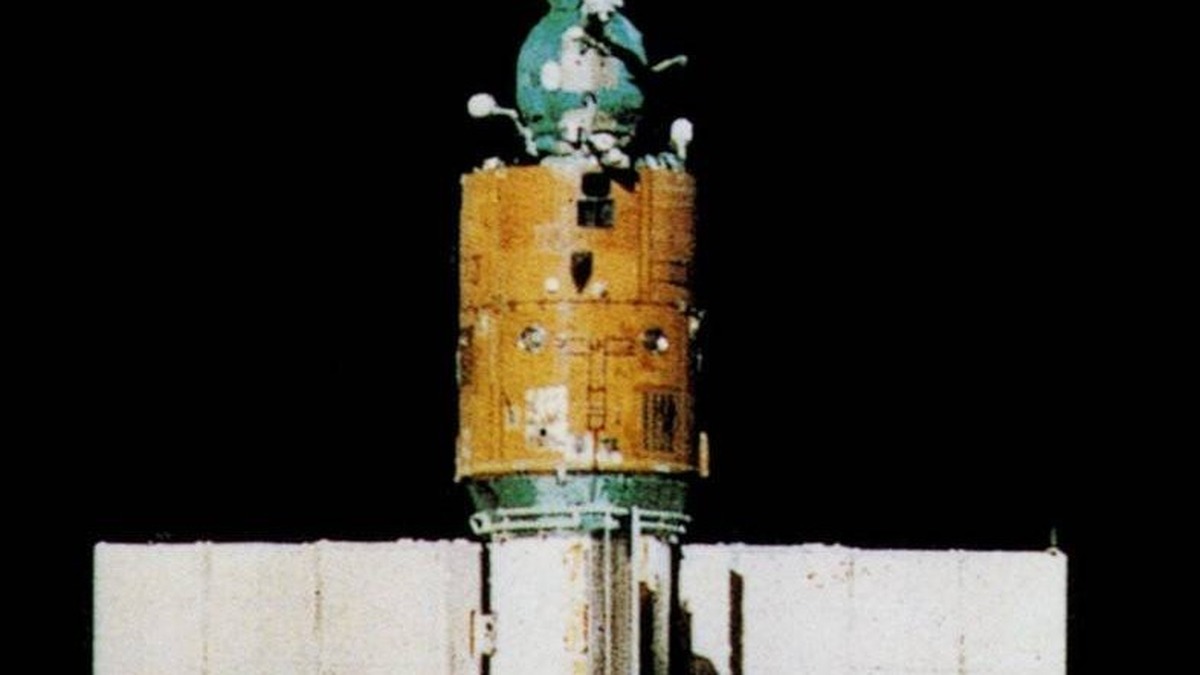
Salyut 6 stayed alive for 175 days with only two men on board and Soviet flight planners did not treat boredom or loneliness as minor side effects. They treated them as mission problems that needed their own countermeasures. Alongside exercise, food and work schedules, the station’s support package included family contact, outside voices, entertainment, mail from Earth and time set aside for privacy.
A translated 1980 summary in NASA’s USSR Space Life Sciences Digest describes that plan in unusually concrete terms. It says a special medical group was formed for the 175-day mission to ease the crew’s boredom and sense of isolation. The same digest describes frequent two-way audiovisual talks with family, supportive interviews with public figures, music and television on board and a daily routine that protected time for sleep, recreation and being alone.
Psychological support in that record should be read as a historical operational report, not as a modern clinical trial. The value of the material is that it shows how early long-duration crews were managed in practice. The larger lesson for current readers is narrower and stronger at the same time: long missions became easier to sustain when ground teams planned for morale, privacy and contact with home instead of hoping crews would simply endure confinement.
What the 175-day mission record actually says
The mission in question was the Soyuz 32 flight to Salyut 6, which carried Vladimir Lyakhov and Valeri Ryumin for a 175-day stay in 1979. NASA’s Mir Hardware Heritage chronology confirms the crew and duration. The translated digest then adds the part that makes the psychological story so striking: a dedicated medical support group was organized before flight to keep the crew motivated, informed and emotionally stable.
The mission-specific summary lists three stress points that planners expected to weigh on the crew: a heavy maintenance and repair workload, the absence of visiting crews and spacewalk operations. That phrasing matters because it shows the support effort was not framed as a general comfort feature. It was designed against known pressure points in a long mission where work intensity and social thinness could build into a real operational burden.
The same summary reports how the plan was carried out. Family talks happened 47 times during the flight. The crew also held discussions with scientific and technical specialists and with actors, comedians and singers. Varied music and news programs were available on board, while cargo deliveries brought letters, newspapers and gifts. The report says scientific consultations were kept upbeat and tied to the uses of the crew’s data, which suggests the planners wanted information from Earth to reinforce purpose as much as companionship.
Why boredom and isolation came first
Long before the ISS, mission planners already understood that a sealed station could wear down attention and morale even when life support systems kept working. A 1985 NASA review, Research opportunities in human behavior and performance, grouped the main psychological stressors of long missions into physical and social isolation, confinement, boredom, crowding, lack of privacy, artificial life support and microgravity. Those words fit the Salyut 6 problem closely.
The 1980 digest also ties psychological support to the broader idea of a good space station microclimate. In that context, microclimate did not mean only air temperature or cabin hardware. It meant the whole lived environment: exercise, diet, work rhythm, recreation, communications and the crew’s chance to withdraw for a while. The digest says all Salyut 6 crews lived on standard Moscow time with a normal work week and enough time for sleeping, eating, recreation and being alone.
Boredom and isolation were central because they could pull several other problems behind them. A crew with too little variation in daily life can lose stimulation, dwell on family worries and become more vulnerable to friction inside a small cabin. Early space medicine reports did not always use today’s language of behavioral health, yet they clearly describe the same core challenge: two healthy workers in orbit still needed a social and emotional buffer against monotony.
How the support package was built
Part of the system was direct contact with home. The 175-day summary emphasizes two-way audiovisual communication with family, while the broader 1985 NASA review says Soviet crews on the five main Salyut 6 expeditions, ranging from 75 to 185 days, had an onboard video and record library with more than 110 viewing and music programs. The 1985 review also says 132 meetings were arranged with 121 public figures from science, sports, journalism and the arts.
One line preserved in the 1985 review captures how the crews themselves described family contact. The report quotes a cosmonaut saying, “talks with families eliminated nervous stress”. The sentence is historical evidence, not proof measured against a control group. Even so, it helps explain why planners invested so much effort in scheduled conversations instead of treating them as a pleasant extra.
Another layer of support came from the station’s routine. The digest says the general goal was to make life aboard the station as normal as possible. That meant planned work weeks, regular mealtimes, time for recreation and room for solitude. Protected private time matters in small crews because emotional stability does not come only from adding more contact. It also depends on giving each person a way to step back, think and recover without having every minute claimed by the mission.
What later space programs kept using
Modern programs do not copy Salyut 6 item for item, but the family-contact logic survived. NASA’s Psychology of Space Exploration says ISS crews receive private weekly videoconferences with family during flight, along with extensive contact with people on the ground, crew care packages, special events and semimonthly videos with a behavioral health clinician. The format is newer, the communication quality is better and the operational idea is recognizably similar.
NASA’s Behavioral health support for International Space Station crews presentation makes the continuity even clearer. It describes private psychological conferences, direct support services for crews and families and regular family conferences as part of standard support. The old Soviet program mixed family contact, media, outside voices and routine; later NASA operations kept the same pillars while adding more formal behavioral health structure around them.
Family videoconferences, preferred music, familiar images from Earth and protected personal communication all address the same human problem. People in orbit still need reminders that life on the ground continues to exist around them and they still need ways to regulate closeness and distance. The hardware changed from taped programs and scheduled interviews to digital calls and private conferences, but the underlying support principle stayed remarkably stable.
Why the historical evidence needs a careful reading
The Soviet evidence is useful, but it is not neat in the way a modern experiment would be neat. One page of the digest says visiting crews could provide varied interpersonal contact and bring letters, newspapers and gifts. The mission-specific note for the 175-day Soyuz 32 stay says planners expected a lack of visiting crews and built the support plan around that gap. Both statements can be true in a wider Salyut 6 context, yet they also show why readers should avoid flattening several summaries into one perfectly tidy narrative.
The reports are translated, selective and strongly operational in tone. When they say the program maintained morale or kept the crew highly motivated, that is best treated as a claim from the mission record. Modern readers can still draw a defensible conclusion from it: long-duration flight teams had already learned that morale required planning. What cannot be pulled from the evidence is a precise ranking of which element worked best, or a clean demonstration that any single tool caused the reported outcomes.
Early space station psychology therefore looks less like a finished science than a practical engineering habit. The planners identified boredom, isolation, privacy loss and workload as risks; they then answered those risks with communication, entertainment, routine and scheduled recovery. For future lunar and Mars missions, the strongest modern conclusion is simple. Support systems for the mind need to be designed as deliberately as support systems for air, water and exercise, because a crew can stay physically alive and still lose steadiness if the mission stops feeling human.