Ready for ocean trivia with answers you can trust? The 25 questions below cover geography, depth, waves, chemistry, climate, exploration and marine life. Each answer comes first, followed by a short explanation that separates established measurements from estimates and avoids familiar ocean myths.
The figures here use current agency or institutional references, but mapping coverage and estimates can change as observations improve. Try answering each heading before reading its paragraph, or use the page as a fact-checked reference for a classroom game.
1. How much of Earth’s surface does the ocean cover?
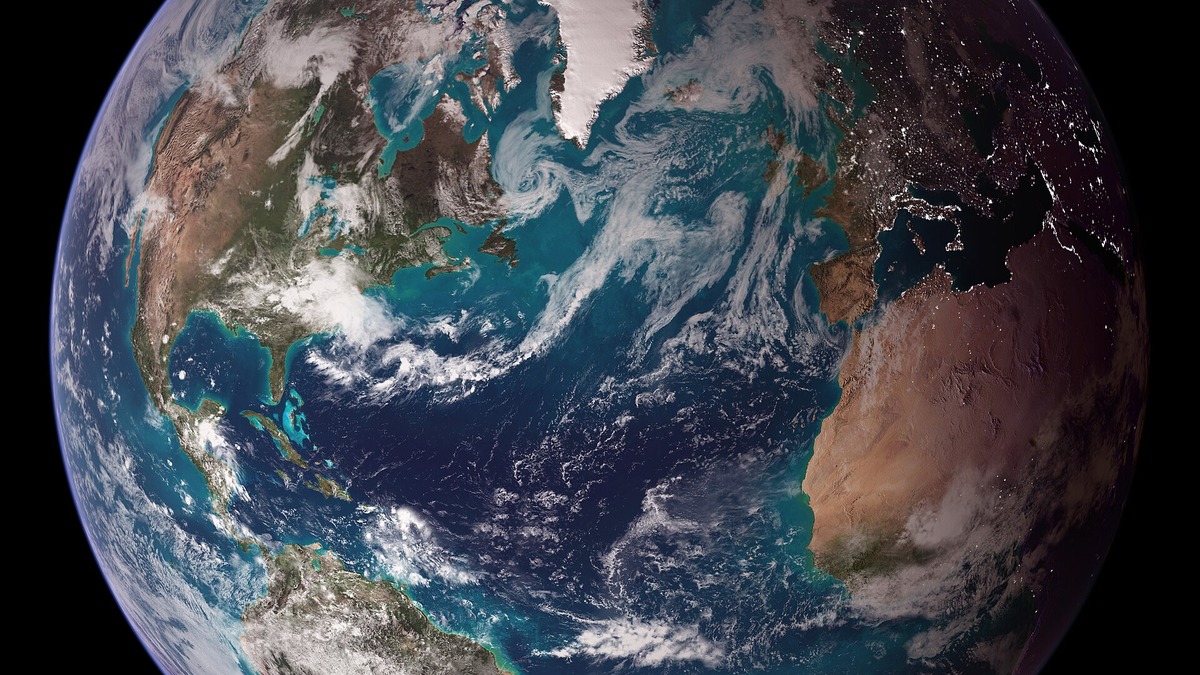
About 71 percent. Earth has one connected global ocean, even though maps divide it into named basins. NOAA describes an ocean surface area of roughly 360 million square kilometers. The remaining surface is land and much of that land still sends water back to the ocean through rivers, groundwater and ice.
2. Which ocean is the largest?
The Pacific Ocean. It covers more than 155 million square kilometers, according to NOAA Ocean Exploration. The Pacific is larger than all continental land combined and contains more than half of Earth’s open-ocean water. Its name does not mean its weather is always peaceful.
3. Which ocean is the smallest?
The Arctic Ocean. It occupies the high northern latitudes around the North Pole and is partly covered by sea ice through the year. “Smallest” refers to surface area among the five commonly named oceans, not ecological importance or water depth. Its wide continental shelves are unusual among ocean basins.
4. What is the deepest known point in the ocean?
Challenger Deep in the Mariana Trench. NOAA reports a measured depth of about 10,935 meters, or 35,876 feet. The exact figure depends on survey method and location within the depression. The trench lies in the western Pacific where one tectonic plate descends beneath another.
5. What is the ocean’s average depth?
About 3,682 meters, or 12,080 feet. NOAA’s depth explanation identifies this as an estimate derived from satellite measurements and other data. The seafloor is uneven, with shallow shelves, broad abyssal plains, ridges, seamounts and narrow trenches, so no single depth describes most places.
6. Is there one ocean or five?
Physically there is one global ocean; geographically it is commonly divided into five. The Pacific, Atlantic, Indian, Arctic and Southern oceans are connected by moving seawater. Named boundaries help organize maps and research. Argo’s Indian Ocean facts explore one basin without implying that it is isolated.
7. Why is the ocean salty?
Dissolved ions accumulate from rock weathering and seafloor processes. Rivers carry ions released as water reacts with rocks, while hydrothermal circulation and submarine volcanism exchange materials with seawater. NOAA’s explanation of why the ocean is salty identifies sodium and chloride as the most abundant ions. Water evaporates but salts mostly remain.
8. What is average ocean salinity?
About 35 parts per thousand. That equals roughly 35 grams of dissolved salts per kilogram of seawater, though modern oceanography often reports salinity on a practical or absolute scale. Evaporation, rainfall, river input, freezing, melting and circulation create regional differences, so 35 is a useful global approximation rather than a universal reading.
9. Why does the ocean look blue?
Water absorbs longer red wavelengths more readily while blue light penetrates and returns to our eyes. The sky’s reflection can influence the surface appearance, but it is not the main explanation for deep clear water. Plankton, sediment, dissolved matter, depth and viewing angle also produce green, brown, gray, or turquoise seas. Argo explains ocean color in detail.
10. How much of Earth’s water is in the ocean?
About 96.5 percent. The USGS global water distribution estimates place nearly all of the planet’s water in saline oceans. Freshwater makes up only a small remainder, much of it frozen or underground. Argo’s calculation of ocean water volume gives this percentage physical scale.
11. What causes tides?
Mainly the gravity of the Moon, with an important contribution from the Sun. Their gravitational forces and Earth’s rotation produce repeating changes in sea level. NOAA’s tide tutorial explains the resulting forces. Coastline shape, water depth and basin resonance alter local timing and range, so many coasts do not follow a simple equal-tide pattern.
12. Are waves and tides the same thing?
No. Ordinary surface waves are mainly generated by wind transferring energy to water, while tides are long-period changes driven primarily by lunar and solar gravity. A wave transports energy with comparatively little net forward movement of water. Tsunamis have yet another cause, usually rapid displacement of a large water volume.
13. What causes a tsunami?
Sudden displacement of seawater. Most large tsunamis follow undersea earthquakes that vertically move the seafloor, but landslides, volcanic activity and impacts can also generate them. In deep water a tsunami may have modest height and very long wavelength; it slows and grows as it enters shallow coastal water.
14. What is the world’s largest mountain range?
The global mid-ocean ridge system. This connected chain of underwater ridges extends for tens of thousands of kilometers through ocean basins. Plates separate along much of it, magma rises and new oceanic crust forms. Only sections such as Iceland stand prominently above sea level.
15. How old is the ocean floor?
Most surviving oceanic crust is younger than about 200 million years. New crust forms at spreading ridges and old crust is recycled into the mantle at subduction zones. Continental rocks can be billions of years old because continents are less routinely consumed. Sediment cover generally thickens as seafloor moves away from a ridge.
16. How much seafloor has been mapped?
The answer depends on the required resolution and reporting date. Satellite gravity provides a broad global picture, but ship-based sonar supplies much finer bathymetry. NOAA reported that about 26 percent had been mapped at high resolution as of June 2024. Saying “unmapped” does not mean scientists have absolutely no information about the rest.
17. Has most of the ocean been explored directly?
No. Mapping, sampling and direct visual exploration are separate achievements. NOAA says only a tiny fraction has been explored, especially in the deep sea. Satellites observe the surface, sonar maps broad areas and submersibles or cameras inspect comparatively small sites.
18. Does the ocean produce oxygen?
Marine photosynthetic organisms produce at least half of Earth’s oxygen. NOAA attributes this production mainly to oceanic plankton, including photosynthetic algae and cyanobacteria. Much oxygen is also consumed within ocean food webs. Today’s atmospheric oxygen reflects production and consumption across the planet over long periods.
19. What is the ocean’s twilight zone?
The mesopelagic, roughly 200 to 1,000 meters deep. Faint sunlight reaches this layer, but generally not enough for photosynthesis. Many animals migrate upward at night to feed and descend by day, moving carbon and nutrients. Boundaries are approximate because light penetration changes with water clarity and season.
20. Can sunlight reach the deepest ocean?
Sunlight cannot reach the deepest ocean. It fades through the upper water column and is absent in the deep aphotic zone. Deep-sea organisms rely on organic material sinking from above, predation, or chemical energy around vents and seeps. Many create biological light and diverse communities occupy the dark water and seabed.
21. How common is bioluminescence in the deep sea?
It is extremely common. MBARI researchers report that about three-quarters of life in the water column can produce light. Organisms use chemical reactions for camouflage, prey attraction, defense and communication. Blue-green wavelengths dominate because they travel relatively well through seawater.
22. What is the largest fish?
The whale shark. Despite its name and enormous body, it is a fish, not a whale. Whale sharks are filter-feeding sharks that consume plankton and small prey. “Largest fish” refers to body size, while the blue whale is larger overall and belongs to the air-breathing marine mammals.
23. Can fish drink seawater?
Many marine bony fish do. They lose water osmotically to their salty surroundings, so they drink and absorb water through the gut, then expel excess salts mainly through specialized gill cells and urine. Sharks balance water differently by retaining high concentrations of urea and other compounds in their body fluids.
24. Do all deep-sea animals have eyes?
No. Some have reduced or absent eyes, while others possess highly sensitive or specialized vision. The best adaptation depends on depth, habitat and behavior. Bioluminescent signals make vision useful in much of the dark ocean, but animals also rely on smell, touch, vibration, electrical sensing and pressure changes.
25. Is the ocean still changing?
Yes, continuously. Tides and currents move water, plates create and destroy seafloor, organisms build and erode habitats and climate alters heat, sea level, acidity and oxygen. Human activity adds fishing pressure, noise, nutrients, plastics and greenhouse gases. More biological surprises appear in Argo’s 25 facts about sea life.