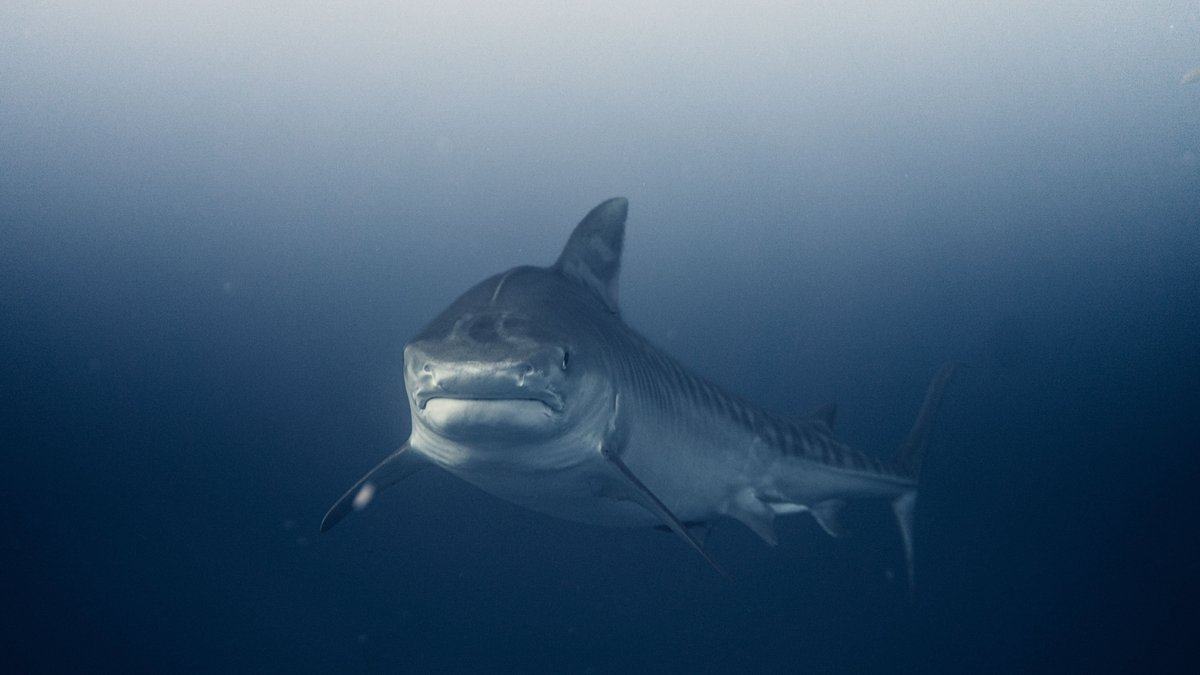
A Movement Ecology study found that juvenile white sharks temporarily abandoned a San Diego nursery when Tropical Storm Hilary hit Southern California on August 20, 2023. Researchers from Scripps Institution of Oceanography and California State University, Long Beach tracked 22 tagged sharks across the storm period. Their records show a fast drop in shark attendance as conditions deteriorated, followed by a quick rebuilding of the group once the coast settled down.
The event gave scientists a rare chance to watch a top coastal predator react to an extreme storm in real time. According to the National Hurricane Center’s Hilary report, the storm reached Category 4 strength over the eastern Pacific and then weakened before landfall in Baja California. Even in that weaker state, Hilary still drenched the Southwest and triggered major flooding. Inside the shark nursery, the sharpest physical change was a sudden plunge in ocean temperature, which lined up closely with the sharks’ retreat from shallow water.
A nursery that suddenly thinned out
The study focused on a nearshore nursery habitat off Torrey Pines and Del Mar, where young white sharks gather in summer and early fall. These shallow coastal waters are warmer than nearby offshore areas and that makes them useful real estate for juveniles that are still growing and learning to forage. The team followed 22 sharks with acoustic transmitters. Thirteen were females and nine were males. Underwater receivers logged each animal’s presence hour by hour.
Before the storm, the researchers usually detected 16 to 19 sharks per hour in the array. During Hilary, that count fell to as few as eight. Most of the departures were temporary, lasting anywhere from a couple of hours to 15 days. Nearly every shark returned within three weeks and most were back much sooner. Lead author Jack Elstner said, “To our knowledge, this is the first study to document storm-response behavior in white sharks.”
Strong site fidelity makes the storm response more striking. Juvenile white sharks do not wander randomly through the region from one hour to the next. A sudden drop in detections during the storm therefore points to a real behavioral shift, not just background noise in the tracking record. The team also built statistical corrections for storm-related changes in receiver performance, which strengthened the case that the nursery truly emptied out in part rather than merely appearing to do so.
The methods help explain why the conclusion carries weight. The paper says the researchers filtered detections from August 1 through September 10, 2023, then compared shark signals with transmissions from 20 synchronization tags fixed inside the receiver array. The fixed tags let the team estimate how storm noise changed receiver performance. The team measured receiver tilt. It also tracked the effects of distance and tested whether signal crowding from many tagged sharks could interfere with detections. The authors then fed those corrections into a Bayesian state-space model designed to separate actual shark departures from hours when rough conditions simply made animals harder to hear.
Cold water appears to have been the main trigger
The storm changed more than the surface weather. Sea-surface temperatures inside the nursery fell from 20 degrees Celsius to 13.9 degrees Celsius in less than 24 hours. That is a steep drop for a shallow coastal habitat and it happened at almost the same time the sharks pulled away. The authors concluded that falling temperature was the strongest predictor of emigration. Rougher waves may have contributed as well. Lower barometric pressure and changing salinity may have added to that push.
NOAA Fisheries notes that white sharks are regionally endothermic, which means they can keep their bodies warmer than the surrounding water. Even so, young sharks have less thermal flexibility than large adults and appear more sensitive to abrupt cooling. In the San Diego nursery, the problem was probably the speed of the change as much as the final temperature. Water that is comfortable one afternoon can become costly habitat by the next morning when storm mixing drags colder water to the surface.
The sharks’ quick return makes sense in light of those thermal changes. Once the storm passed and local conditions improved, the same stretch of coast again offered the benefits that bring juveniles there in the first place. Warm shallow water lowers the energetic burden on small sharks. It also supports prey such as rays and small fish. The same habitat may also spare young sharks some of the risks associated with spending more time in deeper offshore water.
The paper also keeps some uncertainty in view. Falling temperature gave the strongest statistical signal, but the authors did not claim it acted alone. Wave height changed during the same event. Barometric pressure fell and salinity shifted as well. Ambient noise and turbidity also moved at the same time, which makes a storm response more complex than a single trigger pulled at a single moment. Future storms may cool nursery waters differently. They may also push sharks toward different refuge areas because local wind direction can shift, swell can build, or the coastline itself can redirect wave energy.
Some sharks appear to have sheltered near La Jolla Canyon
The researchers could not map every storm escape route, but they did see one clue stand out. Detections rose in La Jolla Cove. This sheltered area sits just south of the main nursery beside a submarine canyon that drops quickly into deeper water. Elstner said, “We believe this more sheltered habitat may have served as an important nearshore refuge for some individuals.” That idea fits the local geography: the cove is partly protected from strong southerly winds, yet it also gives sharks fast access to depth.
One tagged shark offered the clearest example. On the day Hilary reached San Diego, a pressure-sensing transmitter recorded that animal at 132 meters deep in La Jolla Canyon, the deepest dive observed during the study period. The paper treats that record cautiously, but it is consistent with a shark trying to get away from rough water near the surface. Co-author Chris Lowe said some animals may have “tucked” into calmer water, while others reacted differently.
Individual variation shaped the nursery response. The study did not find one rigid storm script followed by every shark in the array. Some left early. Others lingered longer. One animal never returned to the San Diego receivers that year. Wildlife populations often look steady from a distance while individuals make very different decisions underneath that average. Hilary exposed that flexibility within a population that shares the same coastal nursery.
Why this storm response is useful now
The finding is bigger than one dramatic weekend in 2023. Coastal nurseries are built around local conditions that can change fast during an extreme event and climate models suggest that heavy-rain and high-impact coastal storms will remain a major management concern in coming decades. In the official Scripps release, co-author Brice Semmens said the work helps researchers understand how sharks react to rapidly changing ocean conditions while also informing safer ocean use by people.
Shared coastal use gives the study practical value. Southern California beaches are busy places and managers need better forecasts for how wildlife may redistribute during unusual ocean conditions. A partial evacuation of a nursery does not mean sharks vanished from the region. Some animals shifted location. Some likely sought shelter. Local shark presence also became less predictable for several days. That information can support conservation work. It can also inform beach safety efforts and future tracking studies.
The study also shows why long-running monitoring arrays are valuable. Without acoustic tags and fixed receivers, researchers would not have had enough pre-storm data for comparison. Hilary could have passed as an interesting anecdote rather than a measurable biological event. The researchers instead captured a short-term disruption followed by a rapid rebound. They also identified likely environmental cues that can now be tested in future storms. As rare storms brush the California coast again, scientists will have a much better baseline for asking whether young white sharks keep making the same choice.