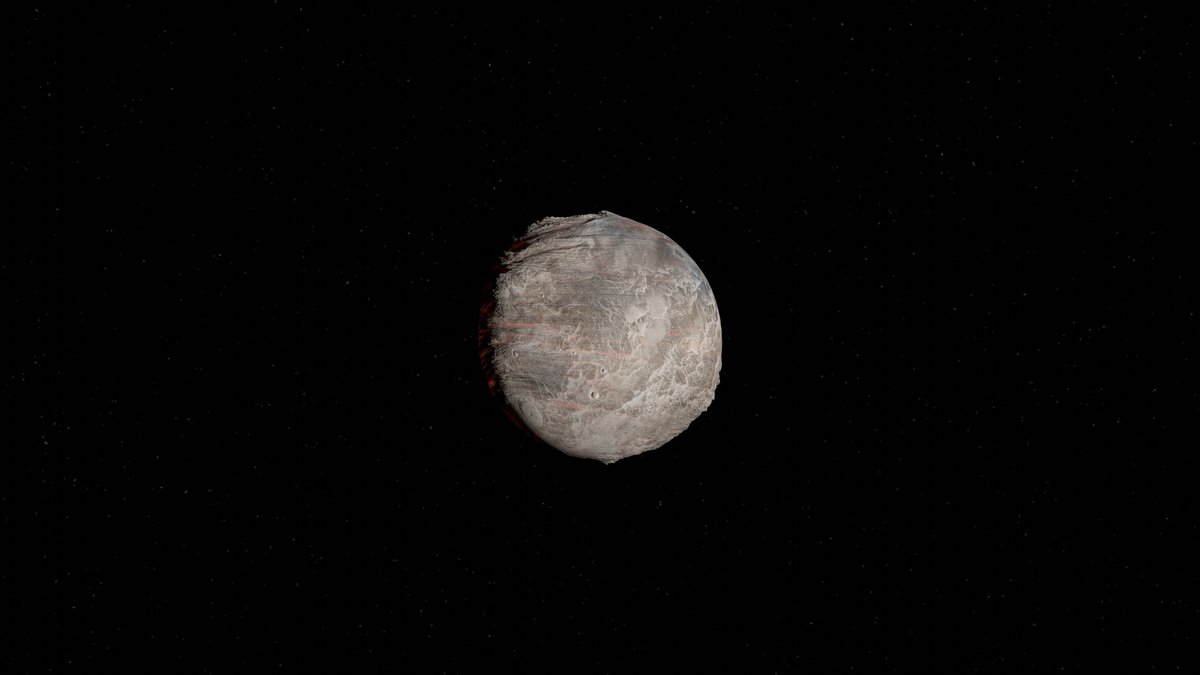
Researchers analyzing NASA’s Webb observations have watched the giant exoplanet HD 80606 b heat up as its stretched orbit carried it close to a Sun-like star. The planet is about four times the mass of Jupiter and its path around its star creates one of the most dramatic atmospheric tests astronomers can observe beyond our solar system.
The new results come from the James Webb Space Telescope, which used infrared light to track the planet before, during and after its closest approach. In that short window, Webb detected a temperature rise of about 1,100°F. For scientists who study exoplanet atmospheres, that sudden change offers a rare chance to watch alien weather respond almost in real time.
The world, called HD 80606 b, has already earned attention because of its punishing orbit. It spends much of its trip at a greater distance from its star, then sweeps inward for an intense blast of radiation. That makes each orbit a repeatable natural experiment in heat, chemistry and atmospheric motion.
A gas giant on a furnace-like orbit
HD 80606 b belongs to a class of planets known as gas giants. It resembles Jupiter in its basic nature, with a massive atmosphere and no familiar solid surface. Its environment is far more violent than anything in our solar system, because its orbit carries it into a harsh close pass around its star.
NASA’s exoplanet catalog lists the planet’s orbital period at 111.4 days. That means scientists can predict when it will rush through the most extreme part of its orbit. The close approach is called periastron, the point where the planet comes nearest to its host star.
The shape of the orbit is the key to the story. NASA lists the planet’s eccentricity at 0.93, which describes a very stretched path. A circular orbit has an eccentricity near zero. HD 80606 b follows a long, narrow loop that creates huge differences in starlight from one part of the orbit to another.
That geometry turns the planet into a moving furnace experiment. As it dives close to the star, the dayside absorbs a sudden flood of energy. Its atmosphere then has to move, radiate, mix and chemically adjust while the planet keeps racing through space.
Webb saw the heat rise
NASA’s Webb team used the telescope’s Mid-Infrared Instrument, known as MIRI, to study heat coming from the planet. Mid-infrared light is especially useful for this kind of work because warm planets glow at these wavelengths. That glow carries information about temperature and atmospheric structure.
The observation covered the crucial stretch before, during and after periastron. During that period, HD 80606 b also passed behind its star from Webb’s point of view. Astronomers call this a secondary eclipse. When the planet disappears behind the star, scientists can compare the combined light of star and planet with the star alone.
That comparison lets researchers isolate the planet’s heat signal. Webb’s sensitivity gave the team a sharper view than earlier infrared observations could provide. The result was striking, because the temperature rise was stronger than scientists had expected from previous data.
Scheduling the measurement took years of planning. Webb can look at different parts of the sky only during certain times of the year, because the telescope must keep its sunshield aligned properly. The planet’s 111-day orbit also had to line up with Webb’s viewing window. When that timing finally worked, MIRI captured the planet during the most revealing part of its orbit.
Why HD 80606 b is so extreme
HD 80606 b stands out because its orbit gives it two very different lives during one trip around its star. Farther out, the planet receives less radiation. Near periastron, the starlight surges. The atmosphere must react quickly as the energy load changes.
Tiffany Kataria, the study’s principal investigator at NASA’s Jet Propulsion Laboratory, placed the planet in a broader exoplanet context. “Hot Jupiters are already considered some of the most extreme exoplanets we know of,” she said. She also called HD 80606 b “one of the most extreme.”
Most hot Jupiters known to astronomers orbit very close to their stars throughout their year. Their atmospheres endure strong heating continuously. HD 80606 b creates a different kind of test because its heat input changes rapidly as it swings inward and then moves away again.
This helps explain why scientists care about such a harsh world. Its value comes from the rapid change. In a matter of hours, Webb can see how the atmosphere responds as conditions shift. That response can sharpen models used for many other exoplanets.
Light reveals alien weather
To turn Webb’s light into science, astronomers use spectroscopy. The method splits incoming light into wavelengths, much like a prism separates white light into colors. Each wavelength can carry clues about temperature, motion and chemistry.
For exoplanets, spectroscopy works like a fingerprint test performed at interstellar distance. Molecules absorb and emit light in particular patterns. If those patterns appear in Webb’s data, scientists can infer which chemicals may be present and how the atmosphere behaves.
Ryan Challener, a co-author from the Cornell Center for Astrophysics and Planetary Science, pointed to chemical signatures such as “methane and carbon dioxide.” Those molecules matter because their abundance can shift as heat, sunlight and atmospheric mixing change over time.
The rapid heating of HD 80606 b gives researchers a chance to watch alien weather under stress. Winds may move heat from one region to another. Chemical reactions may speed up or slow down. Clouds or hazes may form, break apart, or change their opacity as the planet moves through its close approach.
Webb’s data are especially useful because they can connect those processes to a known point in the orbit. Instead of studying a planet under one steady condition, scientists can track how the same atmosphere behaves as the star’s heating rises and falls.
Spitzer’s roasted planet gets a sharper look
HD 80606 b was famous before Webb turned toward it. NASA’s retired Spitzer Space Telescope studied the planet in infrared light and helped establish its reputation as a roasted world. Spitzer’s observations showed that the planet’s orbit produced powerful heating effects.
Webb builds on that foundation with stronger sensitivity and richer spectral information. Spitzer could detect important infrared changes. Webb can separate the light in greater detail, which helps scientists test atmospheric models more precisely.
The comparison between Spitzer-era expectations and Webb’s new measurements is important. Webb found a temperature increase that was stronger than earlier work had suggested. That gap gives modelers something concrete to investigate.
Models of exoplanet atmospheres have to account for radiation, chemistry, winds, clouds and the planet’s rotation. A world like HD 80606 b pushes those models into a difficult regime. The heating arrives quickly and the atmosphere may need time to redistribute energy.
Each new dataset helps scientists refine those calculations. The goal is broader than one unusual planet. Researchers want tools that can interpret the atmospheres of many worlds, from hot giants close to their stars to cooler planets on calmer orbits.
A fast-changing laboratory in space
Laura C. Mayorga, a co-investigator and exoplanet astronomer at the Johns Hopkins Applied Physics Laboratory, described the appeal of this target clearly. “Observing a planet like HD 80606 b is actually very efficient,” she said.
That efficiency comes from the planet’s unusual timing. A single well-planned observation can sample a wide range of conditions. Scientists can watch the same planet before the heating peak, during the close pass and after the strongest blast of starlight.
This makes HD 80606 b a natural laboratory. Laboratory experiments on Earth often change one condition and measure the response. Here, the orbit supplies the changing condition, while Webb records how the atmosphere reacts.
There are still limits. The planet is distant, faint beside its star and observed indirectly through light. Researchers must use careful modeling to connect Webb’s measurements with physical conditions in the atmosphere. Early findings are powerful, but the full dataset will take more analysis.
Even with those challenges, the planet’s repeated orbit is a major advantage. Every 111.4 days, HD 80606 b returns to the same dramatic close pass. Future observations can test whether the atmosphere behaves the same way each time.
What scientists want to learn next
The Webb team has only begun digging into the MIRI observations. Researchers will use the spectra to examine how temperature changes with altitude, how energy moves across the atmosphere and whether chemical signatures vary during the planet’s close approach.
One major question involves heat transport. When the star-facing side is suddenly blasted with radiation, winds may carry some of that heat around the planet. The speed and efficiency of that transport can reveal how giant exoplanet atmospheres circulate under extreme forcing.
Chemistry is another target. Molecules can be broken apart by heat or radiation, then form again as conditions change. Webb’s spectral data may help scientists see whether HD 80606 b’s atmosphere approaches chemical balance or spends much of its orbit in a shifting state.
Cloud behavior may also matter. On hot giant planets, clouds can involve minerals or other exotic condensates that have no everyday Earth equivalent. Their presence can change how much light escapes from different atmospheric layers. Webb’s infrared view can help separate temperature effects from chemical and cloud effects.
For exoplanet science, the larger payoff is a better grasp of dynamic atmospheres. HD 80606 b gives astronomers a rare target where change happens fast enough to watch. Webb has now caught that change in action, turning a roasted gas giant into a benchmark for worlds that live under extreme starlight.