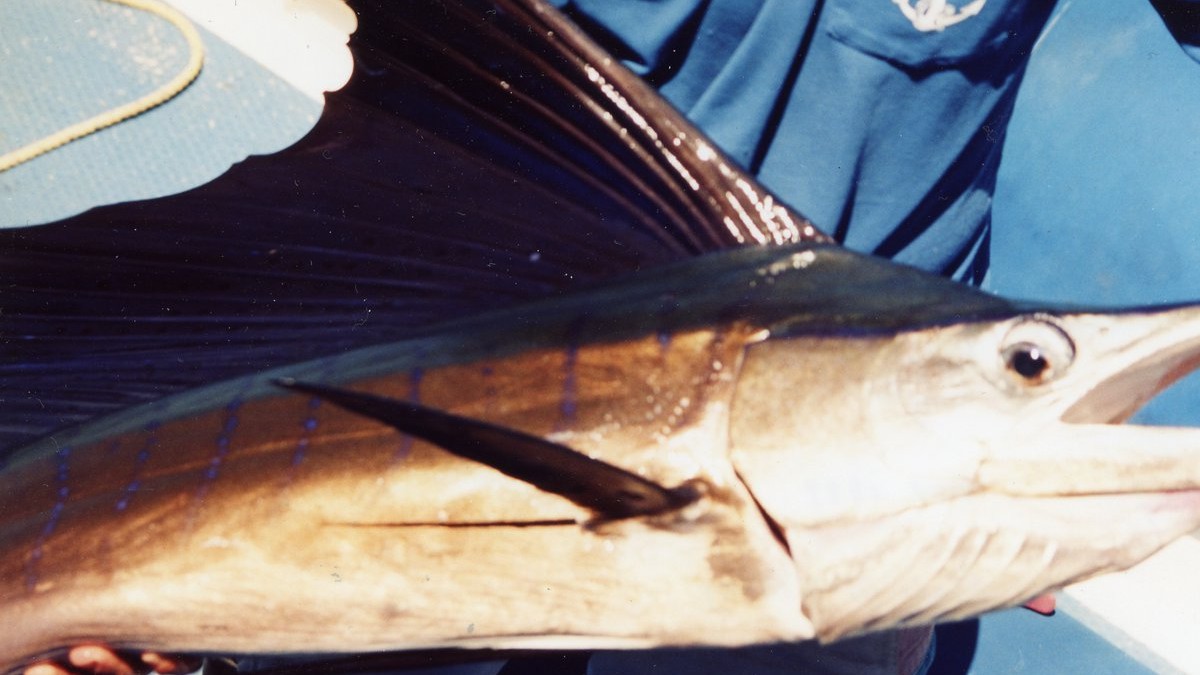
Measuring an ocean fish at full sprint is a difficult scientific task. A sailfish can race through open water, turn inside a schooling fish and vanish beneath the surface before a boat or camera has a useful view. The fastest moments may last seconds. A reliable direct speed record needs a known distance and time, or instruments that track the fish’s movement through the water. Direct speed measurements remain rare for the ocean’s large, roaming predators.
The strongest published test of the famous sailfish claim comes from a 2016 Biology Open study. Its researchers measured the contraction speed of swimming muscle and combined that result with tail-beat stride length. Their estimate for the Indo-Pacific sailfish was 8.3 ± 1.4 meters per second, or about 30 kilometers per hour and 19 mph. The quoted figure is an estimate of potential maximum performance, rather than a stopwatch measurement of a free-swimming sprint.
Sailfish still belong among the ocean’s most impressive speed specialists. Yet the evidence asks for a more careful answer than a single number on a poster. The often repeated 68 mph figure came from historical fishing-line timing. The indirect estimate was affected by the fish’s direction, line angle, drag and boat movement. It was also affected by moments when the fish may be airborne. Peer-reviewed observations and physiological estimates provide a firmer basis for comparison.
Why speed records are hard to capture
A fish’s speed can mean several different things. A sustained travel speed shows how quickly it moves over minutes or hours. A burst speed describes a brief chase or escape. Ground speed also differs from speed through water when currents carry the animal. A fishing reel records line leaving a spool, which supplies useful clues but does not isolate all of those variables. Each method answers a slightly different question.
Researchers use several tools to close that gap. Video can measure distance when the camera view includes a scale. Accelerometers record rapid body motion and tail beats. Acoustic tracking follows tagged animals from a vessel. Satellite and archival tags reveal longer journeys, although their sampling intervals can miss a very short sprint. The data become strongest when several methods overlap during the same behavior.
Distance is often the hardest quantity to establish underwater. A fish can move toward or away from a camera, so its apparent motion across the image may differ from the distance it actually travels. Refraction at the water’s surface can also distort a view from above. Researchers use known-size objects, multiple camera angles, or tracking systems to reconstruct a path. They then report the method alongside the number, since a speed estimate gains meaning from the way it was measured.
Rare behavior adds another challenge. A predator might deliver its fastest effort only when prey are close, light is favorable and the chase begins from the right position. A tag can record a genuine hunt without catching the single fastest event of an animal’s life. For that reason, scientists separate observed peak values from physiological estimates of what the muscles and water might allow.
What the sailfish evidence shows
The 2016 study used twitch contraction time from anaerobic swimming muscle, the tissue that powers intense bursts. The authors paired the fastest measured contraction with a predicted tail-beat cycle and stride length. Across the four species they examined, sailfish produced the highest estimated maximum. The reported value, 8.3 ± 1.4 m/s, equals roughly 18.6 mph. The authors treated it as a physiological estimate with uncertainty, not a world-record timing trial.
Earlier field work reviewed in that paper used high-speed video and accelerometers while sailfish hunted sardines. It placed the upper observed limit at 8.19 m/s, about 29.5 km/h or 18.3 mph. The close agreement with the muscle-based estimate makes the evidence more useful than either approach alone. It also shows why a brief dash deserves context: filmed hunting captures one set of interactions, while anatomy estimates a limit that still depends on the animal and conditions.
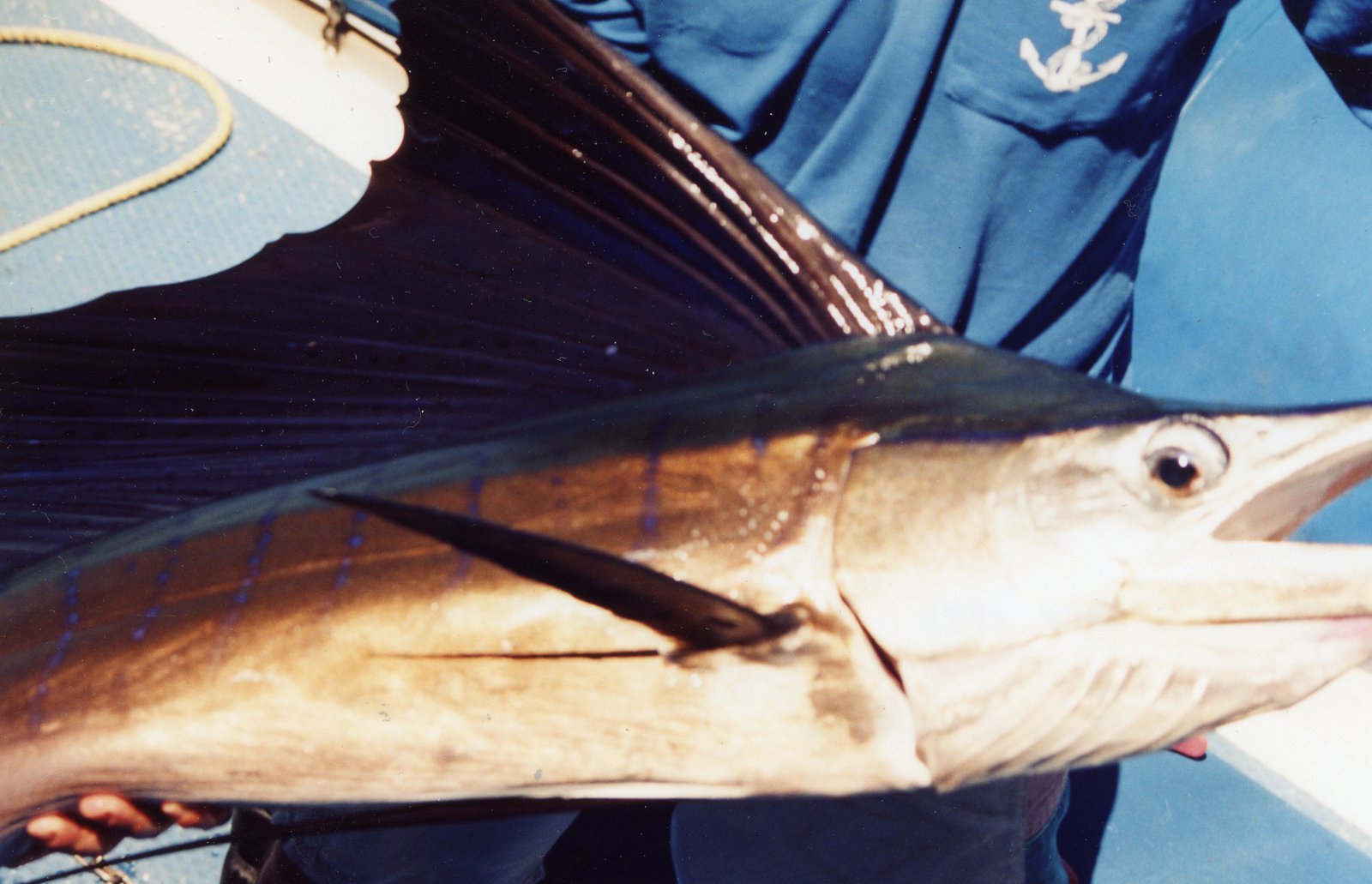
Estimated values deserve their own label. Muscle data can indicate how quickly a tail might beat during an extreme effort, yet the animal must still generate thrust and keep its body stable in moving water. Observed values show what happened in a recorded event, although they may miss a rarer and faster burst. Scientists compare both kinds of evidence because they reveal different parts of the same problem. Neither one turns a historical reel reading into a modern direct record.
Newer instruments can reveal the chase in greater detail. A 2023 tagging study combined biologging data and video to document a solitary sailfish pursuing prey. Its records included depth, body pitch, tail beats and estimated speed during capture attempts. Such biologging tags are valuable because they move with the fish. They also show why one fish’s foraging sequence cannot settle an ocean-wide speed contest by itself.
How water sets a speed limit
Shape helps sailfish move efficiently. Their tapered bodies, narrow tail base and retractable fins reduce resistance during travel. In a wind-tunnel study of preserved sailfish and swordfish, researchers measured very low hydrodynamic drag at cruise-speed conditions. The experiment examined gliding postures at about one body length per second, so it describes efficient routine movement rather than a verified sprint maximum.
Water pushes back much harder as speed climbs. A faster fish needs far more power to overcome drag and pressure changes around fins can become severe. The 2016 authors also considered cavitation, the formation of vapor-filled bubbles when local pressure falls very low. Their analysis placed the likely upper range for sailfish below 10 to 15 m/s, where cavitation could damage fin tissue. The result is a model-based limit, with the exact threshold shaped by depth, body size and swimming posture.
Hunting rewards agility as well as a straight-line dash. Sailfish approach a school with their fins folded and use quick turns as prey scatter. A close pursuit may demand acceleration, braking and body control more than a long, flat-out run. The fish’s hunting behavior helps explain why direct field measurements during feeding often fall below legendary reel-based figures. A predator that can repeatedly maneuver through a school may gain more food than one built only for a single spectacular burst.
The most defensible answer
The shortfin mako shark also belongs in any discussion of fast ocean fish. NOAA Fisheries describes shortfin makos as capable of speeds around 45 mph, a figure that reflects their reputation as powerful pelagic swimmers. Species comparisons still depend on how a speed was obtained. Tag tracks, observed bursts, estimates from muscles and fishing encounters all carry different kinds of uncertainty.
For the question of the fastest fish in the ocean, sailfish remains the leading answer in peer-reviewed comparisons of large marine predators. The same research places its estimated top speed near 8.3 m/s and finds the historic 68 mph claim lacks a direct underwater measurement. The evidence supports admiration for a fast, highly specialized fish while leaving an absolute all-species record open for future instruments to capture.
Separating estimates from direct measurements gives sailfish a more defensible speed record. A future combination of calibrated video, motion sensors and water-current measurements could document a true peak burst in the wild. Until then, the clearest answer is evidence-based: sailfish stand out as elite ocean sprinters and their best supported speeds sit far below the famous 68 mph figure. Future measurements can show how close wild sailfish come to their physiological limits.