The 1977 Galápagos Hydrothermal Expedition sent geologists into a dark stretch of Pacific seafloor and revealed warm, mineral-rich water escaping from fresh lava. Around those openings, the team found dense communities of clams and other animals. The discovery showed that a productive food web could be powered by chemistry far below the reach of sunlight.
Years of clues about heat loss from newly formed seafloor guided oceanographers toward the discovery. In 1977, the view shifted to close range. The human-occupied submersible Alvin, cameras, samples and temperature measurements turned a strong geological prediction into a direct observation of active hydrothermal vents and their unexpected inhabitants.
A clue in 1976 became a target in 1977
In 1976, the Scripps-led Pleiades expedition revisited the Galápagos Rift with a deep-towed camera system. Its photographs showed fields of clam shells on the seafloor. The images documented shells and narrowed the likely vent area. Direct observations of flowing warm water and thriving communities followed during the 1977 expedition.
That distinction matters. The 1976 work narrowed the search and supplied clues for the next cruise. In February 1977, a National Science Foundation-funded expedition aboard R/V Knorr headed for the likely site. Researchers from five leading ocean science institutions joined the effort. Their main expectation was a heat-driven system tied to new crust at the Galápagos Rift.
Scientists had reasons to expect that outcome. Ocean crust at a spreading center is young and hot. Measurements of heat flow, studies of old mineral deposits on land and evidence from the seafloor all pointed toward circulating water below the rift. The 1977 cruise was designed to test that geological idea. The biological discovery came as an unplanned result of finding the active system itself.
Alvin reached a new seafloor landscape
First, the deep-towed camera platform ANGUS photographed a striking concentration of live white clams. WHOI’s expedition history says the images led the scientists to a place they later called Clambake. R/V Lulu then brought Alvin to the area. On February 17, during dive 713, pilot Jack Donnelly and scientific observers Jack Corliss and Tjeerd van Andel descended toward the target.
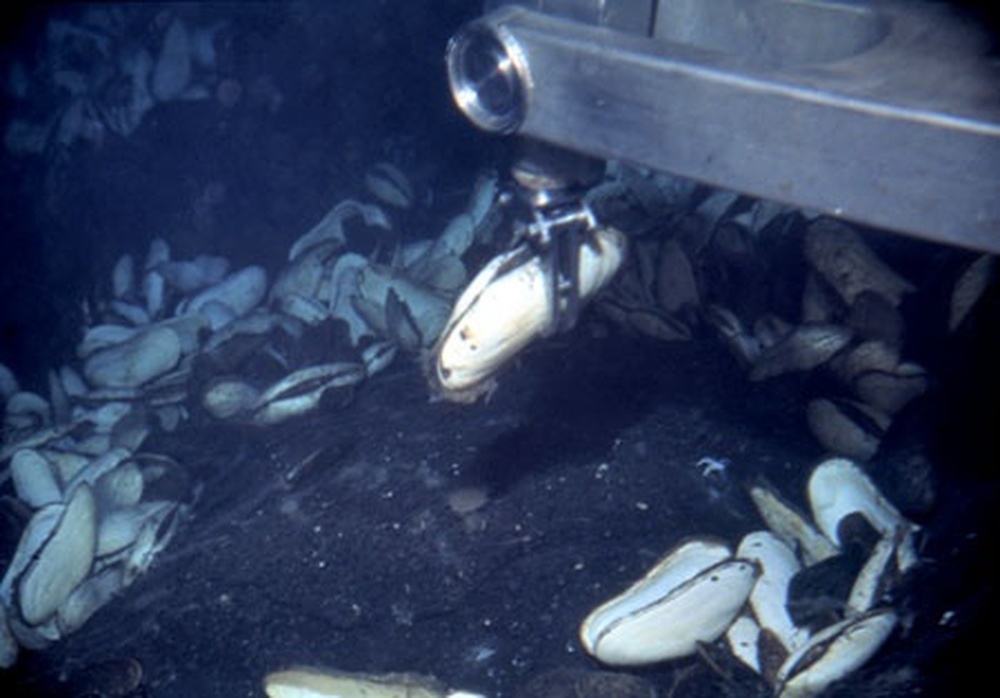
At the bottom, the crew saw warm water shimmering from cracks in lava. As that water mixed with the cold deep ocean, dissolved chemicals formed a cloudy blue plume and stained the lava. Alvin’s sensors measured 8 degrees Celsius in the water near the seafloor, warmer than the surrounding deep water. Corliss radioed the ship and said, “Well, there’s all these animals down here.” The observation captured the surprise behind a new branch of marine science.
The observations depended on several tools working together. ANGUS could survey a broad patch of bottom and point the submersible toward an unusual scene. Alvin then let people inspect the lava, sample material and measure conditions at close range. That sequence linked photographs of living clams with a visible source of warm fluid. It also made the 1977 result stronger than a distant image or an isolated chemical reading.
The acoustic beacons named Sleepy, Dopey and Bashful helped guide Alvin toward the clam field recorded by ANGUS.
How hot water becomes a hydrothermal vent
Along a mid-ocean ridge, tectonic plates move apart and new ocean crust forms. Seawater can enter cracks in that crust. Heat from below warms the water, while reactions with rock change its chemistry. The fluid then rises through openings in the seafloor. NOAA Ocean Exploration explains that high pressure at depth keeps the water from boiling even when it reaches several hundred degrees Celsius.
When the heated fluid meets near-freezing seawater, minerals can come out of solution and build deposits around the opening. This process also moves heat and chemical elements between the crust and ocean. The later 1979 Science report on submarine thermal springs at the Galápagos Rift documented the expedition’s water samples and heat-flow evidence. It helped place the discovery within the larger process of seafloor spreading.
The 1979 analysis also placed the vents in Earth’s heat budget. Its authors estimated that thermal springs could carry about two-thirds of the heat lost from new oceanic lithosphere at the Galápagos Rift during its first million years. That estimate came from studies of conductive and convective heat transfer, so it describes a geological inference based on the available evidence. Even with that limit, the result showed how widespread fluid circulation could cool young crust.
Vent systems can look different from one location to another because their fluids, host rocks and flow paths differ. Some discharge through cracks in fresh lava. Others build mineral chimneys as dissolved metals and sulfur compounds settle out. The central pattern remains the same: seawater travels through hot crust, returns with a changed chemical mixture and meets cold ocean water at the seafloor. That circulation connects geology beneath the ridge with conditions in the deep ocean.
Life used chemical energy near the vents
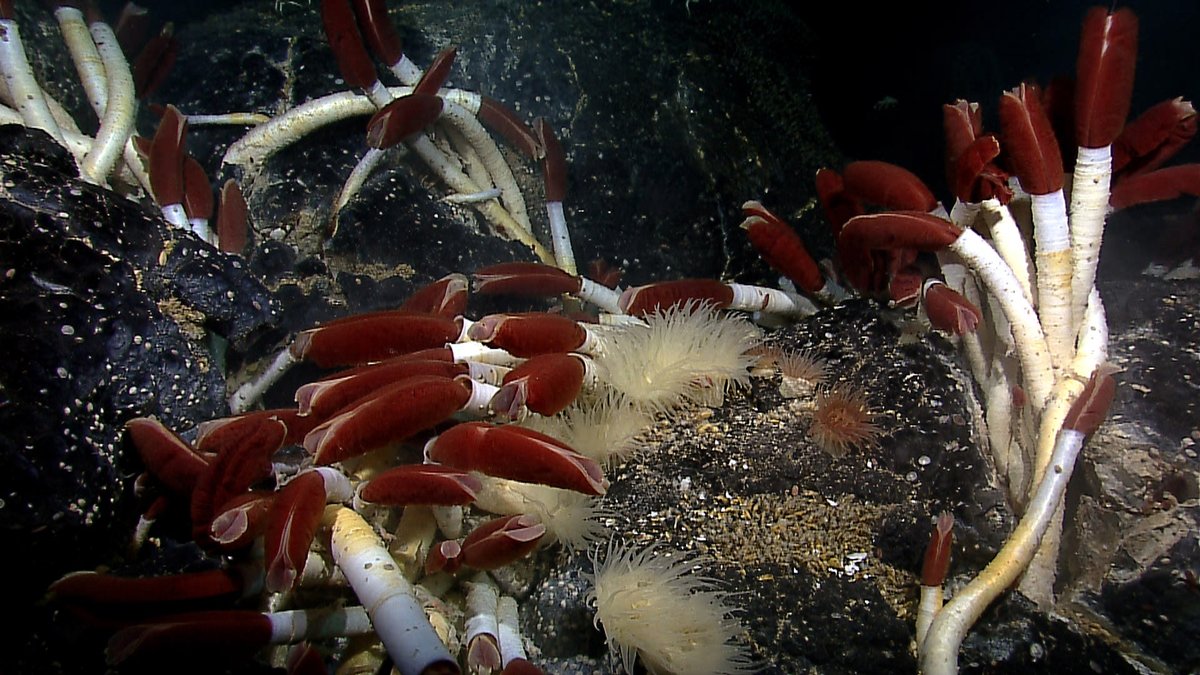
Sunlight drives photosynthesis near the ocean surface. The Galápagos Rift at these depths lies beyond its reach. Vent communities draw energy from another route. Microbes use chemicals in the vent fluids, including hydrogen sulfide, to build organic matter. Larger animals can depend on those microbes through grazing, feeding relationships, or close biological partnerships.
The 1977 cruise was staffed to investigate a geological system, with biological specialists joining later expeditions. The abundance of animals therefore startled the team. A later USGS account notes that the expedition collected clams, mussels and other specimens. Some went into vodka because the available supplies had been chosen for geological work. Those organisms revealed an ecosystem built around a chemical energy source.
Vent communities demonstrated that a separate energy pathway could sustain a local food web under the right conditions. Photosynthesis remains the dominant biological entry point for sunlight across much of Earth’s surface. At vents, microorganisms form the base of the community by using chemical reactions. Animals live where the fluids and microbes create usable resources. This insight expanded the places scientists considered when asking how life can persist in dark, high-pressure environments.
The discovery changed ocean science
The Galápagos observations transformed more than a single expedition. They gave scientists a direct place to investigate how Earth’s interior heat, ocean water, rocks and life interact. Research since then has found hydrothermal systems in the Pacific, Atlantic and Indian oceans. Sites differ in temperature, chemistry, geology and resident species. As a result, vent habitats can change sharply over short distances.
Today, oceanographers study active vents and older systems that have cooled or shifted. The mechanisms remain relevant to ocean chemistry, mineral deposits, volcanic settings and the limits of life. NOAA’s overview of hydrothermal systems describes how the fluids alter rock and support chemosynthetic communities. The 1977 discovery provided the vivid first view that made those connected processes impossible to ignore.
Vent fields also change with the geology beneath them. A crack can close, a fresh flow can alter circulation, or a supply of hot fluid can weaken. That makes repeated observations valuable. Scientists can compare animals, fluids, deposits and seafloor features through time rather than treating a vent as a fixed setting. The first dive near Galápagos offered a remarkable snapshot. Later expeditions turned that surprise into a continuing record of a changing deep-ocean environment.
Working at these depths still requires specialized ships, sensors, cameras and vehicles. The difficulty is part of the reason the 1977 observations carried such weight. They combined direct human observation with measurements and specimens from a place that had previously been almost inaccessible. That approach remains central to studying the seafloor today.
More marine-life guides
Continue with 25 facts about sea life.