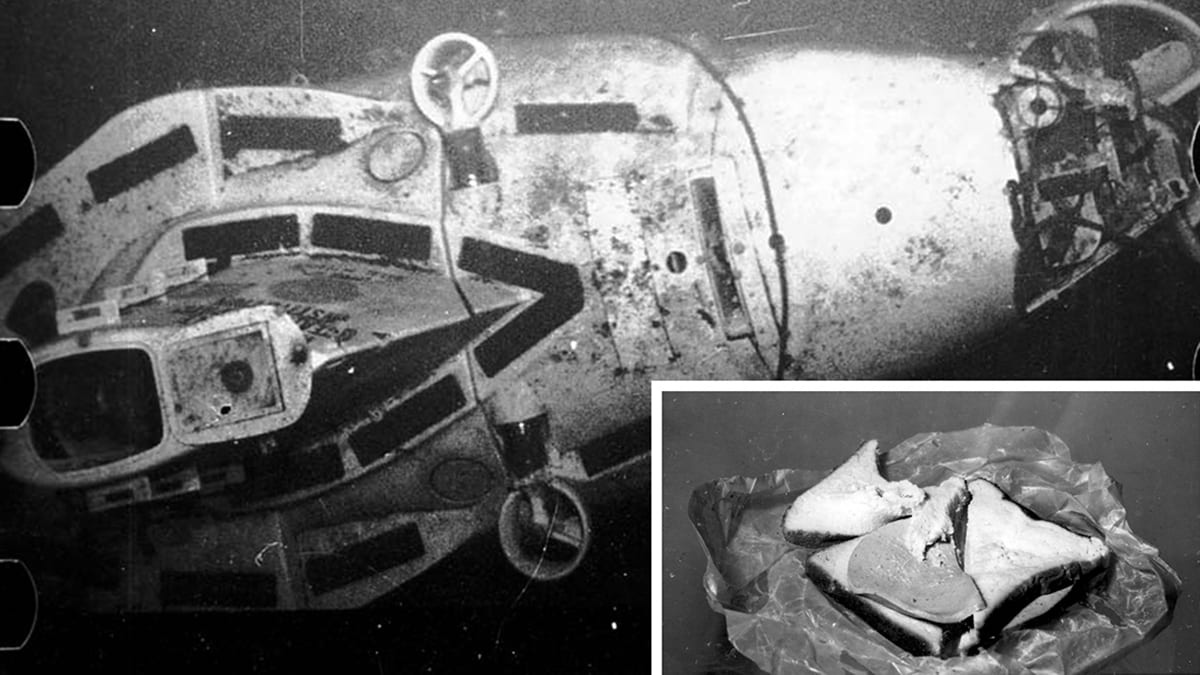
Woods Hole Oceanographic Institution records an unlikely result from a 1968 accident: the research submersible Alvin sat on the seafloor for 10 months with a bologna sandwich in its cockpit, then returned with the sandwich sodden but still edible. The episode gave ocean scientists a vivid clue about the slow pace of decay in a cold deep-sea setting.
Alvin had already shown that people could work close to the ocean floor. Its accidental loss turned a routine launch into a difficult recovery. It also produced an unplanned observation that helped researchers think differently about how to study microbes that live under deep-ocean pressure.
A launch ends on the seafloor
On October 16, 1968, Alvin was being launched for Dive 308 south of Woods Hole, Massachusetts. Its cradle support cables failed while the hatch was still open. Pilot Ed Bland and two observers escaped before the vehicle slid into the water and sank.
The sub came to rest in about 5,000 feet of water. Poor weather and limited recovery equipment kept it there through the rest of the year. The three people got out safely, yet food left in the cockpit went down with the vehicle.
Alvin was a compact, human-occupied research craft rather than a large military submarine. That distinction mattered during the rescue. The work required locating a small vehicle on the seafloor, attaching recovery gear and bringing it up without losing parts along the way.
The launch platform was carried by Lulu, Alvin’s early tender ship. WHOI describes Lulu as a catamaran built from two surplus Navy pontoons. That design made launches possible, yet the broken cables showed how much depended on the equipment above the water as well as the pressure-resistant sphere below it.
Before the accident, Alvin had already taken scientists into waters too deep for ordinary diving. A human-occupied vehicle could photograph a site, collect a specimen and let an observer see the seafloor directly. Losing that capability made the recovery decision a question about the future of hands-on ocean research as well as the value of one vehicle.
Two vehicles bring Alvin back
By Labor Day 1969, the Alvin history says, the recovery team had reached the vehicle. The DSV Aluminaut, a submersible associated with Reynolds Aluminum and the Navy research ship R/V Mizar worked together on the lift.
Aluminaut pilots placed a lifting bar through Alvin’s hatch. The job required breaking the sail, the structure above the pressure hull, to make room for the bar. Mizar then lifted Alvin to roughly 50 feet below the surface, where divers added lines and nets around the craft.
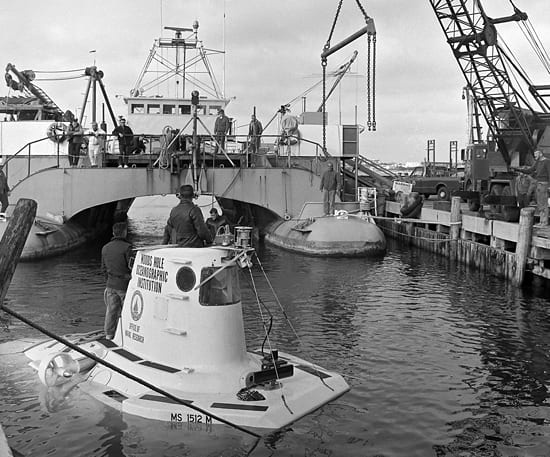
From there, Alvin was towed to Martha’s Vineyard and lifted out by a crane on a barge. WHOI’s account of Aluminaut describes its role in retrieving the craft from beneath 5,000 feet of water. Apart from the damaged sail, Alvin had little structural damage.
The recovery also shows why deep-ocean salvage is slow work. A team had to locate the vehicle, place hardware through a small opening, raise it partway and then let divers secure it near the surface. Each phase used different tools because no single ship or submersible could complete every part of the task.
Why the lunch changed so slowly
The famous detail was a bologna sandwich that remained in the cockpit. WHOI says the sandwich was sodden when Alvin came back in August 1969, yet still edible. Other lunches were similarly wet and edible after the ten-month immersion.
The explanation began with the setting. WHOI attributed the preservation to near-freezing temperatures and a lack of oxygen available for decay at depth. Cold slows many chemical reactions and biological processes, including the activity of microbes that break down food.
Deep water also presents a very different laboratory environment from a kitchen or a ship’s deck. A WHOI history of Alvin notes that the food was wet rather than decayed, a result that caught the attention of microbiologist Holger Jannasch.
The lunch was useful because it had remained in one deep setting for a known period of time. It was an accidental observation from a particular location and recovery. Its scientific value lay in what it suggested about the living conditions faced by deep-sea microbes and the practical difficulty of bringing those conditions into a surface laboratory.
WHOI’s account describes a sandwich that was soggy and apples that were wet. Those details carry more weight than a dramatic claim about a miracle food. They show that the deep sea can preserve evidence in ways that are unfamiliar on land, while still leaving researchers to test the underlying processes carefully.
The accident suggested a better experiment
Jannasch had expected decomposition to be slow in the deep ocean. His larger interest was in the microbes that live there. Such organisms can be difficult to study after a sample travels upward because the pressure falls rapidly during recovery.
The preserved lunch suggested that the ocean floor itself could serve as the setting for an experiment. Researchers could put culture material in containers on the seafloor, expose it to local seawater and let deep-water microbes grow under their own pressure conditions. That approach became part of the development of in situ research, meaning work carried out where the organisms live.
The incident therefore connected an engineering mishap with deep-sea microbiology. It helped point toward sampling tools and culturing methods that avoided forcing every organism to survive a sudden trip to the surface. WHOI says those ideas opened new areas of biological and chemical research.
That distinction was important for pressure-adapted microbes. A container placed on the seafloor could let scientists observe growth and chemical activity before recovery changed the surrounding pressure. The method complemented shipboard analysis by giving researchers another way to ask questions that were difficult to answer with a sample collected only at the surface.
Alvin returned to ocean science
Repairing Alvin took time. The sub underwent a major overhaul after the recovery and its first post-loss dive was Dive 309 in May 1971. The return mattered because Alvin gave scientists a direct view of places previously reached mainly by instruments lowered from ships.
Later work by the vehicle included investigations at the Galápagos Rift, where scientists found rich communities around warm-water vents. WHOI’s Alvin booklet places the 1968 loss and recovery among the milestones that shaped the vehicle’s scientific career.
Its lunch story remains memorable because the evidence was so ordinary. A wet sandwich, an intact pressure sphere and a successful salvage operation all showed how unfamiliar the deep ocean can be. The episode also left a practical lesson: observations made at depth can reveal processes that disappear when samples are brought back to the surface.
Alvin went on to support work across geology, biology and ocean engineering. Its later dives helped scientists investigate seafloor ridges and hydrothermal vents, places where organisms use chemical energy in perpetual darkness. The 1968 loss therefore sits in the vehicle’s history as both a near-disaster and an unexpected bridge to new questions about life in the deep ocean.
The lesson also reached beyond Alvin. Oceanographers increasingly design instruments that keep samples close to their natural temperature and pressure for as long as possible. The recovered lunch gave that principle a simple image. Deep-sea organisms and their chemistry make the most sense when scientists can study them in conditions that resemble the world where they actually live.