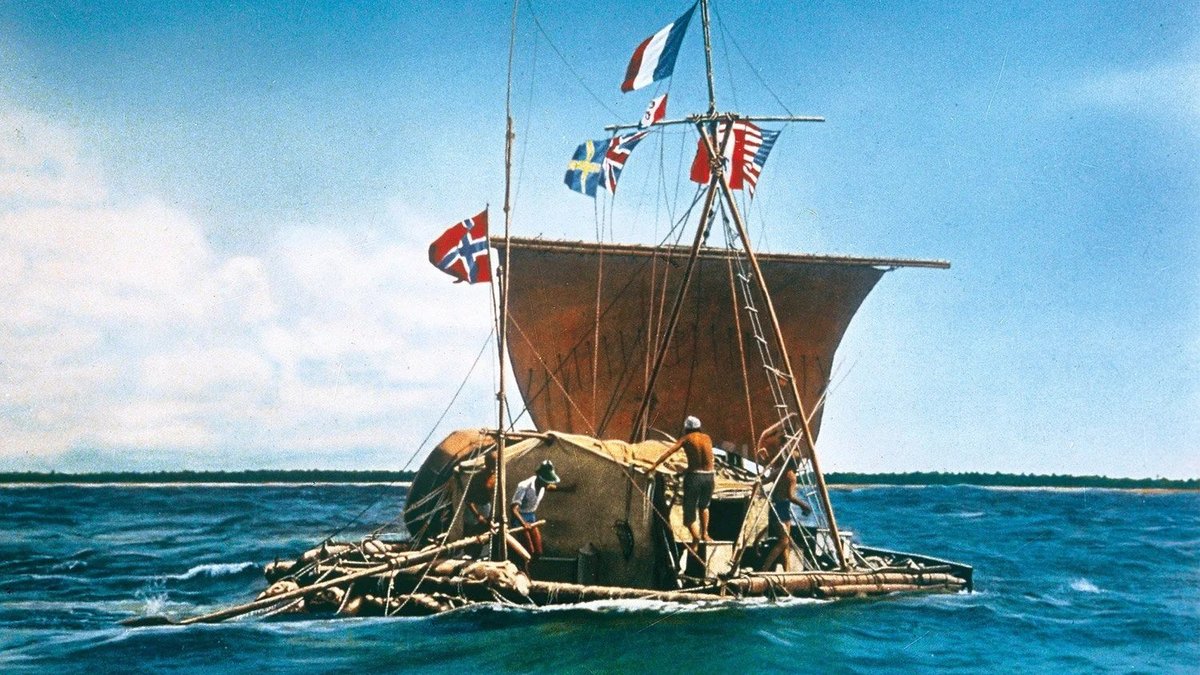
For six men on a low raft of balsa logs, the Pacific offered no harbor, engine, or second chance. On April 28, 1947, Thor Heyerdahl and five companions departed from Callao in Peru on Kon-Tiki. They hoped winds and currents would take them west toward Polynesia. One hundred and one days later, the raft struck a reef near Raroia Atoll in the Tuamotu Islands. Everyone survived. Their arrival came after months of exposed living on a platform built to move with the sea rather than overpower it. Sleeping, cooking, repairs and navigation all happened close to the water.
The feat remains one of the best-known sea experiments of the twentieth century. The Kon-Tiki Museum records the voyage as a demonstration that people from South America could have reached the South Pacific on a balsa raft. That finding matters because it separates a practical ocean question from the much larger question of who first settled Polynesia and how. It also explains the voyage’s lasting appeal. Kon-Tiki was small enough to make its crew seem vulnerable, yet it traveled across an ocean that many readers picture only from a map. The crew’s photographs and film later carried that experience far beyond the raft.
How a balsa raft left Peru
Heyerdahl was 33 when he led the expedition. His proposed history held that people from South America had played a major role in settling Polynesia before European contact. He built Kon-Tiki in Peru with materials and construction ideas inspired by descriptions of pre-Columbian rafts. The crew included engineer Herman Watzinger, navigator and artist Erik Hesselberg, radio operators Knut Haugland and Torstein Raaby and anthropologist Bengt Danielsson. Danielsson was the sixth and final member of the party. Hesselberg’s merchant-fleet experience made him the only crew member with formal maritime experience. The museum says the group went to Ecuador for balsa timber before building the raft in Peru.

Each man brought a useful skill, although the vessel itself left little room for control. Balsa is light because its wood contains many air spaces. Several large balsa logs formed the raft’s floating base, while lashings held the structure together. A mast and square sail captured the wind. Hesselberg painted the famous Kon-Tiki face on the sail, giving the expedition an image that became almost as recognizable as the raft. The design placed survival in the hands of buoyant wood, simple rigging, careful repairs and the crew’s willingness to learn while already at sea. It also offered a visible test of how a log raft behaved over long ocean swells.
What the Pacific route tested
Ocean travel on a raft depends on more than courage. The Humboldt Current flows north along much of South America’s west coast, then turns westward into the Pacific. Easterly trade winds can also push surface craft toward the central Pacific. Kon-Tiki used that broad system rather than beating against it. The crew carried a radio, stored food, fresh water and maps. The passage was therefore an experiment rather than a recreation of an ancient voyage in every detail. Its route still tested the crucial point, whether a lightly built craft could remain afloat long enough for the ocean system to carry it west.
At sea, the raft settled into its role as a floating platform. The logs flexed with the swell and the rig gave the crew some ability to respond to wind. The museum preserves Heyerdahl’s log description of Kon-Tiki as “a fantastic seagoing craft.” After 101 days, the raft ran aground on the coral reef by Raroia. The reef ended the passage, yet its arrival supplied the key result: a balsa raft could survive this east-to-west route under favorable conditions. Reaching an atoll did not make the final landing easy. Reefs provide a sharp boundary between open water and the low islands beyond them. Kon-Tiki’s final impact also kept the story from becoming a simple tale of sailing safely ashore.
Why the crossing settled only one question
Kon-Tiki demonstrated physical feasibility but did not prove Heyerdahl’s broader settlement theory. A successful modern crossing shows that the route was available. It cannot identify the people who made past journeys, tell how often they occurred, or establish that a voyage led to a lasting population. A six-person crew also had modern communications and supplies. Those questions call for evidence from excavations. Languages, plants, artifacts and DNA add further records. Settlement leaves a much wider record than one successful voyage.
That distinction is central to experimental archaeology. A reconstructed craft can reveal how materials behave in waves, whether a current carries a vessel along a proposed route and what skills a crew needs. It cannot supply a complete record of ancient choices. Heyerdahl’s experiment therefore made a durable contribution to the study of prehistoric voyaging, even as researchers continued to test the settlement claim with independent evidence. The value of the result lies in its limits as well as its drama. It turned an argument about possibility into an observation that later scholars could weigh alongside other evidence. Experimental results are strongest when their scope stays clear.
What archaeology and genetics now show
Archaeology, language and genetics place the main ancestral roots of Polynesian peoples in the west-to-east Austronesian expansion across the Pacific. A 2021 genomic study reconstructed an eastern Polynesian sequence that moved from Samoa through the Cook Islands and Society Islands, then into the Tuamotu Archipelago and farther east. Its results describe a serial founder expansion shaped by small founding groups. This pattern differs from a South American founding of Polynesia and gives researchers a way to compare population history island by island. When a small group founds a community, it carries only part of the genetic variation found in the larger population it left behind. Repeated moves can leave that pattern in DNA.
Evidence also shows that the Pacific was connected by more than one kind of contact. A 2020 Nature study analyzed genome-wide variation from 807 people across 17 Polynesian island populations and 15 Native American groups. The authors found evidence consistent with a prehistoric encounter around AD 1200 between Polynesian people and a Native American group related to Indigenous people in present-day Colombia. That result supports contact, while leaving the primary settlement history distinct from Heyerdahl’s proposal. It also shows why a single route or one famous voyage cannot explain the whole human story of the Pacific. Genetic studies estimate relationships and timing from present-day patterns, then compare those estimates with archaeological dates and places.
Researchers continue to compare genetic patterns with dated sites, crop histories and seafaring technology. Sweet potato has long raised questions because it originated in the Americas and appeared in Polynesia before European-era exchange. Such evidence can point to movement across the ocean, yet it needs careful timing and context. The Thor Heyerdahl Archives preserve diaries and correspondence. They also hold photographs, film and manuscripts that document the 1947 journey and the ideas that drove it. The collection also contains research notes and expedition material. Historians can therefore follow the public adventure back to its working records and original documents.
Kon-Tiki’s legacy is therefore both adventurous and scientific. It showed what a current-driven balsa raft could do when weather, construction, supplies and a determined crew aligned. Modern research gives the Pacific story a broader frame, one built from many lines of evidence and attentive to the ancestors of living Polynesian communities. The raft’s long drift remains vivid because it turned an abstract possibility into a real passage across open water. That vivid test still helps explain why people keep asking how early navigators moved through such a vast sea. Its evidence-driven questions remain useful to historians today.